
Electronics Technician E-5 Advancement Practice Exam
$69.00
- Buy to unlock unlimited access to all Quiz questions and Answers in this Quiz.
- After purchase you can print a PDF of the whole quiz at any point. The PDF will contain the questions and the correct answers.
About this Exam
The Electronics Technician E-5 Advancement Exam is a crucial professional milestone for United States Navy Sailors within the Electronics Technician (ET) rating. This comprehensive test measures a Sailor's technical proficiency and readiness to assume the increased responsibilities of a Petty Officer Second Class (ET2). It is designed specifically for E-4 ET3 Sailors aiming to advance their careers and demonstrate mastery in maintaining and repairing the fleet's vital electronic systems. This certification unlocks leadership roles within technical teams and establishes a strong foundation for a career in military electronics.
Ready to test your knowledge?
Buy Now to Access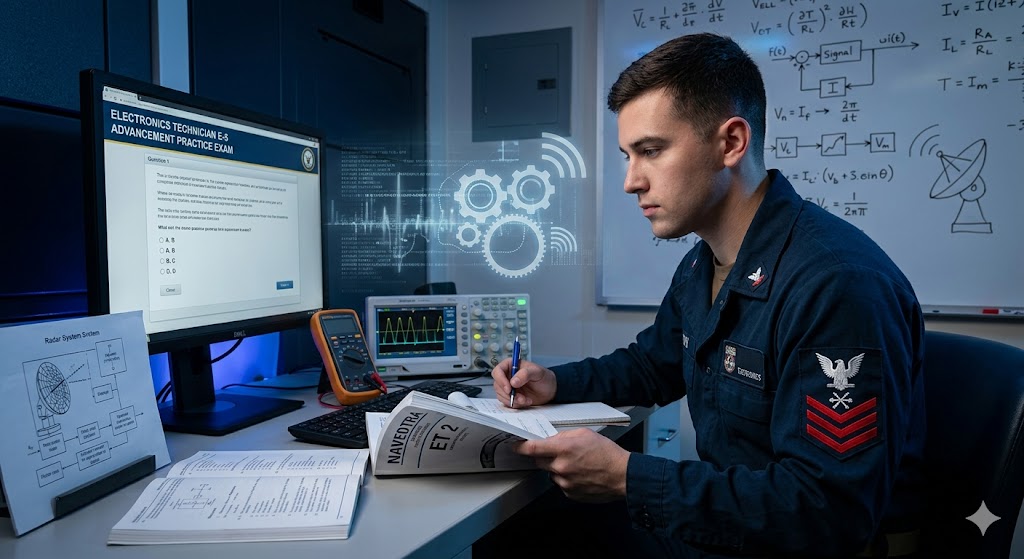
Additional Information
What the Course Entails and Exam Details
Unlike a traditional academic course, preparation for the E-5 advancement exam is an ongoing process based on a combination of hands-on experience and self-study from official Navy training materials. The exam covers a wide spectrum of electronic and electrical systems managed by the ET rating.
Core topics often include:
Electronics Fundamentals: Advanced knowledge of Ohm's Law, Kirchoff's laws, analog circuit analysis, digital logic, and semiconductor theory.
Communication Systems: Operation and troubleshooting of HF, UHF, VHF, satellite communications (SATCOM), and cryptologic equipment.
Radar and Navigation: Mastery of surface search radars, air search radars, navigation systems like GPS and TACAN, and related indicator groups.
Data Systems: Understanding of tactical data links, computer networks, and fiber optic systems.
Test Equipment: Proper application of multimeters, oscilloscopes, spectrum analyzers, and time-domain reflectometers (TDRs).
Maintenance Administration: Proficiency with the Planned Maintenance System (PMS), corrective maintenance procedures, and quality assurance (QA).
Safety: Rigorous enforcement of electrical safety standards, tag-out procedures, and hazardous material handling.
What to Expect in the Final Exam
The E-5 advancement exam is a rigorous, standardized assessment administered by the Navy. The primary focus is on technical rating knowledge.
Exam Format: The exam consists of approximately 175 multiple-choice questions designed to test both theoretical knowledge and practical application scenarios.
Time Limit: Sailors are typically given three hours to complete the examination, requiring efficient time management and a steady pace.
Scoring: There is no single "passing score" for the exam itself; rather, your raw score is converted into a standard score that contributes to your Final Multiple Score (FMS).
Final Multiple Score (FMS): Your advancement eligibility depends on your FMS ranking against your peers. The FMS combines your exam performance with other factors such as performance evaluations, time-in-rate, awards, and previous exam performance. Only those with the highest FMS are advanced based on Navy vacancies.
How to Study and Exam Centers
Preparation must be systematic and begin months before the actual test date. Because the exam is based on current fleet equipment and doctrines, rely heavily on official sources.
Actionable Study Strategies:
Master the Bibliographies: The single most important step is downloading the current official "Bibs" for your rating and paygrade from the MyNavy HR website. These list the exact NAVEDTRA courses, technical manuals, and instructions used to write the exam questions.
Utilize NRTCs: Complete the Non-Resident Training Courses (NRTCs) designated in your bibliographies. Pay close attention to the review questions at the end of each chapter.
Hands-on Practice: Relate what you study to the equipment you maintain daily. Understanding how a system works in practice makes theoretical questions easier to answer.
Join Study Groups: Collating knowledge with other ETs in your command can help clarify complex topics and expose you to different specialized areas of the ET rating (e.g., communications vs. radar).
Use Practice Exams: While Navy-sanctioned practice exams are limited, reputable third-party military advancement study guides can provide valuable multiple-choice practice.
Exam Centers:
The Electronics Technician E-5 Advancement Exam is not taken at public testing centers like Pearson VUE. It is administered simultaneously, Navy-wide, at specific physical testing sites within your local command, authorized schools, or designated Navy bases. Coordination for taking the exam is handled entirely through your command's Educational Services Officer (ESO).
Job Opportunities from the Course
Advancing to E-5 (Petty Officer Second Class) is a clear indicator to leadership and civilian employers that you possess both leadership potential and specialized technical expertise. It validates skills that are in high demand in both the defense and private sectors.
While you do not need tables, here is a list of job titles and career paths this advancement unlocks and enhances:
Electronics Communications Technician (Navy)
Navigational Electronics Systems Technician (Navy)
Radar Systems Maintenance Supervisor (Navy)
Work Center Supervisor (Navy - Technical Leads)
Field Service Engineer (Civilian Sector)
Satellite Communications Systems Operator
Telecommunications Specialist
Calibration Laboratory Technician
Biomedical Equipment Technician
Frequently Asked Questions
Reviews
5.0
Based on 0 reviews
Leave a Review
No reviews yet. Be the first to review!