
Electronics Technician Second Class (ET2) Advancement Practice Exam
$69.00
- Buy to unlock unlimited access to all Quiz questions and Answers in this Quiz.
- After purchase you can print a PDF of the whole quiz at any point. The PDF will contain the questions and the correct answers.
About this Exam
The Electronics Technician Second Class (ET2) Advancement is a critical step for US Navy Electronics Technicians (ETs) advancing from the rank of Petty Officer Third Class (E-4) to Petty Officer Second Class (E-5).
This examination is designed to test the sailor’s proficiency, technical knowledge, and leadership readiness within the highly specialized Electronics Technician occupational rating.
It targets experienced E-4 sailors who have demonstrated the requisite technical skills, completed mandatory training, and are recommended by their commanding officers for increased responsibility.
Earning this advancement unlocks new career opportunities, increased pay, and supervisory roles within the Navy’s complex technical infrastructure.
Ready to test your knowledge?
Buy Now to Access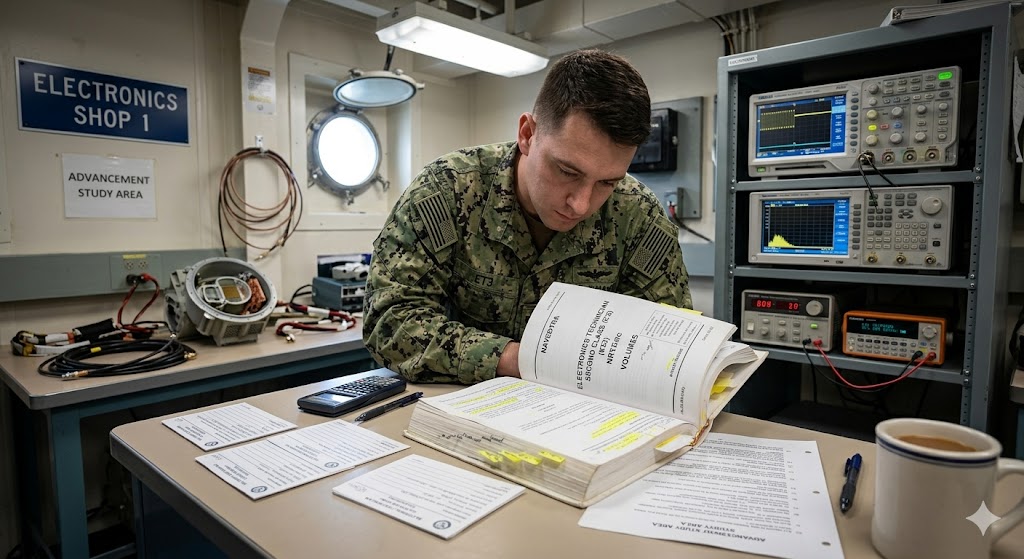
Additional Information
What the Course Entails and Exam Details
To succeed in the ET2 advancement cycle, sailors must master a diverse spectrum of technical subjects.
The core curriculum is primarily drawn from a comprehensive series of standard Naval Nonresident Training Courses (NRTCs).
The key subject areas and volumes you must study include:
Administration: Understanding Navy-specific documentation, logs, supply systems, maintenance data systems (MDS), and standard operating procedures.
Logistics and Supply: Knowledge of the Coordinated Shipboard Allowance List (COSAL), the Naval Supply Systems Command, and official reporting procedures.
Safety: Comprehensive knowledge of electronic safety, tag-out procedures, man-aloft procedures, and handling hazardous materials (HAZMAT).
Communications Systems: Working knowledge of internal and external communication methods, including HF, VHF, UHF radios, satellite communications (SATCOM), and man-portable systems.
Radar Systems: Mastery of basic and advanced radar principles, air search, surface search, ground-controlled approach, and carrier-controlled approach radar systems.
Navigation Systems: Introduction to navigation aids such as OMEGA, SATNAV, and TACAN.
Digital Data Systems: Technical knowledge of digital systems, laptop and desktop systems, and command-specific data networks.
Troubleshooting: Diagnostic techniques for identifying and correcting faults in complex electronic systems.
What to Expect in the Final Exam
The official Navy-Wide Advancement Exam (NWAE) for ET2 is a rigorous assessment administered semi-annually.
While practice exams vary, you should expect a structured experience mimicking the final test:
Format: The final NWAE consists of approximately 175 to 200 multiple-choice questions.
Occupational Rating Questions: The vast majority of these questions deal directly with your occupational rating (ET-specific knowledge) as outlined in your official study bibliography.
Time Limit: The final exam is typically self-paced but has a defined block of time, usually around 3 hours, to complete the session.
Passing Score: There is no single "passing score" in the standard academic sense; instead, advancement depends on your Final Multiple Score (FMS).
Final Multiple Score (FMS): The FMS is a weighted calculation that includes your exam score, your evaluations (EVALs), your time-in-rate, and specific awards. You advance only if your FMS ranks high enough to fill an available ET2 billet in that cycle.
Specific Rules: Only authorized official practice materials should be used, and the final exam must be taken in a controlled setting authorized by your command’s Educational Services Officer (ESO).
How to Study and Exam Centers
Your study strategy should be structured, methodical, and based strictly on official Navy publications.
Study Strategies:
Official Bibliographies: Locate and download the specific "ET2 Advancement Bibliography" (often called "the BIBs") for the current advancement cycle. This document lists the exact chapters of standard manuals that will be tested.
Master the NAVEDTRAs: Dedicate your time to studying the assigned Nonresident Training Courses (NAVEDTRA 14087 series) referenced in the BIBs.
Take Practice Tests: Use official standard practice tests and quizzes provided by your division or the Navy advancement portals. Do not rely on third-party unofficial sites.
PQS/OJT Review: Review your completed Personnel Qualification Standards (PQS) and On-the-Job Training (OJT) logs, as practical experience reinforces theoretical knowledge.
Form Study Groups: Organize study sessions with fellow ETs preparing for the same exam to quiz each other and discuss complex systems.
Exam Centers:
Authorized Taking: The actual NWAE is not taken at civilian testing centers like Pearson VUE. It is administered directly by your command.
Command Facilitation: The Educational Services Officer (ESO) of your command, whether on a ship, submarine, or shore station, facilitates the exam.
On-Ship/Base: The final exam is typically held in a designated controlled classroom environment on your base or ship.
Job Opportunities from the Course
Achieving the rank of Electronics Technician Second Class signifies that you are a highly capable technical leader.
This advancement opens doors within the Navy and provides a solid foundation for lucrative civilian careers.
Here are specific job opportunities and career paths:
Navy: Leading Electronics Technician (LET)
Navy: Workcenter Supervisor (WCS)
Navy: Divisional Technical Instructor
Civilian: Radar Maintenance Technician
Civilian: Telecommunications Network Technician
Civilian: Satellite Communications Operator/Maintainer
Civilian: Marine Electronics Installer
Civilian: Field Service Engineer (RF and Comms)
Civilian: Biomedical Equipment Technician
Civilian: Automation and Control Systems Technician
Civilian: Technical Project Manager (with additional experience)
Frequently Asked Questions
Reviews
5.0
Based on 0 reviews
Leave a Review
No reviews yet. Be the first to review!