
Electrostatic Discharge (ESD) Practice Test
$69.00
- Buy to unlock unlimited access to all Quiz questions and Answers in this Quiz.
- After purchase you can print a PDF of the whole quiz at any point. The PDF will contain the questions and the correct answers.
About this Exam
The Electrostatic Discharge (ESD) Practice Exam is a comprehensive study tool designed for individuals aiming to achieve certification or simply validate their knowledge in managing and preventing electrostatic discharge in sensitive environments. Electrostatic discharge is a critical concern, especially within the electronics manufacturing, repair, and assembly industries. A sudden, uncontrolled flow of static electricity can cause catastrophic failures or latent defects in electronic components, leading to significant financial losses and product reliability issues. This exam is ideal for engineering professionals, electronics technicians, production supervisors, quality control inspectors, and anyone involved in the handling or processing of electrostatic-sensitive devices (ESDs). It ensures that individuals possess the fundamental understanding and practical skills required to implement and maintain effective ESD control programs in compliance with industry standards.
Ready to test your knowledge?
Buy Now to Access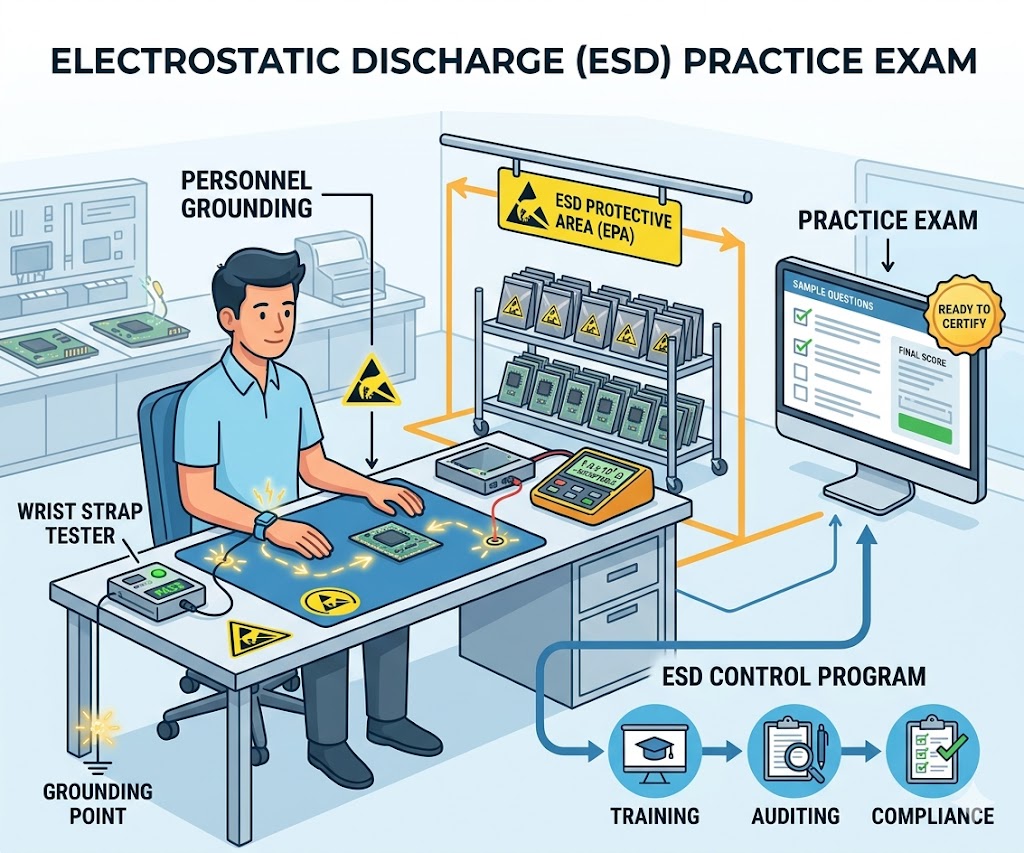
Additional Information
What the Course Entails and Exam Details
This practice exam covers a broad spectrum of topics essential for becoming proficient in ESD control. While specific course syllabus details may vary slightly by training provider, the core subject matter is generally based on internationally recognized standards, most notably those from the ESD Association (ESDA), such as ANSI/ESD S20.20. Key areas of focus typically include:
Fundamentals of Electrostatics: Understanding static electricity generation (triboelectric charging) and induction, and the conditions that lead to electrostatic discharge events.
ESD Effects: The mechanics of how ESD damages electronic components, including catastrophic and latent failures.
ESD Control Principles: The foundational principles of grounding, bonding, shielding, and the use of static dissipative and conductive materials.
Personnel Grounding and Equipment: Proper use and testing of wrist straps, heel straps, conductive flooring, and ESD garments.
ESD Protective Area (EPA) Requirements: Designing and maintaining an EPA, including appropriate signage, workstations, and environmental controls.
Handling and Packaging: Procedures for the safe movement and storage of sensitive devices, including the use of ESD bags, trays, and totes.
Testing and Auditing: Methods for verifying the effectiveness of ESD control measures, such as surface resistance testing, wrist strap monitoring, and program auditing techniques.
Compliance and Standards: Familiarity with relevant ESD standards and the importance of compliance.
What to Expect in the Final Exam
The actual final certification exam, which this practice test is designed to prepare you for, is typically a formal, structured assessment. While the specific format is determined by the certifying body, it most commonly consists of:
Format: A multiple-choice examination. Some more advanced certifications might include scenario-based questions or, occasionally, a practical assessment, but a computer-based multiple-choice test is the most frequent.
Number of Questions: Usually ranging from 50 to 100 questions.
Time Limit: Candidates are generally given between 60 and 90 minutes to complete the test.
Passing Score: The required minimum score to pass is often set around 70-80%.
Delivery: Often delivered in a controlled, proctored environment, whether online with remote proctoring or at an authorized physical testing center.
Rules: Specific rules will apply, such as limitations on the use of reference materials. Many exams are "closed-book," though some may allow specific, non-annotated standard documents.
How to Study and Exam Centers
Preparation is key to success. A combination of formal training and self-study is highly recommended. Effective study strategies include:
Take a Formal ESD Control Course: Many industry organizations, training companies, and technical schools offer courses (online or in-person) that are specifically structured around ESD standards and certification requirements. These courses are invaluable for gaining a structured understanding of the subject.
Study the Relevant Standards: Dedicate time to reading and understanding the primary ESD standards, such as ANSI/ESD S20.20 and others related to your specific industry sector. These documents form the core of the knowledge base.
Utilize This Practice Exam: Use this practice exam repeatedly to assess your understanding of different topics, identify areas where you need further study, and familiarize yourself with the types of questions and the pacing you will encounter in the final exam.
Review Practical Applications: Connect the theoretical concepts you study with real-world scenarios. Consider how ESD controls are applied in a manufacturing or repair facility.
Form Study Groups: Collaborating with colleagues can provide diverse perspectives and help reinforce learning.
Regarding Exam Centers, the final certification exam is usually administered through specific channels associated with the certifying body (e.g., the ESD Association, iNEMI, or other specialized training providers).
Online Portals: Many certifications offer computer-based exams that can be taken through dedicated online portals, often requiring remote proctoring services to ensure exam integrity.
Authorized Training Centers (ATCs): Physical locations, such as technical schools, community colleges, or specialized private training facilities, may be authorized to host both the training courses and the corresponding exams.
Industry Events and Conferences: Certifying organizations sometimes offer exam sessions at major industry trade shows and technical conferences.
It is rare to find niche, specialized certifications like ESD control offered through broad, general test providers like Pearson VUE, although it’s not impossible if the certification is part of a larger, more general electronic manufacturing program. Always verify the specific testing procedures and approved centers directly with your chosen certification provider.
Job Opportunities from the Course
A certification or strong knowledge base in ESD control opens doors to various career paths in the electronics industry. Specific job titles and roles where these skills are essential include:
ESD Coordinator/Program Manager: The primary individual responsible for designing, implementing, and auditing an organization's entire ESD control program.
Electronics Technician: Involved in the assembly, testing, repair, and maintenance of electronic systems, requiring strict adherence to ESD protocols.
Quality Assurance (QA) / Quality Control (QC) Inspector: Responsible for ensuring that products are manufactured and handled according to standards, which includes verifying ESD controls and conducting audits.
Manufacturing Engineer / Process Engineer: Designing and optimizing production processes to minimize defects and ensure efficiency, including integrating ESD prevention into the manufacturing line.
Production Supervisor / Team Leader: Overseeing manufacturing personnel and ensuring compliance with all operational procedures, including ESD safety.
Facility Manager: Ensuring that the overall facility infrastructure supports critical processes, such as appropriate grounding and environmental controls for an EPA.
Component Engineer: Evaluating electronic components and establishing handling requirements to protect them from ESD damage.
Frequently Asked Questions
Reviews
5.0
Based on 0 reviews
Leave a Review
No reviews yet. Be the first to review!