
Elsevier Community Health I & II Practice Test
$69.00
- Buy to unlock unlimited access to all Quiz questions and Answers in this Quiz.
- After purchase you can print a PDF of the whole quiz at any point. The PDF will contain the questions and the correct answers.
About this Exam
The HESI Community Health I & II Practice Exam is a comprehensive assessment tool designed for nursing and allied health students approaching the culmination of their community and public health coursework.
This exam serves as a critical benchmark, evaluating a student's readiness to apply theoretical knowledge to real-world population-based scenarios.
It is particularly valuable for those preparing for the HESI Community Health specialty exam, the NCLEX, or eventual certification as a public health or community health nurse.
Ready to test your knowledge?
Buy Now to Access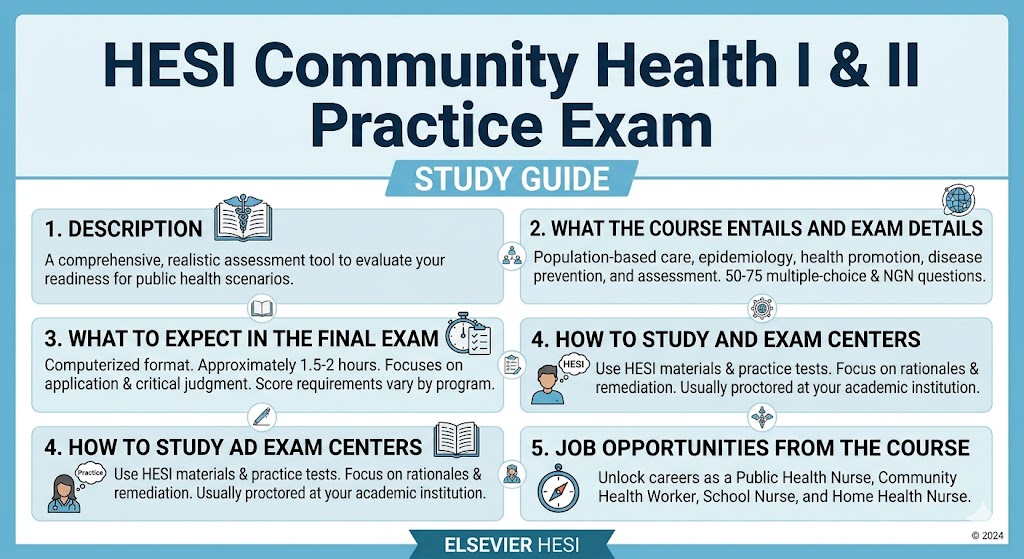
Additional Information
What the Course Entails and Exam Details
This examination is not just a test of recall, but a rigorous evaluation of clinical judgment and application within a community context.
The HESI Community Health I & II Practice Exam covers a wide spectrum of essential public health topics, including:
Principles of Epidemiology and Disease Surveillance
Health Promotion and Disease Prevention (Primary, Secondary, Tertiary levels)
Community and Population Health Assessment Techniques
Care for Vulnerable Populations and Addressing Health Disparities
Environmental Health Risks and Interventions
Disaster Preparedness, Response, and Recovery
Public Health Policy, Advocacy, and Ethics
Global Health Perspectives
The practice exam mimics the structure of the official proctored HESI test. It typically consists of approximately 50 to 75 multiple-choice questions, which may include Next Generation NCLEX (NGN) standalone items and case studies.
What to Expect in the Final Exam
While a practice exam provides flexibility, it is crucial to understand the format of the official proctored HESI Community Health Exam it prepares you for.
Exam Format: The test is computerized and primarily uses a multiple-choice format. Expect challenging questions that require high-level application and analysis of scenarios rather than simple recall. NGN question types, which test clinical judgment through evolving case studies, are becoming increasingly common.
Time Limit: For the proctored exam, students generally have a time limit, often around 1.5 to 2 hours for 50-75 questions. Pace yourself to spend approximately one minute per item.
Passing Score and Rules: Unlike a licensure exam, there is no single universal "passing score."
HESI uses a proprietary scoring system (0 to over 1000). However, educational institutions typically set a conversion score benchmark, often aiming for a HESI score of 850 or higher as indicative of proficiency.
How to Study and Exam Centers
Preparation for the HESI Community Health Exam requires a strategic approach.
Actionable Study Strategies:
Utilize Official HESI Resources: Your best tool is the Elsevier/HESI "Community Health Nursing" study guide and accompanying remediation materials provided by your program.
Take Multiple Practice Exams: Use this practice test and others available to build stamina and familiarize yourself with the question style. Analyze every rationale, both for correct and incorrect answers, to understand the "why" behind the solution.
Focus on HESI Remediation: After taking practice or partial tests, focus on your personalized HESI remediation report, which highlights your weak areas. This is where you should dedicate your review time.
Practice NGN Item Types: Specifically seek out practice questions in the Next Generation NCLEX format to become comfortable with the clinical judgment measurement model.
Study Groups: Collaborate with peers to discuss complex epidemiological concepts and share application strategies.
Exam Centers: The official HESI Community Health Exam is rarely taken at a public center like Pearson VUE. It is almost always administered through your academic institution.
Typically, you will take the exam in your school’s designated, secure computer testing lab. However, some programs may offer the option to take it remotely using an approved online proctoring service. Consult your course syllabus and instructor for specific location details.
Job Opportunities from the Course
A strong performance on the HESI Community Health Exam, and successful completion of your program, unlocks numerous career paths in public and community health. These include:
Public Health Nurse
Community Health Worker (CHW)
School Nurse
Occupational Health Nurse
Home Health Nurse
Case Manager
Epidemiologist (often requires advanced degree)
Health Educator
Infection Control Preventionist
Frequently Asked Questions
Reviews
5.0
Based on 0 reviews
Leave a Review
No reviews yet. Be the first to review!