
Embraer Regional Jet (ERJ) Systems Practice Test
$69.00
- Buy to unlock unlimited access to all Quiz questions and Answers in this Quiz.
- After purchase you can print a PDF of the whole quiz at any point. The PDF will contain the questions and the correct answers.
About this Exam
Preparing for the Embraer Regional Jet (ERJ) Systems examination is a critical milestone for aviation professionals seeking to master the intricacies of the ERJ 135, 140, and 145 aircraft family.
This comprehensive systems practice test is specifically designed for aspiring airline pilots, transition pilots, aircraft maintenance technicians (AMTs), and avionics specialists who need a robust understanding of the aircraft's mechanical, electrical, and avionic architecture.
Mastery of these systems is not merely an academic requirement; it is foundational to operational safety, efficient fault diagnosis, and confident decision-making in the flight deck or on the maintenance line.
By utilizing a structured practice test, candidates can accurately gauge their knowledge retention, identify specific areas requiring further study, and simulate the pressure of the formal certification environment.
This study guide will navigate you through the core components of the exam, providing actionable strategies to ensure you are fully prepared to excel in your final assessment.
Ready to test your knowledge?
Buy Now to Access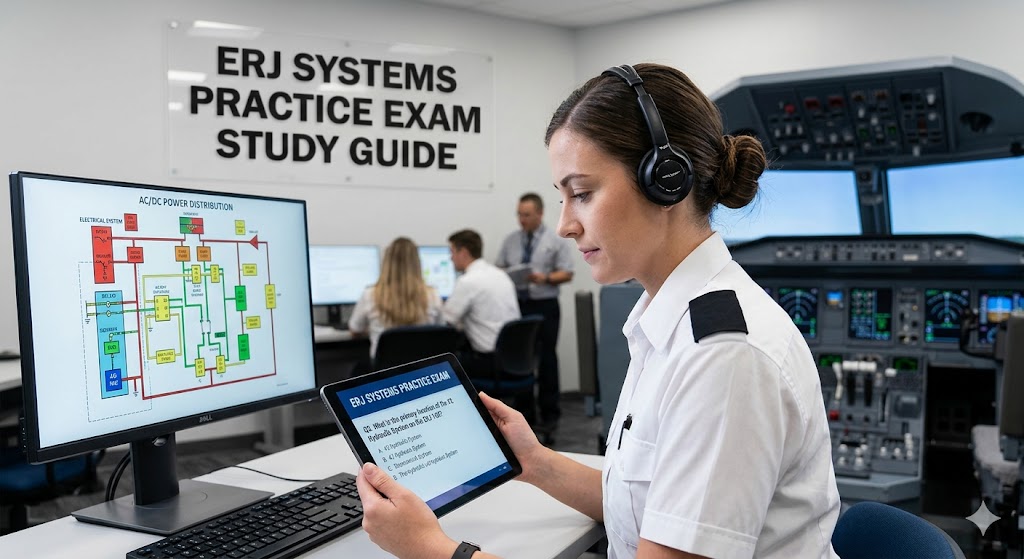
Additional Information
What the Course Entails and Exam Details
A standard ERJ systems course provides an in-depth dive into the technical operations of the aircraft family, focusing on how individual components integrate to ensure safe and efficient flight.
The theoretical training encompasses a vast array of topics, requiring a student to demonstrate detailed knowledge of the aircraft's applicable systems, structure, operations, maintenance, repair, and troubleshooting methodologies according to approved technical data.
Candidates will explore the intricacies of the Electrical System, including AC/DC power generation and distribution; the Hydraulic System, understanding the operation of the independent systems powering flight controls and landing gear; and the Fuel System, covering tank arrangement, engine feed, and refueling procedures.
Critical safety systems are also a major focus, such as the Pneumatic and Environmental Control Systems (ECS), Ice and Rain Protection, and the Fire Protection architecture for engines, APU, and cargo compartments.
The course heavily covers the integration of the Flight Controls (both primary and secondary), the sophisticated Avionics suite (specifically the Honeywell Primus 1000 EICAS and FMS), the Landing Gear, and the Powerplant, focusing on the operation and limitations of the Rolls-Royce AE 3007 Series engines and the Full Authority Digital Engine Control (FADEC) system.
What to Expect in the Final Exam
While the exact format can vary slightly between training providers (such as CAE, FlightSafety International, or dedicated airline training academies), the final systems exam is typically a challenging, comprehensive assessment.
Most formal systems exams are conducted in a controlled environment as a closed-book, multiple-choice questionnaire, consisting of anywhere from 50 to over 100 questions.
The examination is timed, usually allowing between 60 to 120 minutes for completion, demanding not just accuracy but quick recall of technical specifications and system logic.
The passing score requirement is generally high, reflecting the safety-critical nature of the material, with a common standard being a minimum of 75% or 80%.
Questions may ask candidates to identify correct system schematic flows, describe component functions, specify operational limitations (e.g., maximum altitudes, temperatures, or pressures), and correctly interpret Electronic Flight Instrument System (EFIS) or Engine Indication and Crew Alerting System (EICAS) messages.
How to Study and Exam Centers
Effective preparation for the ERJ systems exam requires a multi-faceted approach that goes beyond mere rote memorization, focusing instead on a deep understanding of system interdependencies.
Begin your study by thoroughly reviewing the Aircraft Flight Manual (AFM), the Flight Safety Training Manual (FSTM), or the Aircraft Maintenance Manual (AMM), depending on your specific role.
Supplement your reading with system schematics and diagrams; visually tracing electrical paths, hydraulic lines, and fuel flows is one of the most effective ways to solidify structural knowledge.
The cornerstone of your preparation should be taking multiple, simulated ERJ systems practice tests; this not only reinforces the material but also builds necessary time-management skills and helps identify lingering weak points.
Create flashcards for specific limitations, switch positions, and EICAS message logics to improve rapid recall, and, if available, utilize simulator time or Cockpit Procedures Trainers (CPTs) to apply theoretical knowledge in a practical, simulated context.
Regarding exam centers, for practice tests, students typically access online study portals, quiz banks, or computer-based training modules provided by their authorized training organization or airline.
The final, formal certification exams are usually administered on-site at the training provider's facility, authorized pilot schools, authorized maintenance organizations, or designated simulator centers globally.
Job Opportunities from the Course
A detailed command of ERJ systems is an essential prerequisite for numerous career paths within the regional airline and corporate aviation sectors. This certification unlocks several specific job titles.
ERJ First Officer (Regional Airline)
ERJ Captain (Regional Airline or Corporate)
Aircraft Maintenance Technician (AMT) - ERJ Specialist
Avionics Technician - Regional Jet
Flight Instructor (ERJ Type-Specific)
Airline Simulator Instructor
Maintenance Fleet Manager (ERJ Series)
Technical Support Specialist (Aviation OEM)
Field Service Representative (Aviation OEM)
Frequently Asked Questions
Reviews
5.0
Based on 0 reviews
Leave a Review
No reviews yet. Be the first to review!