
Emergency Department Course 1 – Past Histories & ED Flow Practice Test
$69.00
- Buy to unlock unlimited access to all Quiz questions and Answers in this Quiz.
- After purchase you can print a PDF of the whole quiz at any point. The PDF will contain the questions and the correct answers.
About this Exam
The Emergency Department Course 1 – Past Histories & ED Flow Practice Test is a crucial educational resource designed for aspiring emergency medicine professionals and current healthcare providers looking to validate their knowledge. This practice exam is ideal for Nurses (RNs, LPNs, LVNs), Emergency Medical Technicians (EMTs), Emergency Room Technicians, Patient Care Technicians, and Medical Assistants aiming to specialize in the fast-paced ED environment. It serves as an excellent benchmark, helping individuals assess their understanding of foundational emergency care principles, particularly the critical initial patient assessment and the structured flow of treatment. Mastering these concepts is essential for ensuring efficient, high-quality patient care in one of the most demanding hospital settings.
Ready to test your knowledge?
Buy Now to Access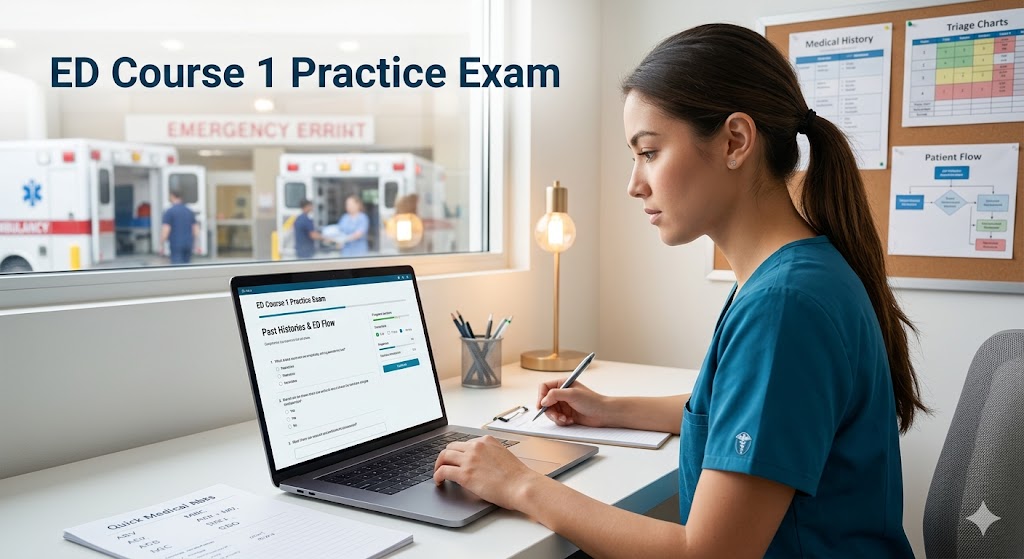
Additional Information
What the Course Entails and Exam Details
This comprehensive course, often the first module in a sequence of emergency department certifications, dives deep into the two most critical early steps of patient care: capturing an accurate Past History and understanding ED Flow. The content covers the systematic process of gathering a patient's medical history, including previous conditions, surgical history, family medical background, social history, and current medications, always prioritizing information that affects acute treatment. Furthermore, it explores the intricate, optimized patient journey within the Emergency Department—from arrival and triage, through diagnostic testing and immediate treatments, to final disposition (admission, discharge, or transfer). The course provides essential tools for understanding how efficient communication and prioritized workflow enhance patient safety and operational effectiveness.
What to Expect in the Final Exam
The final practice exam for Emergency Department Course 1 – Past Histories & ED Flow is a thorough assessment of the key concepts presented in the curriculum. Typically, this is a computer-based test that features a variety of question formats, including multiple-choice, select-all-that-apply, and often scenario-based case studies where students must apply their knowledge to realistic ED situations. The exam is structured to mimic the pressure and critical thinking required in a real emergency, with specific time limits, often between 60 to 90 minutes. A passing score, commonly set at 75% or 80%, is required to demonstrate proficiency. Students should be prepared for questions that test their ability to quickly synthesize patient information and identify correct workflow steps and prioritization strategies, following strict testing regulations in both online and in-person environments.
How to Study and Exam Centers
Preparation for this crucial practice exam requires a multi-faceted approach. To succeed, students should leverage all provided course materials, including lecture notes, textbooks, and interactive online modules. It is vital to actively practice recalling and applying information, especially through the use of dedicated practice tests, which simulate the actual exam environment and highlight areas needing improvement. Engaging with peers and instructors in study groups, and focusing on real-world case scenarios to master patient history taking and ED flow prioritization, can significantly boost performance. Regarding exam centers, this test can often be taken directly through the online portal of the course provider or a participating authorized school or medical institution. Depending on the specific certification body, the official exam might be proctored online or held at specific physical testing locations, such as Pearson VUE centers or pre-approved institutional testing sites, making detailed research on available options essential for proper planning.
Job Opportunities from the Course
A strong performance on this course and practice exam, leading to subsequent certification, opens the door to numerous high-demand career opportunities within the emergency medical field. Validating these fundamental skills is a key asset for securing various roles, including:
Emergency Department Nurse (RN or LPN/LVN)
Emergency Medical Technician (EMT)
Emergency Room Technician (ER Tech)
Patient Care Technician (PCT) in the Emergency Department
Medical Assistant with an Emergency Focus
Emergency Intake Specialist or Patient Access Representative
Triage Coordinator Assistant
Clinical Research Coordinator specializing in Emergency Medicine
Future enrollment into advanced emergency medicine or nursing programs.
Frequently Asked Questions
Reviews
5.0
Based on 0 reviews
Leave a Review
No reviews yet. Be the first to review!