
Emergency Endotracheal Intubation (EEI) Airway Practice Test
$69.00
- Buy to unlock unlimited access to all Quiz questions and Answers in this Quiz.
- After purchase you can print a PDF of the whole quiz at any point. The PDF will contain the questions and the correct answers.
About this Exam
The Emergency Endotracheal Intubation (EEI) certification is a specialized credential designed for healthcare providers who manage critical airways in high-stress environments.
This exam tests your ability to rapidly and safely secure a patient’s airway when they are unable to breathe independently.
It is primarily designed for paramedics, emergency room nurses, respiratory therapists, and critical care transport teams.
Earning this certification proves that you possess the life-saving skills necessary to perform intubations under pressure, ensuring oxygenation and ventilation when seconds count.
Ready to test your knowledge?
Buy Now to Access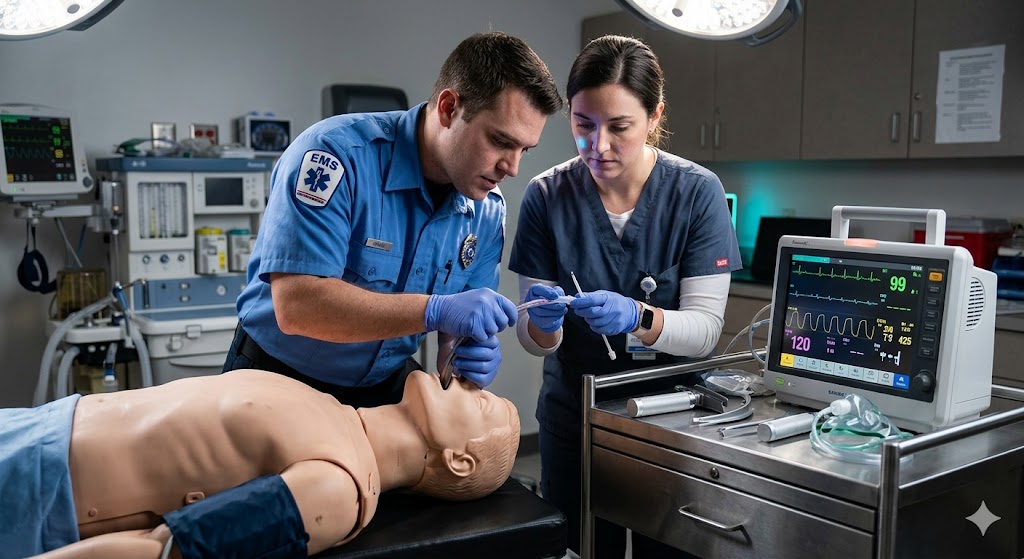
Additional Information
What the Course Entails and Exam Details
The EEI Airway course covers a comprehensive syllabus centered around advanced airway management.
Candidates will dive deep into upper airway anatomy, recognizing difficult airways, and mastering the Rapid Sequence Intubation (RSI) protocol.
The coursework extensively details pharmacology, focusing on induction agents and neuromuscular blocking drugs.
You will also learn how to properly select and handle equipment, including direct and video laryngoscopes, endotracheal tubes, bougies, and supraglottic rescue devices.
Furthermore, the curriculum emphasizes post-intubation management, such as securing the tube, confirming placement with capnography, and continuous patient monitoring.
What to Expect in the Final Exam
The final EEI Airway exam is a rigorous evaluation split into two main components.
First, you will face a comprehensive multiple-choice written test that assesses your theoretical knowledge of airway anatomy, pharmacology dosages, and decision-making algorithms.
Second, you must pass a high-stakes practical skills station using an advanced airway mannequin.
During this physical assessment, evaluators will grade your technique, speed, and adherence to safety protocols in real-time scenarios.
You are generally given 90 minutes to complete the written portion, while the practical exam is strictly timed to simulate real-world emergency pressures.
A passing score typically requires at least an 80% on the written test and a flawless execution of critical steps in the practical assessment.
How to Study and Exam Centers
Success in the EEI Airway exam requires a blend of book studying and hands-on muscle memory.
Begin by taking multiple practice exams to familiarize yourself with the question formats and identify your weak areas in pharmacology or algorithms.
Create flashcards for RSI drug dosages, indications, and contraindications to ensure rapid recall.
For the practical portion, spend as much time as possible in a simulation lab practicing your physical intubation technique on medical mannequins.
Exams are traditionally administered at authorized medical training facilities, hospital education departments, or certified simulation centers.
The written portion may be taken through online proctored portals like Pearson VUE, but the practical skills assessment must always be completed in person under the supervision of a certified instructor.
Job Opportunities from the Course
Earning your EEI Airway certification drastically enhances your clinical resume and opens doors to highly specialized, fast-paced medical roles. Below are some of the key job titles this credential can unlock:
Flight Paramedic
Critical Care Transport Nurse
Emergency Room (ER) Registered Nurse
Advanced Practice Respiratory Therapist
Tactical EMS Provider
Resuscitation Team Leader
Rapid Response Team Clinician
Frequently Asked Questions
Reviews
5.0
Based on 0 reviews
Leave a Review
No reviews yet. Be the first to review!