
Emergency Medical Dispatcher (EMD) Certification Practice Exam
$69.00
- Buy to unlock unlimited access to all Quiz questions and Answers in this Quiz.
- After purchase you can print a PDF of the whole quiz at any point. The PDF will contain the questions and the correct answers.
About this Exam
The Emergency Medical Dispatcher (EMD) certification is a vital credential for anyone looking to become the critical first link in the emergency response chain.
This certification verifies your ability to handle high-pressure situations, gather crucial information from panicked callers, and dispatch the appropriate medical resources immediately.
It is specifically designed for aspiring 911 dispatchers, emergency communications professionals, and first responders who want to specialize in emergency telecommunications.
By passing this exam, you prove you have the calm demeanor and technical knowledge required to save lives over the phone before an ambulance even arrives.
Ready to test your knowledge?
Buy Now to Access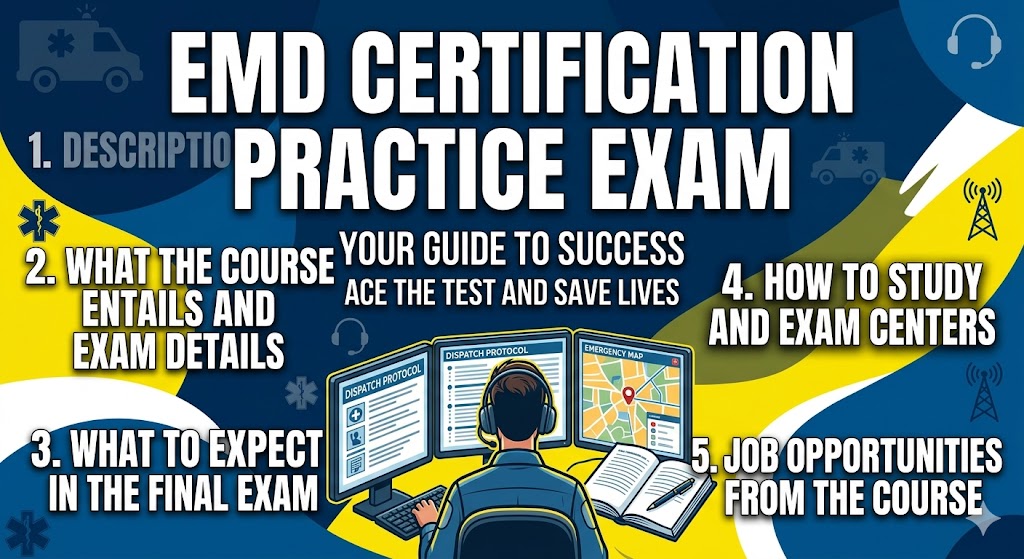
Additional Information
What the Course Entails and Exam Details
An EMD certification course is rigorous and covers a wide array of life-saving topics and procedural protocols.
Students learn the anatomy of a successful emergency medical call, including effective caller interrogation techniques and how to maintain control of chaotic conversations.
A major focus of the syllabus is mastering Pre-Arrival Instructions (PAIs), which allow dispatchers to guide callers through life-saving procedures like CPR, bleeding control, and emergency childbirth.
The course also dives deep into legal and liability issues in emergency dispatch, ensuring you understand the boundaries of your duties.
Additionally, you will learn essential stress management techniques to help you cope with the emotional demands of working in a 911 communications center.
You will also be trained extensively on how to navigate standardized priority dispatch systems and software quickly and accurately.
What to Expect in the Final Exam
The final EMD certification exam evaluates your mastery of the strict protocols used in emergency dispatch centers.
Most exams consist of 50 to 100 multiple-choice questions, depending on the specific certifying agency like the International Academies of Emergency Dispatch (IAED) or APCO International.
You must typically achieve a passing score of at least 80% to earn your certification.
The test is usually strictly timed, giving candidates anywhere from one to two hours to complete all questions.
It is a closed-book examination, meaning you must have all dispatch protocol paths, legal guidelines, and medical terminologies fully memorized.
Expect scenario-based questions where you must choose the most appropriate dispatch code or pre-arrival instruction based on a theoretical caller's description.
How to Study and Exam Centers
Preparation is key to passing the EMD certification exam on your first attempt.
Start by taking multiple practice exams to familiarize yourself with the phrasing of the questions and the strict logic of the dispatch protocols.
Create flashcards for different emergency scenarios, medical terminologies, and the exact sequence of questions you must ask a caller.
Role-playing is one of the most effective study methods; practice active listening and giving instructions out loud with a study partner to simulate real-world pressure.
When it comes time to take the test, your options will depend on your certifying organization.
Many candidates take the exam through secure, proctored online portals directly from their own homes.
Alternatively, you can schedule your exam at authorized physical testing centers, such as Pearson VUE facilities.
Some law enforcement agencies and emergency communication centers also host the exam on-site at the conclusion of their internal training academies.
Job Opportunities from the Course
Earning this certification opens the door to a highly rewarding, fast-paced career in public safety and emergency services.
Here are some of the primary career paths and job titles this credential unlocks:
Emergency Medical Dispatcher (EMD)
911 Telecommunicator
Police, Fire, and Ambulance Dispatcher
Emergency Communications Officer
Communications Center Supervisor
Air Ambulance Flight Dispatcher
Dispatch Training Coordinator
Tactical Dispatcher for Specialized Response Teams
Frequently Asked Questions
Reviews
5.0
Based on 0 reviews
Leave a Review
No reviews yet. Be the first to review!