
Emergency Medical Dispatcher (EMD) Protocol Selection Practice Test
$69.00
- Buy to unlock unlimited access to all Quiz questions and Answers in this Quiz.
- After purchase you can print a PDF of the whole quiz at any point. The PDF will contain the questions and the correct answers.
About this Exam
The Emergency Medical Dispatcher (EMD) Protocol Selection Practice Test is an essential study tool designed for aspiring 911 dispatchers and current medical professionals seeking certification. This exam focuses specifically on the critical skill of selecting the correct medical protocol during a crisis call.
Effective EMDs must rapidly assess a caller’s situation, understand the symptoms, and apply the standardized protocol (like MPDS or similar) to ensure appropriate resources are dispatched immediately. This practice test simulates that high-stakes decision-making environment, allowing candidates to refine their analytical skills.
It is designed for public safety answer point (PSAP) personnel, future emergency dispatchers, and anyone preparing for the official EMD certification exam. Mastering protocol selection is fundamental to ensuring patient safety and maximizing the efficiency of emergency medical services.
Ready to test your knowledge?
Buy Now to Access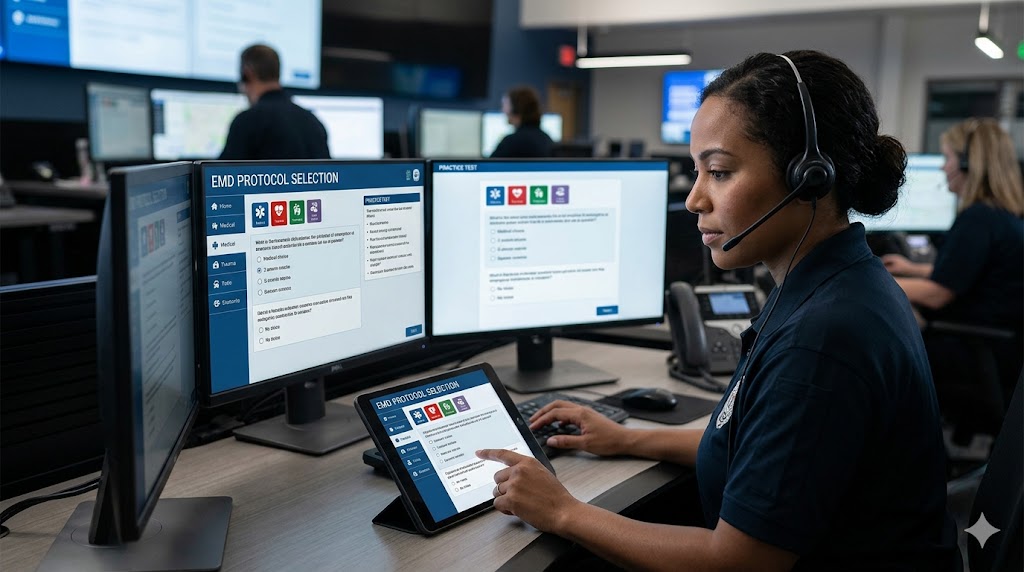
Additional Information
What the Course Entails and Exam Details
This practice test focuses intently on the core responsibility of an EMD: applying structured medical interrogation and categorization protocols. While a full EMD course covers anatomy and physiology, the final certification is dependent on your ability to process information and select the right path.
The course typically entails comprehensive modules on understanding the EMD role, the principles of medical priority dispatching, and the legal aspects of dispatching advice. The primary goal is teaching the student to identify the correct protocol based on the caller’s chief complaint.
The exam details involve navigating numerous scenarios representing the entire spectrum of medical emergencies, including cardiac arrest, stroke, trauma, psychiatric crises, and obstetric emergencies. Practice tests will challenge you with ambiguous or chaotic call simulations.
What to Expect in the Final Exam
When sitting for the final official EMD certification exam, you can expect a rigorous evaluation focused heavily on scenario-based assessment. The final exam is primarily multiple-choice, focusing on applying your knowledge to realistic, critical situations.
The official exam is standardized and usually computer-based. The time limit for the full exam varies slightly by agency but is generally intense, requiring quick thinking—typically around 1.5 to 2 hours for the primary knowledge section.
Candidates must typically achieve a high passing score, often 80% or above, to earn certification. Strict rules regarding prohibited materials and identification are enforced at testing sites, and a background check is often a prerequisite.
How to Study and Exam Centers
Actionable study strategies are key to passing. First, review your specific agency's protocol manual (such as APCO, PowerPhone, or the International Academies of Emergency Dispatch MPDS protocols) repeatedly until you can recite the primary complaint categories.
Utilize the [EMD Protocol Selection Practice Test] extensive practice test. Treat it like the real exam: time yourself and do not use materials during the simulation. This builds mental stamina and identifies your weak points.
The official final exam is usually administered via secured online portals or at authorized public safety training academies. In many cases, candidates take the exam at certified physical testing centers or directly within their sponsoring public safety agency.
Job Opportunities from the Course
Earning your EMD certification unlocks specialized career paths in public safety. Successful candidates find that this certification is often a non-negotiable requirement for advancement.
Jobs you can pursue after completing the course include:
Emergency Medical Dispatcher (EMD)
911 Call Taker/Telecommunicator
Communications Center Supervisor
Public Safety Dispatcher (Combined Police/Fire/EMS)
Emergency Dispatch Instructor or Trainer
Frequently Asked Questions
Reviews
5.0
Based on 0 reviews
Leave a Review
No reviews yet. Be the first to review!