
Emergency Medical Responder (EMR) British Columbia Provincial Licensing Practice Exam
$69.00
- Buy to unlock unlimited access to all Quiz questions and Answers in this Quiz.
- After purchase you can print a PDF of the whole quiz at any point. The PDF will contain the questions and the correct answers.
About this Exam
The Emergency Medical Responder (EMR) certification in British Columbia is a crucial foundational qualification for anyone seeking a career in emergency pre-hospital care.
It acts as the primary stepping stone for dedicated individuals who want to provide life-saving medical assistance before advanced paramedics arrive on the scene.
This certification is highly recommended and specifically designed for aspiring paramedics, firefighters, law enforcement officers, and industrial safety workers.
By passing the provincial licensing exam, candidates prove they possess the critical thinking and clinical skills necessary to stabilize patients during medical and trauma emergencies.
Earning your EMR license through the Emergency Medical Assistants Licensing Board (EMALB) signifies your readiness to serve your community with competence, care, and professionalism.
Ready to test your knowledge?
Buy Now to Access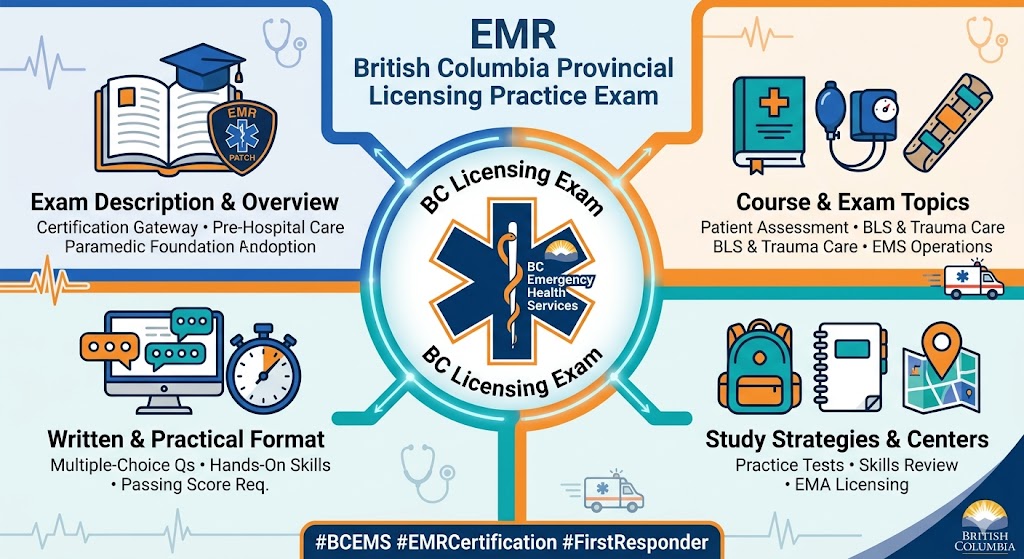
Additional Information
What the Course Entails and Exam Details
The EMR course curriculum is intensive, hands-on, and carefully structured to build a strong foundation in human anatomy and emergency response.
Students dive deep into essential pre-hospital skills, starting with scene assessments, primary and secondary patient surveys, and vital signs monitoring.
A significant portion of the syllabus covers advanced airway management, cardiopulmonary resuscitation (CPR), and the use of Automated External Defibrillators (AED).
Candidates are also trained extensively in trauma management, which includes hemorrhage control, spinal immobilization, and splinting fractures.
Furthermore, the coursework entails managing specific medical emergencies such as diabetic crises, anaphylaxis, cardiac arrests, and respiratory distress.
You will also learn the basics of pharmacology, specifically regarding the safe administration of life-saving medications like epinephrine, naloxone, and oral glucose.
What to Expect in the Final Exam
The British Columbia EMALB provincial licensing exam is a rigorous two-part evaluation designed to test both your theoretical knowledge and practical competence.
The first component is a comprehensive written examination consisting of multiple-choice questions that cover all aspects of the EMR curriculum.
You will typically have up to two hours to complete the written portion, which demands a solid grasp of medical terminology, protocols, and standard operating procedures.
To successfully pass the written exam, candidates must achieve a minimum passing score of 70%.
The second component involves practical examinations, often referred to as Objective Structured Clinical Examinations (OSCEs) or scenario-based evaluations.
During the practical exam, evaluators will present you with simulated emergency situations where you must physically demonstrate your assessment, treatment, and communication skills in real-time.
Both components are strictly monitored, and candidates are expected to adhere to all professional conduct rules, including strict time management and safety protocols during the hands-on scenarios.
How to Study and Exam Centers
Preparation is the key to conquering the EMR provincial exam, and taking consistent, timed practice tests is one of the most effective study strategies.
Simulating the actual test environment with practice exams helps you identify knowledge gaps, improve your pacing, and reduce test-day anxiety.
For the practical portion, form study groups with your peers to run through medical and trauma scenarios repeatedly until your physical interventions become second nature.
Flashcards are highly recommended for memorizing vital sign ranges, medication dosages, and specific provincial treatment protocols.
When you are ready to test, the written exams are typically administered online through secure, proctored portals authorized by the BC EMALB.
Alternatively, you may be scheduled to take your exams at specific physical testing centers or authorized training schools located in major regions across British Columbia, such as Vancouver, Victoria, or Kelowna.
Always check the official EMALB website for the most up-to-date scheduling instructions, exact testing center locations, and registration deadlines.
Job Opportunities from the Course
Successfully obtaining your EMR license opens the door to a highly rewarding and dynamic career path in emergency services.
First and foremost, it qualifies you to work directly as an Emergency Medical Responder within the BC Emergency Health Services (BCEHS) system.
It is also an essential prerequisite for individuals looking to apply to municipal fire departments to become professional Career Firefighters.
In the private sector, many graduates find lucrative roles as Industrial First Aid Attendants or Site Medics in construction, forestry, and oil and gas industries across Western Canada.
Additionally, you can secure employment as a Patient Transfer Attendant, assisting in the safe transport of non-critical patients between medical facilities.
Finally, this certification serves as the mandatory foundation for those who wish to advance their education and become Primary Care Paramedics (PCP) in the future.
Frequently Asked Questions
Reviews
5.0
Based on 0 reviews
Leave a Review
No reviews yet. Be the first to review!