
Emergency Medical Responder (EMR) National Registry Practice Exam
$69.00
- Buy to unlock unlimited access to all Quiz questions and Answers in this Quiz.
- After purchase you can print a PDF of the whole quiz at any point. The PDF will contain the questions and the correct answers.
About this Exam
The Emergency Medical Responder (EMR) National Registry certification is the foundational stepping stone for anyone looking to enter the critical and fast-paced world of emergency medical services.
This credential is specifically designed for first responders, including police officers, firefighters, park rangers, and industrial safety personnel, who are often the very first professionals to arrive at the scene of a medical emergency.
By passing the NREMT EMR exam, candidates prove they possess the essential knowledge required to provide immediate, life-saving care to patients before an ambulance arrives.
It is an incredibly rewarding path for individuals passionate about public safety, community health, and making a tangible difference during high-stress situations.
Ready to test your knowledge?
Buy Now to Access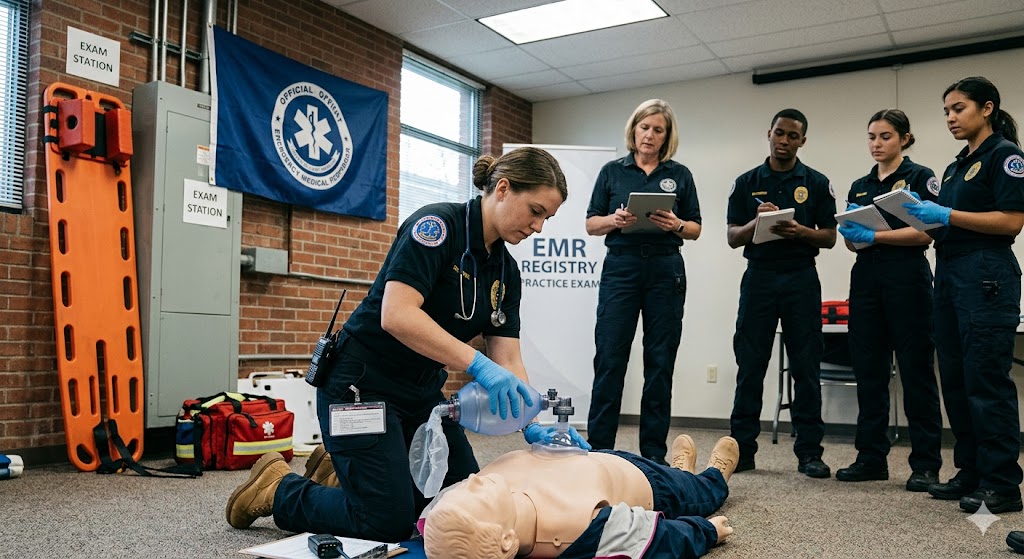
Additional Information
What the Course Entails and Exam Details
An EMR training course covers a comprehensive syllabus designed to equip students with critical, life-saving medical skills.
The core topics revolve around basic life support, ensuring that students can stabilize patients suffering from a wide variety of medical and traumatic emergencies.
You will dive deep into airway management, learning how to clear obstructions and assist with breathing using basic adjuncts.
Patient assessment is another major pillar of the course, teaching you how to quickly evaluate a scene, assess a patient’s vital signs, and determine the severity of their condition.
Furthermore, the syllabus includes rigorous training in CPR, the proper usage of an Automated External Defibrillator (AED), bleeding control, shock management, and emergency childbirth.
What to Expect in the Final Exam
The National Registry EMR cognitive exam is a fast-paced, computer-based test that evaluates your understanding of emergency medical care.
The exam typically consists of between 90 and 110 multiple-choice questions.
You will be given a strict time limit of 1 hour and 45 minutes to complete the cognitive portion of the exam.
The questions are distributed across various key categories, including Airway, Respiration & Ventilation, Cardiology & Resuscitation, Trauma, Medical/Obstetrics/Gynecology, and EMS Operations.
A significant portion of the test focuses on adult and geriatric patients, while pediatric care also makes up a crucial percentage of the questions.
To achieve a passing score, you must meet the competency standard set by the National Registry, which means the exam is designed to ensure you are safe and effective for entry-level practice.
Additionally, you will need to pass a hands-on psychomotor (practical) exam authorized by your state EMS office or training institution to prove your physical clinical skills.
How to Study and Exam Centers
Success on the EMR exam requires a strategic mix of reading, memorization, and applied critical thinking.
Your best study strategy is to utilize high-quality EMR National Registry practice exams to familiarize yourself with the format and wording of the real test.
Take these practice tests under timed conditions to build your stamina and identify your weak subject areas.
Create flashcards for specific medical terminology, vital sign ranges, and CPR ratios to ensure rapid recall during the test.
When you are ready to take the cognitive exam, you must create an account on the NREMT website and receive your Authorization to Test (ATT) letter.
The actual computer exam is administered exclusively through Pearson VUE testing centers.
You can easily locate a physical Pearson VUE testing facility near you by visiting their official website and scheduling a time that fits your availability.
Job Opportunities from the Course
Earning your EMR certification opens the door to a variety of exciting and crucial roles within public safety and healthcare. Below are some of the primary career paths this certification unlocks:
Firefighter: Many fire departments require their personnel to be EMR certified at a minimum, as they are frequently dispatched to medical calls alongside rescue operations.
Law Enforcement Officer: Police officers and sheriff's deputies use EMR skills daily to treat victims of accidents or violence while waiting for paramedics to secure the scene.
Security Guard or Industrial Safety Officer: Large manufacturing plants, construction sites, and corporate campuses hire EMRs to serve as on-site medical responders for workplace injuries.
Park Ranger / Search and Rescue: Outdoor recreation professionals rely heavily on EMR training to stabilize injured hikers and campers in remote, austere environments.
Emergency Room Technician: Some hospitals and urgent care clinics employ EMRs to assist nurses and doctors with taking vital signs and managing patient flow.
EMT Stepping Stone: For many, the EMR certification is the perfect foundational credential before returning to school to become an Emergency Medical Technician (EMT) or Paramedic.
Frequently Asked Questions
Reviews
5.0
Based on 0 reviews
Leave a Review
No reviews yet. Be the first to review!