
Emergency Medical Responder Practice Exam
$69.00
- Buy to unlock unlimited access to all Quiz questions and Answers in this Quiz.
- After purchase you can print a PDF of the whole quiz at any point. The PDF will contain the questions and the correct answers.
About this Exam
The Emergency Medical Responder (EMR) certification is an entry-level credential in the field of Emergency Medical Services (EMS). It is specifically designed for individuals who are likely to be the first to arrive at the scene of an emergency, such as firefighters, law enforcement officers, industrial health and safety personnel, and even dedicated community volunteers.
The primary goal of an EMR is to provide immediate, lifesaving care to critical patients while awaiting the arrival of additional, higher-level EMS resources, such as Emergency Medical Technicians (EMTs) or Paramedics. EMRs possess the essential knowledge and skills needed to perform basic interventions with minimal equipment, often managing the scene and beginning patient care within those first crucial minutes.
Ready to test your knowledge?
Buy Now to Access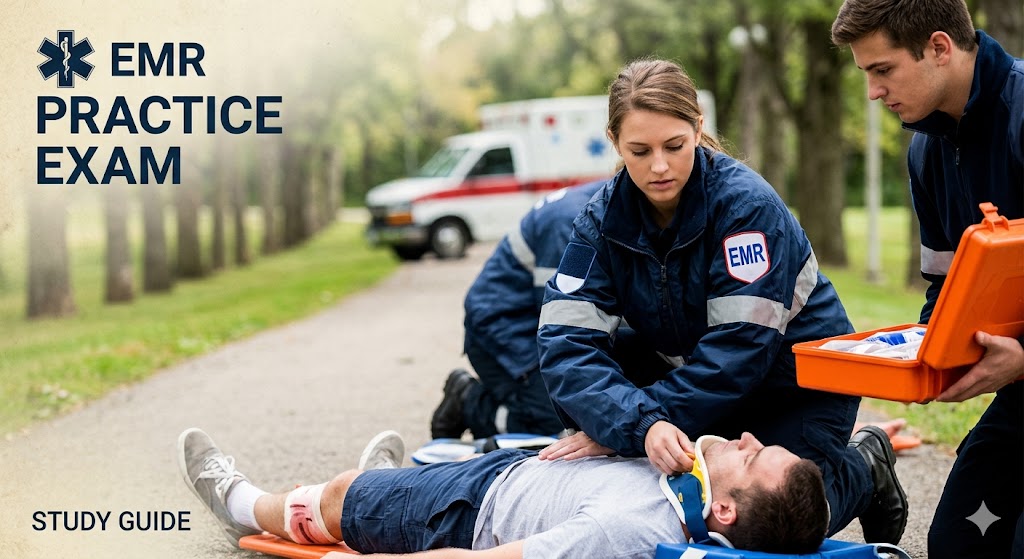
Additional Information
What the Course Entails and Exam Details
Before you can challenge the Emergency Medical Responder Practice Exam, you must complete a state-approved or National Registry of Emergency Medical Technicians (NREMT)-recognized EMR education program. These courses typically require 40 to 60 hours of training.
The curriculum is focused on the core components of the National EMS Education Standards. The main areas of study and examination topics are:
Preparatory: Introduction to EMS systems, safety, wellness, medical-legal, and ethical issues.
Anatomy and Physiology: Basic understanding of human body systems.
Medical Terminology: Fundamental language used in medical communication.
Pathophysiology: The functional changes associated with disease or injury.
Life Span Development: Understanding patient care needs from infancy to geriatrics.
Public Health: Concepts of disease prevention and scene safety.
Pharmacology: Principles of safe medication administration (within EMR scope).
Airway Management, Respiration, and Artificial Ventilation: Techniques for opening and maintaining an airway and assisting ventilation.
Assessment: Comprehensive patient assessment models for medical and trauma emergencies.
Medicine: Recognition and management of common medical emergencies (respiratory, cardiovascular, neurological, endocrine, etc.).
Shock and Resuscitation: Principles of managing hypoperfusion and cardiac arrest.
Trauma: Management of specific injuries (bleeding, soft tissue, musculoskeletal, head, and spinal).
Special Patient Populations: Care for obstetrical, neonatal, pediatric, geriatric, and special needs patients.
EMS Operations: Scene size-up, incident management, and vehicle operations.
What to Expect in the Final Exam
To become certified, candidates typically must pass two components of the examination. The most prominent national standard is set by the NREMT.
1. The Cognitive (Written) Exam
The NREMT Cognitive Exam is a Computer Adaptive Test (CAT). A CAT tailors the exam to your ability level.
Format: Multiple-choice questions.
Number of Questions: The exam ranges from 90 to 110 questions. As you answer correctly, the questions get harder; if you answer incorrectly, they get easier. The test ends once the system has determined, with 95% confidence, whether your ability is above or below the passing standard.
Time Limit: You have 1 hour and 45 minutes to complete the test.
Scoring: The NREMT uses a scaled score. There is no set percentage to pass; you must demonstrate entry-level competency across all domains.
Topics: The core subjects listed in Section 2 are covered, with a distribution of approximately 85?ult and 15% pediatric content.
2. The Psychomotor (Practical) Exam
This exam tests your hands-on skills in a simulated emergency environment.
Format: Hands-on skill stations. You are evaluated by an observer.
Scope: The practical exam requires you to demonstrate competency in skills such as:
Patient Assessment and Management (Trauma and Medical scenarios).
BVM Ventilation of an Apneic Adult Patient.
Oxygen Administration.
Cardiac Arrest Management (AED use).
Spinal Immobilization.
Bleeding Control and Shock Management.
Passing: You must pass all skill stations to achieve certification.
How to Study and Exam Centers
Preparation is the key to conquering the Emergency Medical Responder Practice Exam.
Actionable Study Strategies
Master the Standards: Thoroughly review the National EMS Education Standards for EMR, which are the blueprint for the exam content.
Leverage Practice Tests: Utilizing an Emergency Medical Responder Practice Exam repeatedly is one of the most effective methods. It builds your familiarity with the question format, timing, and identifies weak areas. Focus on understanding why an answer is correct, not just memorizing.
Hands-on Practice: For the psychomotor exam, you cannot rely only on a book. Rehearse the skill sheets with classmates, simulating scenarios until they become muscle memory.
Deconstruct Questions: In multiple-choice exams, practice the process of elimination. Read the stem carefully, identify what the question is truly asking (the 'call to action'), and rule out obviously incorrect answers.
Use Visual Aids: Create flashcards for medical terms, vital signs, and anatomy. Use diagrams for body systems.
Where to Take the Exam
Cognitive Exam: For NREMT certification, the cognitive exam is administered through authorized Pearson VUE testing centers. You must create an NREMT account, complete your application, and once authorized to test (ATT), schedule your exam appointment at a location convenient for you.
Psychomotor Exam: State EMS offices and EMR training institutions (with state oversight) are responsible for scheduling and administering psychomotor exams. Candidates should coordinate with their course instructor to find available test dates.
Job Opportunities from the Course
Earning your EMR certification unlocks a variety of career paths where your skills in initial emergency care are highly valued. This credential is often used as a direct requirement for entry-level public safety positions or as a powerful stepping stone to advanced EMS roles.
Specific job opportunities include:
Firefighter (many departments require EMR/EMT as a prerequisite)
Law Enforcement Officer (patrol officers often arrive first at medical scenes)
Industrial First Aid Attendant (safety teams at factories, construction sites, and plants)
Ski Patrol Member
Wilderness First Responder
Search and Rescue Team Member
Event Medic (providing coverage at sports events, concerts, and festivals)
Volunteering with Community Emergency Response Teams (CERT)
Hospital Emergency Department Aide (where permitted by state scope)
This certification is also the foundational first step for those planning to become an Emergency Medical Technician (EMT), Advanced EMT (AEMT), or Paramedic.
Frequently Asked Questions
Reviews
5.0
Based on 0 reviews
Leave a Review
No reviews yet. Be the first to review!