
Emergency Medical Services (EMS) Operations Practice Exam
$69.00
- Buy to unlock unlimited access to all Quiz questions and Answers in this Quiz.
- After purchase you can print a PDF of the whole quiz at any point. The PDF will contain the questions and the correct answers.
About this Exam
Welcome to your essential first step toward mastering Emergency Medical Services (EMS) operational principles. An EMS Operations Practice Exam is a powerful tool designed for aspiring and current EMS professionals—including Emergency Medical Responders (EMRs), Emergency Medical Technicians (EMTs), Advanced EMTs (AEMTs), and Paramedics. This exam simulates critical field scenarios and knowledge, ensuring you possess the proficiency to coordinate complex responses, manage resources effectively, and prioritize safety and communication. Whether you're a student preparing for initial certification or a seasoned provider brushing up on core operational skills, this practice test provides invaluable insight and readiness.
Ready to test your knowledge?
Buy Now to Access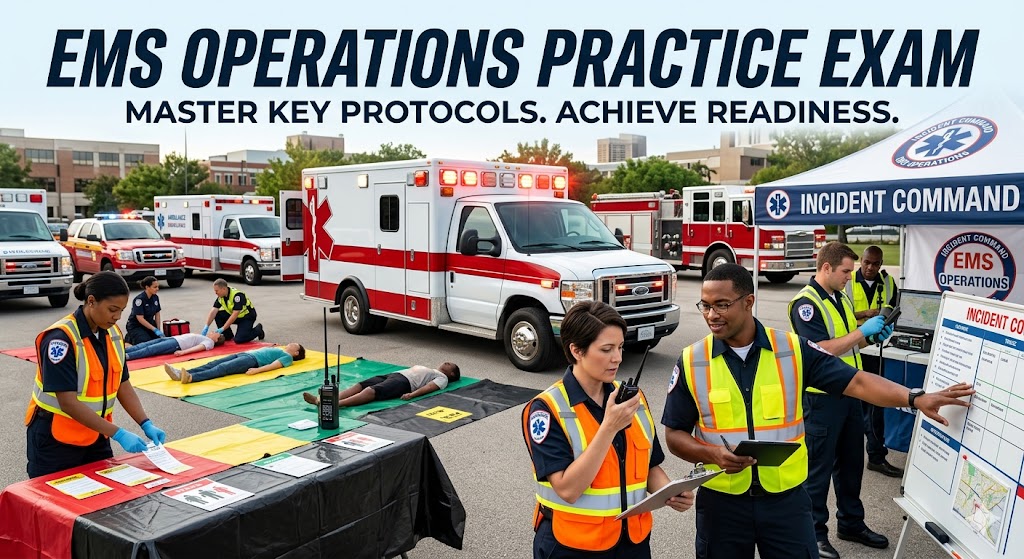
Additional Information
What the Course Entails and Exam Details
A comprehensive EMS Operations curriculum and its associated exams cover a diverse range of critical field skills and knowledge. Key areas typically include:
Incident Management and the Incident Command System (ICS): Understanding unified command structures, scene organization, resource allocation, and roles within various incidents.
Mass Casualty Incidents (MCI) and Triage: Proficiency in rapidly assessing and prioritizing multiple patients using established triage systems (like START/JumpSTART).
Effective Communication Protocols: Mastering clear, concise, and accurate radio and interpersonal communication within the EMS team, with dispatch, and with other agencies.
Personnel and Scene Safety: Implementing strategies to ensure provider, patient, and bystander safety, including proper use of Personal Protective Equipment (PPE), scene assessment, and hazard recognition.
Vehicle Operations: Knowledge of safe emergency driving practices, defensive driving, standard operating procedures for vehicles, and maintenance.
Patient Movement and Transport: Understanding best practices for lifting, moving, and securely transporting patients in various environments and under different conditions.
Documentation: Accurate, timely, and complete documentation of patient care and operational details, adhering to legal and ethical standards.
Hazmat and Disaster Response (Overview): Recognizing hazardous materials, following appropriate initial response protocols, and contributing effectively to larger disaster management efforts.
Regulations and Ethics: Compliance with local, state, and federal regulations, and adherence to professional ethical guidelines in all operational contexts.
Practice exams reflect these core topics, featuring questions on theory application, scenario analysis, and critical thinking based on current EMS education standards and best practices.
What to Expect in the Final Exam
Official EMS certification exams, such as those administered by the National Registry of Emergency Medical Technicians (NREMT) and various state agencies, typically consist of a cognitive exam and, in many cases, a psychomotor (skills) exam. The EMS Operations component is integrated into the cognitive exam, which is frequently presented in a computer-based format. This section typically features:
Multiple-Choice Questions (MCQs): A series of questions with scenario-based applications and direct knowledge recall.
Varying Difficulty: Official exams may use Computer Adaptive Testing (CAT), adjusting question difficulty based on your performance to determine true competency. Practice exams should aim to challenge you with realistic, high-quality questions.
Time Limits: Candidates are given a specific amount of time to complete the entire cognitive exam (which covers all content areas including operations). Be prepared for standard, often strict, time constraints.
Passing Requirements: There isn't a specific, universal pass mark for a practice exam. However, official certification exams require you to achieve a predefined level of entry-level competency to pass. Aim consistently high (e.g., 80% or better) on reputable practice tests to build confidence and readiness for the final hurdle.
Testing Rules: Expect strict security measures at official testing centers, including verification of identification and prohibitions on unauthorized items. For this practice exam, you should still simulate timed conditions in a quiet, dedicated space to maximize the benefit.
(Proper Spacing)
How to Study and Exam Centers
Preparation is key to succeeding on your final certification exam, and utilizing an EMS Operations Practice Exam is a vital component. Implement these strategies:
Actionable Study Strategies:
Review Core Textbooks: Deeply study standard EMS education materials and specific textbooks focusing on operations, ICS, and field protocols.
Use Practice Questions and Flashcards: Regularly work through diverse practice questions, especially those that provide detailed rationales for correct and incorrect answers. Utilize flashcards for key terms, definitions, protocols, and ICS structures. (Generic mention: many online platforms offer these tools).
Master the ICS Structure: Create diagrams or mind maps to visualize the ICS hierarchy, roles, and responsibilities.
Simulate Test Day: Regularly take timed practice exams under quiet, dedicated conditions to build stamina, improve time management, and reduce anxiety. Review every question afterward, understanding the logic.
Engage in Scenario-Based Learning: Practice applying operational principles to real-world scenarios and case studies, both individually and in study groups. Discuss decision-making and rationale.
Join Study Groups: Collaborate with peers to reinforce concepts, quiz each other, and gain diverse perspectives on complex topics.
Practice Practical Skills: If your certification involves a psychomotor component, make sure you also dedicate ample time to practicing scene size-up, triage, patient movement, and communication skills through hands-on practice or simulated drills.
Where and How to Take the Exams:
Practice Exams: You can typically access high-quality practice exams through dedicated online learning portals, integrated study programs from reputable publishers, specific test prep websites, or materials provided by accredited EMS training institutions.
Official Certification Exams: The method and location for official certification (like NREMT) differ.
Cognitive Exam: Standardized cognitive exams are typically taken at authorized testing centers, such as Pearson VUE, located globally. You must register, schedule, and pay through the official certifying body's website (e.g., NREMT) and then select a convenient testing center and time.
Psychomotor Exam: The practical, hands-on portion is often administered by your specific state EMS office, region, or accredited training program, typically held at authorized schools, dynamic drill fields, or designated physical testing facilities. Information on scheduling and locations for these practical exams is usually provided through your course coordinator or state EMS website. Be sure to understand your state's specific requirements, as they can vary. Some exams may now also utilize online proctoring where feasible and approved, but standard, physical testing centers and institutions remain the most common path for both parts.
Job Opportunities from the Course
Achieving proficiency in EMS Operations and succeeding in related certifications can unlock diverse and rewarding career paths. Specific job titles and roles made possible or enhanced by this expertise include:
Emergency Medical Technician (EMT): Primary frontline providers in the field, responsible for scene assessment, basic patient care, and safe transport.
Paramedic: Advanced life support providers with enhanced diagnostic and treatment capabilities, often leading field teams and managing complex scenes.
Emergency Dispatcher: Crucial link for coordinating emergency responses, providing pre-arrival instructions, and managing resource deployment. (Enhanced by operational understanding)
EMS Supervisor/Manager: Leading teams, ensuring adherence to protocols, and managing the daily operations of an EMS agency.
Emergency Manager: Planning for, coordinating responses to, and recovering from emergencies and disasters on a larger scale.
Disaster Response Coordinator: Focusing specifically on preparing for and executing effective responses to major incidents and mass casualty events.
Firefighter/EMT or Paramedic: Combining firefighting skills with emergency medical care, responding to a diverse range of incidents.
Tactical EMS Provider: Specialized medics working alongside law enforcement tactical teams in high-risk environments.
Flight Paramedic/EMT: Providing critical care in air medical transport environments, requiring advanced skills and operational expertise.
Wildland Fire Medic: Medical personnel embedded with wildfire crews, managing both fire-related injuries and operational safety.
Corporate/Industrial Safety Officer: Applying emergency response principles in various corporate and industrial settings.
EMS Educator/Instructor: Teaching and mentoring the next generation of EMS professionals, drawing heavily upon operational knowledge and experience.
Frequently Asked Questions
Reviews
5.0
Based on 0 reviews
Leave a Review
No reviews yet. Be the first to review!