
Emergency Medical Technician (EMT) Basic Certification Practice Exam
$69.00
- Buy to unlock unlimited access to all Quiz questions and Answers in this Quiz.
- After purchase you can print a PDF of the whole quiz at any point. The PDF will contain the questions and the correct answers.
About this Exam
The EMT-Basic is the entry-level certification for emergency medical services (EMS). This certification is the foundation for anyone wanting to work in the field of emergency medical care. The National Registry of Emergency Medical Technicians (NREMT) sets the standard for this certification. This guide and practice exam are designed for aspiring EMTs who want to ensure they are fully prepared to pass their certifying exam, which evaluates their ability to provide critical, life-saving care in pre-hospital settings.
Ready to test your knowledge?
Buy Now to Access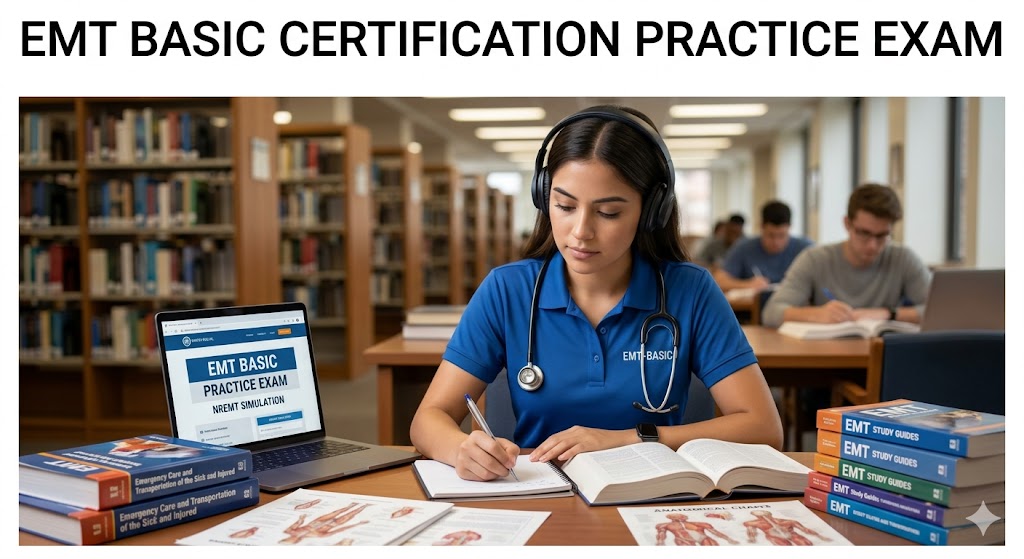
Additional Information
What the Course Entails and Exam Details
The EMT Basic course is a comprehensive program covering the fundamental knowledge and hands-on skills necessary to respond to medical emergencies. The syllabus typically aligns with the NREMT cognitive exam categories and psychomotor skill requirements. You will learn how to: Perform patient assessments (both medical and trauma). Maintain open airways and use advanced airway adjuncts (e.g., supraglottic airways). Provide positive pressure ventilation and administer oxygen therapy. Assess and manage cardiac arrest (including using an AED). Handle various medical emergencies (diabetic, respiratory, allergic reactions, poisonings). Treat trauma injuries (hemorrhage control, shock management, spinal immobilization, splinting). Care for obstetric and pediatric patients. Understand EMS operations, communication, documentation, and the legal and ethical responsibilities of an EMT.
What to Expect in the Final Exam
To earn your EMT Basic certification, you must pass both a cognitive exam and a psychomotor exam. The Cognitive Exam is a computer-adaptive test (CAT) administered by the NREMT. You will face between 70 and 120 questions that test your knowledge across the content areas mentioned in the course details. You will have a maximum of two hours to complete this part. The exam is dynamic; the difficulty of the questions changes based on your answers. You don't get a "score" in the traditional sense; you either pass or fail based on your ability to meet the standard. The Psychomotor Exam is the practical portion where you must demonstrate hands-on skills in a series of scenarios. These scenarios typically include patient assessment (trauma and medical), static skills (like spinal immobilization or splinting), and random skill stations (such as bleeding control/shock management or oxygen administration). You must pass all skill stations to pass the psychomotor exam. This part is typically organized by your training program or state EMS office.
How to Study and Exam Centers
Effective studying is crucial for success. Here’s how you can prepare: Utilize Your Course Materials: Review your EMT textbook, lecture notes, and any study guides provided by your training program. Take Practice Exams: The most critical step. Online practice exams simulate the NREMT format, helping you become familiar with the question style and manage your time. Look for practice exams that provide detailed explanations for correct and incorrect answers to understand the rationales. Focus on Key Concepts: Identify your weak areas from practice tests and re-study those sections thoroughly. Pay special attention to patient assessment flowcharts and trauma algorithms. Hands-on Practice: For the psychomotor exam, practice your skills with a partner until they are second nature. Memorize the steps and checklists for each skill station. The cognitive exam is administered through Pearson VUE test centers. You can schedule your exam on the NREMT website once you are approved to test. The psychomotor exam is scheduled through your EMS training program or your state’s EMS office. Check with them for specific dates and locations.
Job Opportunities from the Course
Achieving your EMT Basic certification is the key that opens the door to numerous career paths and advanced medical opportunities. Some of the specific jobs this certification unlocks include:
Emergency Medical Technician (Ambulance Service)
Firefighter (EMT certification is often required or preferred)
Paramedic (EMT-Basic is a prerequisite)
Hospital Emergency Department Technician
Flight EMT (Requires advanced training after experience)
Search and Rescue Team Member
Tactical EMS Medic (For law enforcement units)
Critical Care Transport EMT
Industrial or Commercial First Responder
Park Ranger (Often requires EMT certification)Here is the comprehensive, SEO-optimized study guide and practice exam for the EMT Basic Certification.
Frequently Asked Questions
Reviews
5.0
Based on 0 reviews
Leave a Review
No reviews yet. Be the first to review!