
Emergency Medical Technician (EMT) Intermediate Practice Exam
$69.00
- Buy to unlock unlimited access to all Quiz questions and Answers in this Quiz.
- After purchase you can print a PDF of the whole quiz at any point. The PDF will contain the questions and the correct answers.
About this Exam
The Emergency Medical Technician (EMT) Intermediate certification is a crucial stepping stone for pre-hospital care providers looking to advance their medical careers.
This qualification bridges the vital gap between Basic Life Support (BLS) and advanced Paramedic level care.
It is specifically designed for currently licensed EMT-Basics who want to expand their clinical capabilities and take on more critical responsibilities in emergency situations.
By mastering these advanced skills, you will be better equipped to provide life-saving interventions and comprehensive care when seconds matter most.
Ready to test your knowledge?
Buy Now to Access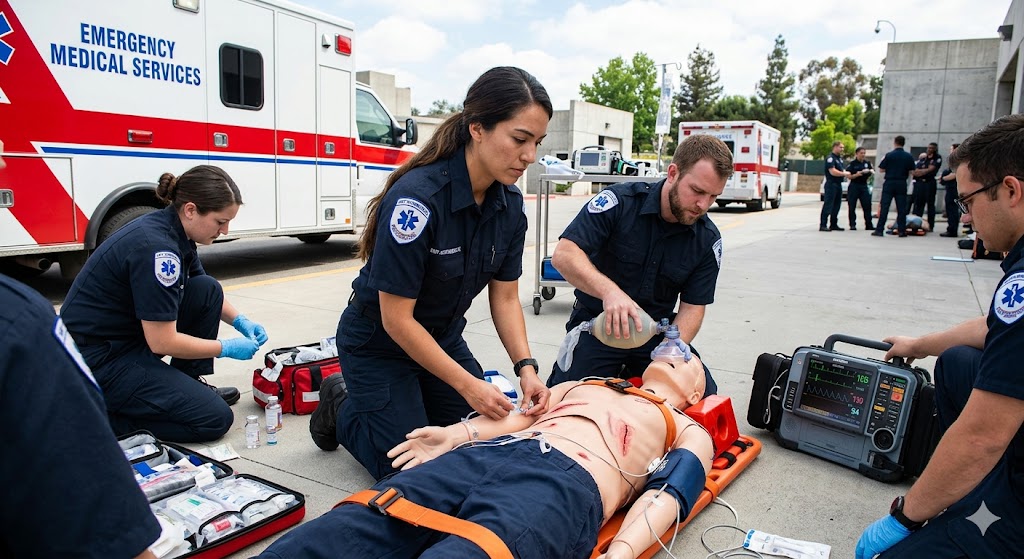
Additional Information
What the Course Entails and Exam Details
The EMT Intermediate curriculum is rigorous and builds heavily upon your foundational knowledge of emergency medical care.
Students will dive deep into advanced airway management techniques, including the use of supraglottic airways and basic endotracheal intubation.
A major component of the training involves intravenous (IV) therapy and intraosseous (IO) infusion, teaching you how to safely establish vascular access and administer life-saving fluids.
You will also learn advanced pharmacology, allowing you to confidently administer a wider range of medications during cardiac, respiratory, and diabetic emergencies.
Furthermore, the syllabus covers basic cardiac rhythm interpretation, enabling you to recognize and assist in treating life-threatening arrhythmias in the field.
What to Expect in the Final Exam
The final certification exam is designed to rigorously test both your theoretical knowledge and your practical, life-saving skills under pressure.
Typically, the exam is divided into two main sections: a computer-based cognitive (written) portion and a psychomotor (hands-on) skills assessment.
The cognitive exam is generally a multiple-choice test consisting of 100 to 135 questions, often with a strict time limit of about two hours.
You can expect challenging questions that require critical thinking and scenario-based problem-solving, rather than just simple vocabulary memorization.
To pass, candidates usually need to meet the standard passing competency determined by the National Registry (NREMT) or your specific state's EMS board.
How to Study and Exam Centers
Preparation is the key to success, and taking an EMT Intermediate practice exam is one of the most effective ways to familiarize yourself with the testing format.
Create a consistent study schedule that blends reading your primary textbook, utilizing flashcards for pharmacology, and taking timed practice tests to build your mental stamina.
For the psychomotor portion, regular hands-on practice with your medical equipment and running mock patient scenarios with your peers is absolutely essential.
When it comes time to test, the cognitive portion is typically administered at secure, third-party computer testing facilities such as Pearson VUE centers.
The psychomotor practical exams are usually hosted at authorized training schools, community colleges, or designated state emergency medical services testing sites.
Job Opportunities from the Course
Earning this advanced certification opens up a diverse array of exciting, fast-paced, and well-paying career paths in the medical field.
Here are some of the primary roles you can pursue once you secure your license:
Advanced Emergency Medical Technician (AEMT) for municipal or private ambulance services.
Emergency Room Technician assisting nurses and doctors in hospital settings.
Firefighter EMT-I responding to 911 medical calls for city fire departments.
Industrial Site Medic providing standby care for offshore rigs, mines, and large construction sites.
Flight Medic Assistant providing critical support for aeromedical helicopter transport teams.
Special Event Medical Responder coordinating care at large entertainment venues and sports arenas.
Frequently Asked Questions
Reviews
5.0
Based on 0 reviews
Leave a Review
No reviews yet. Be the first to review!