
Emergency Medical Technician (EMT) Practice Test
$69.00
- Buy to unlock unlimited access to all Quiz questions and Answers in this Quiz.
- After purchase you can print a PDF of the whole quiz at any point. The PDF will contain the questions and the correct answers.
About this Exam
The EMT Practice Exam is an invaluable resource for individuals aspiring to become Emergency Medical Technicians (EMTs) or for current EMTs looking to renew their certification. This guide is specifically designed to simulate the experience of the actual EMT national registry exam (NREMT) or equivalent state-level assessments, offering a critical milestone on the path to a rewarding career in emergency medical services. For candidates preparing for their initial certification, a practice test acts as a comprehensive check of their readiness and highlights areas that require focused study. Current EMTs can use these practice assessments to gauge their knowledge retention and ensure they remain sharp in critical procedures. Whether you're in the middle of your EMT training course or a seasoned professional brushing up, these practice exams serve as an essential tool to boost confidence, improve time management, and ultimately achieve success in your certification endeavors.
Ready to test your knowledge?
Buy Now to Access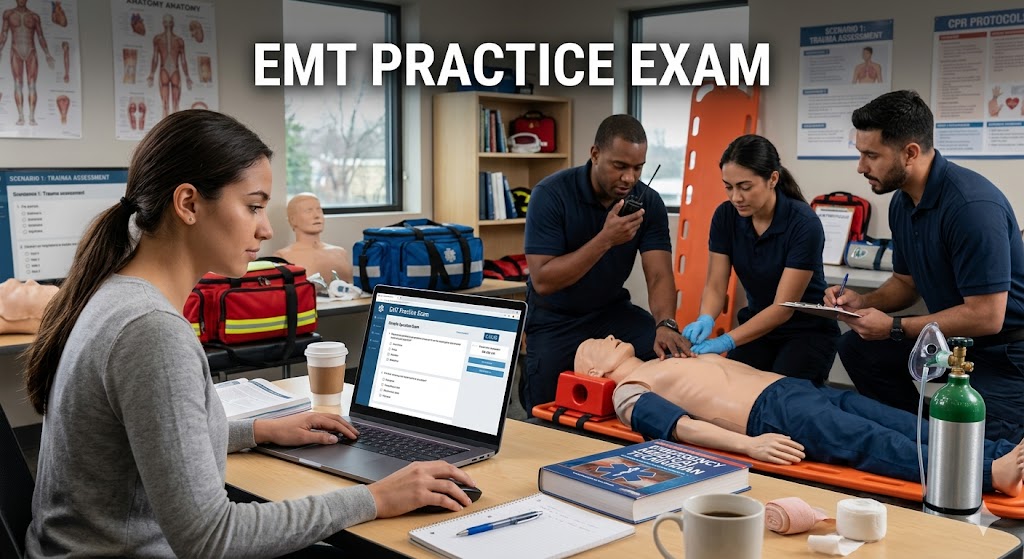
Additional Information
What the Course Entails and Exam Details
A comprehensive EMT course covers a wide range of essential life-saving skills and theoretical knowledge across several key modules. These typically include:
Airway Management & Oxygenation: Mastering techniques to maintain open airways, provide artificial ventilation (e.g., using a bag-valve mask), and administer supplemental oxygen.
Patient Assessment: Learning standardized protocols for systematic evaluation of patients, including both primary (immediate threats) and secondary (detailed medical history and physical) assessments.
Medical Emergencies: Understanding the signs, symptoms, and appropriate responses for various conditions, such as cardiac arrest, respiratory distress, shock, allergic reactions, diabetes, strokes, and seizures.
Trauma: Gaining proficiency in managing injuries resulting from physical forces, including wound care, bleeding control, bone fracture stabilization, spinal immobilization, and burn management.
Special Populations: Learning to recognize and respond to the unique needs of different age groups, such as pediatric and geriatric patients, as well as handling obstetric situations and childbirth.
EMS Operations: Understanding ambulance operations, radio communications, documentation procedures, hazardous materials awareness, and mass casualty incident management.
Pharmacology Basics: Reviewing the actions, indications, dosages, and contraindications of medications that EMTs are authorized to administer or assist with.
Successful completion of an accredited EMT training program is typically required before a candidate can sit for the official cognitive and psychomotor certification exams. The practice test, however, is open to anyone studying or wishing to assess their current level of EMT knowledge. The detailed breakdown of topics and their weighting can vary slightly by organization or jurisdiction, but generally follows standard EMS curricula.
What to Expect in the Final Exam
For those preparing for the NREMT, the final evaluation involves a two-part process. The cognitive exam is a computer-adaptive test (CAT) featuring dynamic question delivery, meaning the difficulty of subsequent questions is adjusted based on your answers. It contains a range of multiple-choice questions (typically 70 to 120), focusing on fundamental knowledge and critical decision-making skills. The score you receive is a scaled score rather than a simple raw percentage, with a minimum passing requirement set to demonstrate entry-level competency. The exact passing score can shift but is designed to reflect consistent knowledge across all tested areas. The time limit for this portion is often around two to three hours, requiring efficient management to complete all questions within the allowed timeframe.
The second part is the psychomotor exam, which assesses your hands-on ability to perform essential EMT skills in various simulated scenarios. These are practical, skill-station-based assessments where evaluators observe and grade your performance using standardized skill sheets. Common stations include patient assessment (trauma and medical), spinal immobilization, cardiac arrest management, airway maintenance, and other core skills. You must successfully pass each individual skill station to achieve overall certification. Rules during the exams are typically strict, requiring proper identification, limiting the use of electronic devices, and ensuring testing integrity. Practice tests help you prepare for the format and pressure of the computer-based cognitive exam specifically, enhancing your performance readiness for this critical component.
How to Study and Exam Centers
Preparation for the EMT exam requires a strategic blend of knowledge acquisition and practical application. Utilizing reliable EMT-specific study guides, textbooks (such as the Emergency Care series), and online resources is fundamental. A key strategy is to integrate regular EMT Practice Tests into your study routine, as this helps you become familiar with the multiple-choice format, identify weak subject areas, and develop vital time-management skills. Focus your efforts on understanding patient assessment algorithms, pathophysiology, standard protocols, and medical terminology. Consider creating flashcards, joining study groups to discuss complex scenarios, and explaining concepts to others to solidify your understanding. It is also crucial to dedicate sufficient time to practicing the hands-on skills required for the psychomotor exam with a partner or training manikins.
To take the official cognitive exam, you must register with the relevant certifying body, such as the NREMT (National Registry of Emergency Medical Technicians), or through your state’s EMS office. Registration typically involves creating an account, paying an exam fee, and then scheduling a testing appointment at an authorized computer-based testing facility, often Pearson VUE testing centers or other proctored test sites. The psychomotor exam is usually organized by state EMS agencies or approved EMT training institutions at specific, designated locations. When scheduling and attending, remember to review all requirements regarding acceptable identification and testing center protocols.
Job Opportunities from the Course
Earning your EMT certification unlocks numerous rewarding career opportunities in pre-hospital emergency care and related fields. Some of the potential job titles and career paths include:
Emergency Medical Technician (EMT - Basic/Advanced): Providing front-line emergency care and transport to patients.
Firefighter/EMT: Combining firefighting duties with essential medical response in many fire departments.
Paramedic (requires additional training): Advancing to a higher level of medical care after gaining EMT experience.
Wildland Firefighter/EMT: Applying medical expertise in remote and wilderness environments.
Police Officer (with EMT training): Utilizing medical skills to assist in various law enforcement and public safety roles.
Hospital Emergency Department Technician: Working within hospital emergency rooms to support medical teams.
Search and Rescue (SAR) Technician: Providing medical aid as part of specialized rescue operations.
Transport EMT/Ambulance Attendant: Focuses on patient care during non-emergency and critical care inter-facility transports.
Flight EMT (often leads to Paramedic): Gaining experience for potential roles in helicopter or fixed-wing air ambulance services.
Correctional Facility EMT: Providing medical care within prisons and detention centers.
Offshore/Remote Medic (requires experience): Offering medical services in industrial or remote settings, like oil rigs or construction sites.
Event Medic: Working at concerts, sporting events, festivals, and large public gatherings.
Tactical EMS (TEMS) Provider: Providing medical support during specialized law enforcement or military operations (often after advanced training).
Healthcare Administrator/Instructor: Moving into management, education, or quality improvement within the EMS system.
Frequently Asked Questions
Reviews
5.0
Based on 0 reviews
Leave a Review
No reviews yet. Be the first to review!