
Emergency Medical Technician (EMT) Section 1 Practice Exam
$69.00
- Buy to unlock unlimited access to all Quiz questions and Answers in this Quiz.
- After purchase you can print a PDF of the whole quiz at any point. The PDF will contain the questions and the correct answers.
About this Exam
The Emergency Medical Technician (EMT) certification is the foundational level of licensure for emergency medical services (EMS) personnel in the United States. It is designed for individuals who aspire to work as first responders, providing critical, life-saving care to patients in the pre-hospital setting. The EMT Section 1 Practice Exam serves as a vital first step in a student’s preparation journey, focusing on the core, foundational knowledge required before advancing to more complex medical and trauma scenarios. This practice exam is specifically designed to assess a candidate’s understanding of the basic concepts of EMS systems, safety, airway management, and the fundamentals of patient assessment.
Ready to test your knowledge?
Buy Now to Access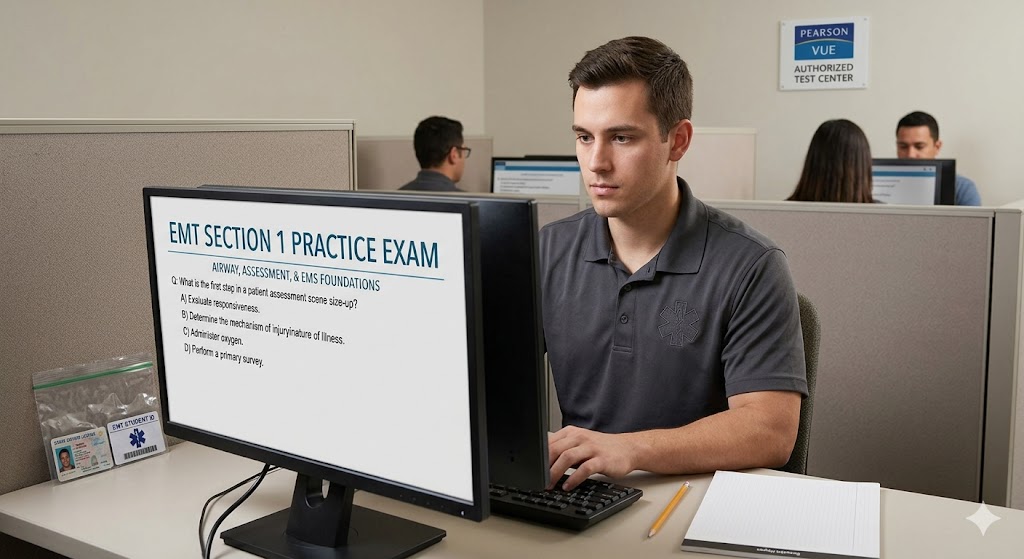
Additional Information
What the Course Entails and Exam Details
To prepare for the full NREMT certification, candidates must first complete a state-approved EMT course. While a "Section 1 Practice Exam" is often part of a preparatory curriculum, the comprehensive NREMT cognitive exam covers five primary content areas across the lifespan of a patient (adult and pediatric). The core knowledge assessed in early preparation includes:
EMS Systems and Operations: Understanding the roles and responsibilities of an EMT, medical direction, quality improvement, and the history of EMS.
Workforce Safety and Wellness: Proper body mechanics, stress management, scene safety, personal protective equipment (PPE), and standard precautions.
Medical, Legal, and Ethical Issues: Consent, refusal of care, confidentiality (HIPAA), scope of practice, negligence, and mandatory reporting.
Airway Management, Respiration, and Artificial Ventilation: The most critical aspect of BLS, including anatomy, airway opening maneuvers (head-tilt/chin-lift, jaw-thrust), suctioning, and basic adjuncts (OPA/NPA).
Patient Assessment: The structured process of scene size-up, primary survey, history taking (SAMPLE/OPQRST), secondary assessment, and reassessment.
A foundational "Section 1" practice test would typically pull questions from these areas to ensure a student has mastered the prerequisites for more advanced cardiac and trauma modules.
What to Expect in the Final Exam
To become a nationally certified EMT, you must successfully pass two components: the NREMT Cognitive Exam and a state-approved Psychomotor (practical) Exam. This guide focuses on the cognitive aspect.
The cognitive exam is a computer-adaptive test (CAT). This means the test adapts to your performance; if you answer a question correctly, the next one is slightly more difficult, and if you answer incorrectly, the next is easier.
Format: Multiple-choice questions.
Number of Questions: 70 to 120 (10 of which are unscored "pretest" questions).
Time Limit: 2 hours.
Passing Score: There is no fixed percentage to pass. The exam continues until the computer is 95% confident that your ability is either above or below the entry-level competency standard.
Rules: You must bring two forms of valid, government-issued identification to the testing center. No external materials or electronic devices are permitted during the test.
How to Study and Exam Centers
Preparation for the NREMT requires a dedicated study plan combining content review with active practice.
Actionable Study Strategies:
Master Your Textbook: Do not rely solely on practice questions. Read and outline your main EMT textbook (e.g., AAOS "Emergency Care and Transportation of the Sick and Injured") completely.
Use Practice Exams Strategically: Take full-length, timed EMT Section 1 Practice Exams to assess your knowledge base early. Analyze your results, focusing not just on what you got wrong, but why. Use them to identify weak content areas for targeted review.
Flashcards for Rote Memorization: Create or use digital flashcards (like Quizlet) for anatomy, medical terminology, acronyms (SAMPLE, OPQRST, DCAP-BTLS), and drug dosages within your scope.
Simulate Patient Scenarios: Practice assessment flow verbally. Recite the steps of a scene size-up and primary survey until they are second nature.
Exam Centers:
You do not take the cognitive exam through your EMT school. The National Registry (NREMT) utilizes Pearson VUE testing centers for all cognitive examinations.
How to Take It: Once you have completed your course and your program director has verified your eligibility on NREMT.org, you will receive an Authorization to Test (ATT) letter. You must then log into the Pearson VUE website to schedule your exam at a convenient location and time. Pearson VUE has hundreds of authorized testing centers across the country.
Job Opportunities from the Course
Earning your EMT certification is a direct pathway to a rewarding career dedicated to helping others in times of crisis. It unlocks a wide range of employment opportunities across public safety, private industry, and clinical settings.
Specific job titles and career paths enabled by this certification include:
Ambulance EMT: Providing emergency transport and basic life support for private ambulance services or municipal EMS agencies.
Firefighter/EMT: Many fire departments require applicants to be certified EMTs, with the dual role of fire suppression and emergency medical response.
Emergency Room Technician: Working in hospital emergency departments alongside nurses and doctors to assist with patient care.
Industrial EMT: Providing on-site medical coverage for large industrial sites, construction projects, or remote work environments.
Tactical EMT (with additional training): Working with law enforcement special response teams (SWAT).
Flight EMT (with experience): Providing medical care on helicopter or fixed-wing air ambulance services.
Event Medic: Providing medical standby services at concerts, sporting events, and festivals.
Wildland Fireface EMT: Providing medical support for crews fighting forest fires.
Police Officer/EMT: Some departments utilize cross-trained officers for initial medical response.
Frequently Asked Questions
Reviews
5.0
Based on 0 reviews
Leave a Review
No reviews yet. Be the first to review!