
Emergency Medical Technician (EMT) Trauma Practice Test
$69.00
- Buy to unlock unlimited access to all Quiz questions and Answers in this Quiz.
- After purchase you can print a PDF of the whole quiz at any point. The PDF will contain the questions and the correct answers.
About this Exam
An Emergency Medical Technician (EMT) certification is a vital credential for anyone wishing to provide immediate medical attention to victims of emergencies, accidents, and illnesses. EMTs are often the first healthcare professionals to arrive at the scene of a crisis. Mastering the trauma portion of the EMT course is crucial, as it prepares students to assess and manage severe injuries, such as from motor vehicle collisions, falls, and violence. This [EMT Trauma Practice Test] is designed specifically as a comprehensive study tool to help you validate your knowledge, identify areas needing more focus, and build the critical confidence required to succeed on both the cognitive and psychomotor parts of your formal EMT certification exam. Whether you are currently in an EMT program or preparing for re-certification, this practice test is a must-have resource.
Ready to test your knowledge?
Buy Now to Access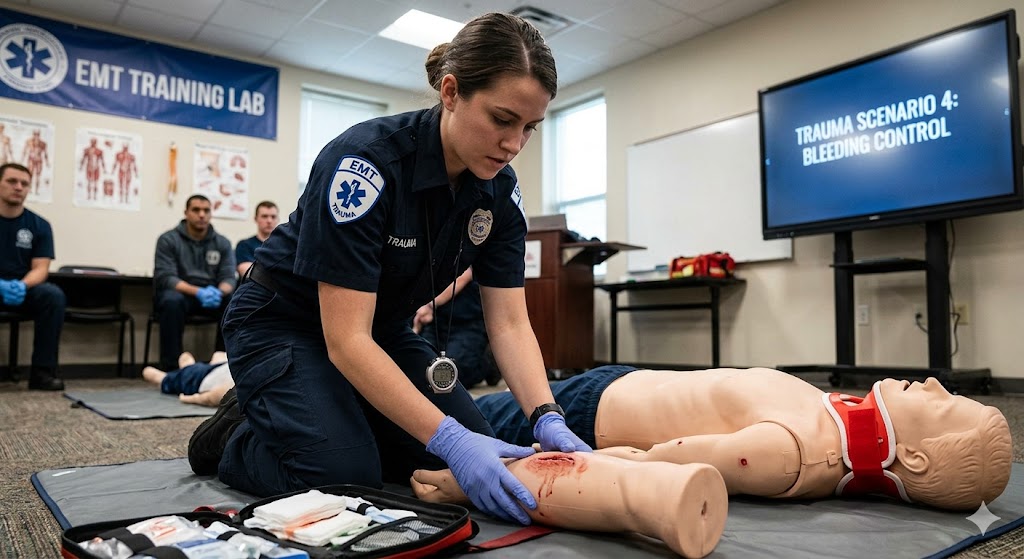
Additional Information
What the Course Entails and Exam Details
A standard EMT training program provides intensive instruction and hands-on practice in many critical areas, with a significant emphasis on trauma care. The full course will cover topics such as patient assessment (both medical and trauma), airway management, ventilation, cardiac care, shock and bleeding control, soft tissue injuries, musculoskeletal injuries, head and spinal injuries, and care for special populations. The dedicated trauma sections typically involve understanding different mechanisms of injury (MOI), rapid patient assessment techniques (the primary and secondary survey), and specific intervention strategies for stabilizing life-threatening trauma before transport.
When you sit for your formal certification exam, which is often administered by the National Registry of Emergency Medical Technicians (NREMT) or a state-specific licensing board, the trauma module will test your theoretical understanding and practical application of these skills. You will be expected to demonstrate a swift, systematic approach to a patient with a traumatic injury, including managing the scene, assessing responsiveness, ensuring spinal protection, opening an airway, controlling major bleeding, and providing appropriate treatment for shock. Mastering the content tested in this practice exam will prepare you for these requirements.
What to Expect in the Final Exam
The formal certification process generally consists of two main components: a cognitive exam and a psychomotor exam. The cognitive portion is a computer-adaptive test that typically covers the full spectrum of EMT knowledge, including a substantial number of questions focused purely on trauma scenarios. You should expect multiple-choice questions that require you to apply your knowledge to make clinical decisions about patient care. The level of difficulty adjusts based on your performance as you proceed through the test. The scoring structure is designed to measure your competency, and you will receive notification of whether you have achieved a passing score based on predefined standards. There is a time limit for the cognitive exam, often around 2 hours, which you must manage effectively.
The psychomotor exam is a series of practical stations where you will be asked to demonstrate hands-on skills in front of evaluators. You will encounter several "skills stations," which may include patient assessment for a trauma scenario. In this station, you will be expected to correctly verbalize and perform a primary survey, manage immediate life threats, and conduct a detailed physical exam and secondary assessment on a simulated patient, showing your ability to work quickly and logically under pressure. This practice test helps you prepare for both by testing your underlying knowledge of trauma protocols and assessment sequences. Strict rules are in place for both parts of the exam to ensure a fair and consistent assessment of every candidate.
How to Study and Exam Centers
Effective studying is key to passing your EMT certification. Begin by creating a structured study schedule that allocates ample time for reviewing all topics, especially focusing on the areas highlighted as weaknesses in this practice test. Utilize your official EMT textbook (such as the AAOS Emergency Care and Transportation of the Sick and Injured) as your primary source. Supplement your learning with flashcards (for acronyms, medication dosages, and key signs/symptoms) and various other study aids like mobile apps or online video tutorials. Formation of study groups with classmates can also be highly beneficial, allowing for collaborative learning and practical skill practice. Review wrong answers on this [EMT Trauma Practice Test] thoroughly to understand the "why" behind the correct response, which will prevent you from making the same mistake again.
For the psychomotor exam, nothing beats hands-on repetition. Practice every skill station repeatedly until it becomes muscle memory. For trauma assessment, visualize and verbalize your approach, starting with scene size-up and proceeding through the whole process. Ensure you are working within the official skill sheets provided by your program or the NREMT. While this specific practice test is taken as a digital study tool, you will register for your official NREMT cognitive exam through the NREMT website and schedule it to be taken at a Pearson VUE testing center. Psychomotor exams are often hosted by local EMT training schools, community colleges, or fire departments. You should check with your program coordinator or your state's EMS office for specific details about official psychomotor exam locations and times.
Job Opportunities from the Course
Earning your EMT certification (often enabled by strong performance on the trauma portion and other key areas) unlocks a wide range of career opportunities in the dynamic field of pre-hospital emergency care. Here are some of the job titles and environments where your certification will be valuable:
Emergency Medical Technician (EMT) on an Ambulance Crew
Firefighter/EMT (often a combined role)
Emergency Room Technician (ER Tech) / Emergency Department Tech
Search and Rescue Team Member
Industrial Safety Officer / Site Medic
Medical Transport Specialist (for non-emergency patient movement)
EMS Instructor or Evaluator (after gaining experience)
Dispatch Operator (knowledge of medical protocols is an asset)
Flight Medic (requires advanced training and experience)
Offshore Medic
Police Medic / Tactical EMT (after specialized law enforcement training)
Hospital Assistant
Frequently Asked Questions
Reviews
5.0
Based on 0 reviews
Leave a Review
No reviews yet. Be the first to review!