
Emergency Medical Technicians (EMT) National Registry Practice Exam
$69.00
- Buy to unlock unlimited access to all Quiz questions and Answers in this Quiz.
- After purchase you can print a PDF of the whole quiz at any point. The PDF will contain the questions and the correct answers.
About this Exam
The Emergency Medical Technician (EMT) certification is the cornerstone for individuals seeking to work in the field of emergency medical services (EMS). This certification equips you with the essential knowledge and skills to provide life-saving care to patients experiencing medical emergencies, trauma, and other critical situations. The EMT National Registry Exam is the standardized test that verifies your competence and readiness to serve as a vital part of the emergency healthcare team. If you're passionate about helping others and desire a challenging yet fulfilling career on the frontlines of healthcare, this certification is for you.
Ready to test your knowledge?
Buy Now to Access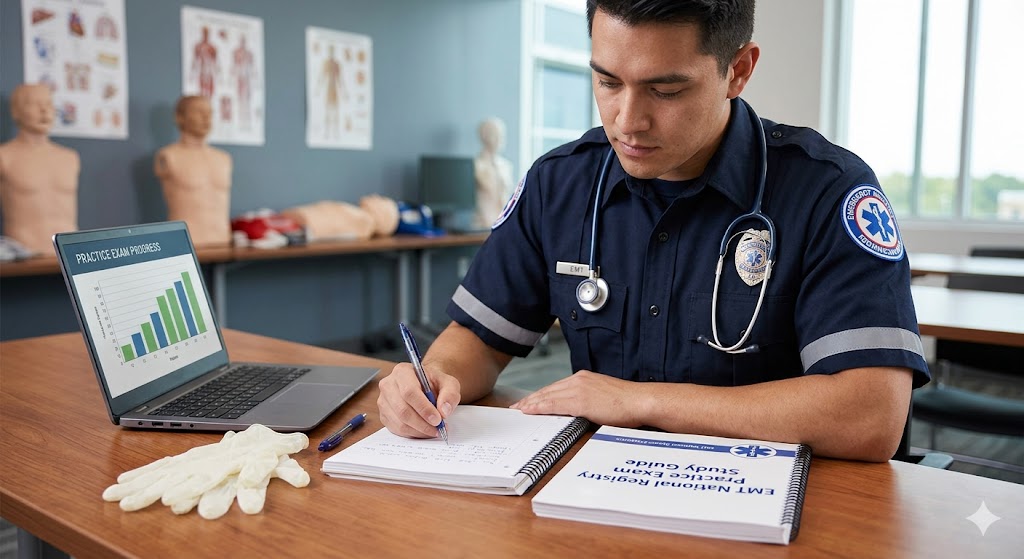
Additional Information
What the Course Entails and Exam Details
Before tackling the NREMT exam, you must successfully complete an accredited EMT training course. These courses, typically spanning several months, cover a comprehensive curriculum that blends theoretical knowledge with hands-on skill development. You'll delve into topics like:
Patient Assessment: Learning systematic methods to evaluate patients, identify life-threatening conditions, and prioritize treatment.
Airway Management: Mastering techniques to maintain open airways, provide ventilations, and manage respiratory emergencies.
Cardiology: Understanding the fundamentals of the cardiovascular system, recognizing cardiac conditions, and performing CPR.
Trauma: Acquiring skills to assess and manage various traumatic injuries, from simple fractures to life-threatening hemorrhage.
Medical Emergencies: Learning to recognize and treat a wide range of medical conditions, including seizures, allergic reactions, and poisoning.
Obstetrics and Pediatrics: Understanding the unique challenges and interventions required when caring for pregnant patients and children.
EMS Operations: Gaining knowledge about EMS systems, communications, safety protocols, and ethical considerations.
What to Expect in the Final Exam
The EMT National Registry Practice Exam is designed to simulate the actual cognitive and psychomotor examinations you'll face. The cognitive exam is a computer-adaptive test (CAT) featuring multiple-choice questions. This means the difficulty level of the questions adjusts based on your answers. The exam typically consists of 70 to 120 questions and covers five primary areas:
Airway, Respiration, & Ventilation: 18%-22%
Cardiology & Resuscitation: 20%-24%
Trauma: 14%-18%
Medical; Obstetrics & Gynecology: 27%-31%
EMS Operations: 10%-14%
You will have 2 hours and 30 minutes to complete the cognitive exam. A passing score is dynamic and depends on the specific form of the exam you receive, but you must demonstrate competency in all content areas.
The practical component of the exam, the Psychomotor Exam, evaluates your hands-on skills in various scenarios. This may include stations on patient assessment, airway management, spinal immobilization, and medication administration.
How to Study and Exam Centers
Preparation is key to success on the NREMT exam. Here are some effective study strategies:
Master the Textbook: Thoroughly review your EMT textbook and supplementary materials.
Take Practice Exams: Utilize reliable EMT National Registry Practice Exams to familiarize yourself with the question format, identify areas of weakness, and track your progress.
Form a Study Group: Collaborate with peers to discuss complex concepts, review scenarios, and test each other's knowledge.
Focus on Key Concepts: Prioritize understanding core EMT principles rather than just memorizing facts.
Practice Practical Skills: Dedicate time to perfecting your hands-on skills through simulation and practice.
Seek Guidance: Consult with your instructors or experienced EMTs for advice and support.
The actual NREMT cognitive exam is administered through Pearson VUE testing centers worldwide. You can schedule your exam appointment online through the Pearson VUE website once you've completed your training and met all eligibility requirements. The psychomotor exam is typically coordinated through your state EMS office or authorized training program.
Job Opportunities from the Course
Earning your EMT certification opens doors to diverse and exciting career opportunities in the EMS field. Here are some common job paths:
Emergency Medical Technician (EMT): The primary role, providing pre-hospital care on ambulances, fire departments, and other emergency response agencies.
Firefighter/EMT: Many fire departments require firefighters to be certified EMTs, enabling them to provide both fire suppression and emergency medical services.
Paramedic: With further training and experience, EMTs can advance to the role of a Paramedic, capable of providing advanced life support interventions.
Dispatcher: EMT training provides a valuable foundation for individuals working in emergency dispatch centers, coordinating the response of emergency personnel.
Flight EMT: In some settings, EMTs can specialize in transporting critically ill or injured patients via helicopter or fixed-wing aircraft.
Industrial EMT: Working in specialized settings like construction sites, oil rigs, or theme parks to provide emergency care to employees and visitors.
Event Medical Services: Providing medical standby coverage for concerts, sporting events, and other large gatherings.
Frequently Asked Questions
Reviews
5.0
Based on 0 reviews
Leave a Review
No reviews yet. Be the first to review!