
Emergency Nurse Practitioner (ENP) Practice Test
$69.00
- Buy to unlock unlimited access to all Quiz questions and Answers in this Quiz.
- After purchase you can print a PDF of the whole quiz at any point. The PDF will contain the questions and the correct answers.
About this Exam
The Emergency Nurse Practitioner (ENP) certification is a prestigious, competency-based credential designed for certified Family Nurse Practitioners (FNPs) who have specialized education and extensive practice experience in the high-acuity environment of emergency care. This certification, recognized by the American Academy of Nurse Practitioners Certification Board (AANPCB), validates your expert knowledge, clinical decision-making skills, and ability to manage acute conditions across the lifespan in emergency settings. Earning this designation signals to employers and colleagues that you are prepared to deliver high-quality, efficient, and compassionate care, triaging and managing everything from acute myocardial infarctions to intricate pediatric procedural sedations with confidence.
Ready to test your knowledge?
Buy Now to Access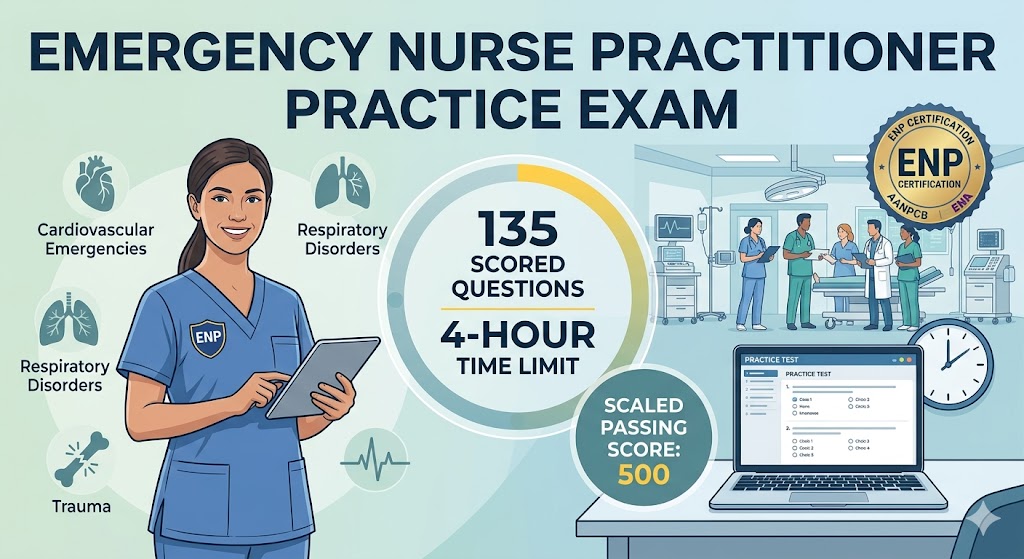
Additional Information
What the Course Entails and Exam Details
The ENP exam is not a course but a comprehensive validation of your existing expert knowledge. While you do not take a 'course' to sit for the exam, your preparation should align with the official exam blueprint. The examination covers five primary clinical domains that define the scope of ENP practice:
Domain I: Medical Screening (16%) – This includes performing focused history and physical exams, establishing patient acuity, and identifying patients requiring immediate intervention.
Domain II: Medical Decision Making/Differential Diagnosis (24%) – This area focuses on identifying and prioritizing differential diagnoses, assessing the risk of morbidity and mortality, and evaluating diagnostic studies.
Domain III: Patient Management (36%) – This is the largest section, testing your ability to rapidly resuscitate and stabilize patients, prescribe pharmacologic agents, perform necessary diagnostic and therapeutic procedures, and initiate non-pharmacologic therapies.
Domain IV: Transitions of Care (16%) – This section covers patient disposition, including admission, discharge, transfer, and ensuring appropriate follow-up care.
Domain V: Professional Practices (8%) – This tests your understanding of legal, ethical, and regulatory issues, such as EMTALA, quality improvement, and cultural competence in the emergency department.
Your knowledge will be tested on a wide range of patient conditions, with major emphasis on cardiovascular (11%), abdominal and gastrointestinal (13%), musculoskeletal (7%), thoracic-respiratory (10%), traumatic (8%), and neurological (6%) disorders.
What to Expect in the Final Exam
The final ENP certification exam is a rigorous, computer-based test that requires stamina and sharp critical thinking. You should prepare for the following format and rules:
Question Count: The exam consists of 150 multiple-choice questions.
Scored Items: Your final score is determined solely by 135 scored questions. The remaining 15 are unscored "pretest" items used for statistical analysis and are indistinguishable from the scored items.
Time Limit: You will have exactly four (4) hours to complete the examination.
Passing Score: Success is achieved by earning a scaled score of 500 or higher on a range that spans from 200 to 800.
Rules and Structure: The test is highly scenario-based, mimicking real clinical encounters. Candidates often take an optional break at the midpoint to maintain focus. A successful strategy involves maintaining a pace of approximately 90 seconds per question, flagging difficult questions to return to them later.
How to Study and Exam Centers
Preparation for the ENP exam must be strategic and structured. Here are actionable study methods:
Download the Official Blueprint: Your absolute first step must be downloading the current AANPCB ENP Test Content Outline to understand the exact breakdown of topics.
Self-Rate and Prioritize: Honestly self-rate your confidence in each domain. Create a study schedule that dedicates 80% of your time to your weakest areas, using the remaining 20% to reinforce your strengths.
Utilize High-Quality Q-Banks: Invest in a specialized ENP question bank, such as BoardVitals, and practice in timed mode to simulate exam pressure and review rationales for both correct and incorrect answers.
Take a Review Course: Many candidates benefit from structured content refreshers, such as the live or home-study courses offered by Barkley & Associates.
Review Core Curriculum: Revisit fundamental resources like the ENA's Emergency Core Curriculum, ACLS, and PALS guidelines, and use apps like ECG Weekly to sharpen your interpretation of complex arrhythmias.
Regarding exam locations, the AANPCB ENP exam is administered via a computer-based format at Prometric testing centers globally. These professional centers offer appointments Monday through Saturday year-round, allowing you maximum flexibility. Once your application is approved, you will be given a 120-day window to schedule your testing appointment.
Job Opportunities from the Course
Earning your ENP certification makes you highly competitive and opens diverse career paths in the acute care continuum. The specific job titles and practice settings available to a certified Emergency Nurse Practitioner include:
Emergency Nurse Practitioner (ENP)
Urgent Care Nurse Practitioner
Trauma Nurse Practitioner
Critical Access Hospital Nurse Practitioner
Emergency Department Provider
Pediatric Emergency Nurse Practitioner
Emergency Medicine Fellowship Graduate
Frequently Asked Questions
Reviews
5.0
Based on 0 reviews
Leave a Review
No reviews yet. Be the first to review!