
Emergency Operations Center (EOC) Practice Exam
$69.00
- Buy to unlock unlimited access to all Quiz questions and Answers in this Quiz.
- After purchase you can print a PDF of the whole quiz at any point. The PDF will contain the questions and the correct answers.
About this Exam
Welcome to your comprehensive study guide for the Emergency Operations Center (EOC) Practice Exam. This guide is meticulously crafted for professionals and aspiring individuals in the fields of emergency management, first response, public safety, and governmental coordination. The actual EOC certification or relevant training programs are designed to validate your capability to effectively plan for, manage, and coordinate a diverse range of incidents and disasters within an EOC environment. An Emergency Operations Center serves as the central coordination hub during a crisis, bringing together various agencies and resources to ensure an efficient and effective response. This practice exam is your essential tool to simulate the official testing experience, identify your knowledge gaps, and build the confidence needed to succeed. Whether you are a local official, a paramedic, a fire chief, or a dedicated emergency planner, this guide and the accompanying practice exam will prepare you for the challenges ahead.
Ready to test your knowledge?
Buy Now to Access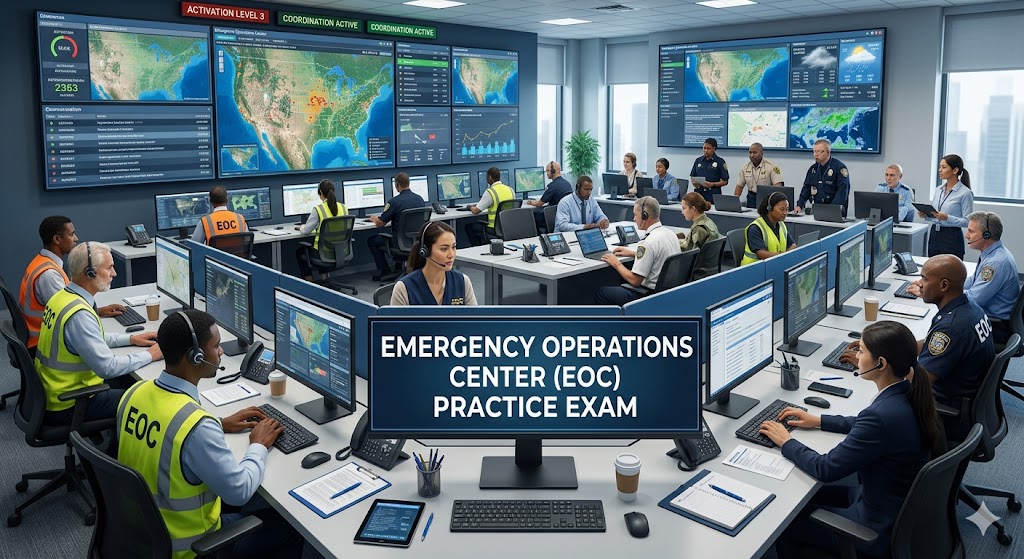
Additional Information
What the Course Entails and Exam Details
Relevant training courses provide a comprehensive overview of EOC operations, typically covering:
NIMS & ICS Integration: Understanding how EOC functions align with the National Incident Management System and Incident Command System.
EOC Roles and Organization: Detail on staffing, leadership structures, and functional sections (Planning, Operations, Logistics, Finance/Admin).
Activation & Deactivation: Procedures for opening, scaling up, and closing an EOC.
Information Management: Methods for gathering, analyzing, and disseminating critical incident data and maintaining situational awareness.
Resource Management: Coordination of personnel, equipment, and supplies across multiple agencies.
Communication & Technology: Utilization of communication systems and common EOC management software (e.g., WebEOC).
Multi-Agency Coordination (MAC): Principles of collaboration and decision-making among diverse stakeholders.
Courses range from foundational, self-paced online modules of a few hours to multi-day, intensive in-person training involving realistic simulation exercises. The official exam content will directly reflect these syllabus topics.
What to Expect in the Final Exam
While specifics vary by certifying body and course, you can generally anticipate the following for EOC-related foundational exams, particularly online versions:
Format: Predominantly multiple-choice questions assessing knowledge of terminology, concepts, and procedural application. Some exams may include scenario-based questions.
Passing Score: Typically around 75% or higher is required to successfully pass and receive certification.
Time Limits: Online foundational exams are often self-paced, allowing reasonable time for completion. However, proctored or more advanced certification exams may have strict time constraints.
Rules: For many online, foundational courses, exams are open-book, permitting reference to course materials. Scrambled question order is common to protect test integrity. Always review the specific instructions provided for your particular exam.
How to Study and Exam Centers
Effective preparation involves more than just a quick review. Implement these strategies:
Master the Course Materials: Deeply engage with all lectures, study guides, textbooks, and interactive elements from your training provider. Take detailed notes.
Utilize Practice Exams: Actively seek out and complete "EOC Operations Practice Exams" and question banks like this one. Treat these as diagnostic tools to identify knowledge gaps and reinforce your learning. Understand why answers are correct or incorrect.
Focus on Key Concepts: Pay particular attention to fundamental principles of NIMS, ICS, EOC functions, information flow, and resource allocation. Flashcards can be helpful for memorizing terms and acronyms.
Apply Scenarios: Practice applying your knowledge to hypothetical emergency situations. Consider how you would respond to specific challenges within the EOC framework.
Review Prerequisites: Ensure you have a solid grasp of any prerequisite knowledge, such as basic NIMS/ICS courses.
To take the actual official exam:
Online Portals: Many foundational exams, like those for FEMA Independent Study courses, are taken directly through the official online portal upon course completion.
Authorized Centers & Platforms: For state-level or specialized training, you may need to access a specific learning management system, visit an authorized physical testing center, or complete the exam as part of an in-person training workshop. Your course provider will supply detailed instructions on where and how to test.
Job Opportunities from the Course
Achieving an EOC-related certification significantly strengthens your candidacy for various positions across the public and private sectors. Explore these promising career paths and job titles:
Emergency Management Director / Coordinator
EOC Manager / Supervisor
EOC Operations Specialist
EOC Communications Specialist
Planning Section Chief (EOC)
Logistics Section Chief (EOC)
Operations Section Chief (EOC)
Finance & Administration Section Chief (EOC)
Public Information Officer (EOC)
Government Liaison Officer
Business Continuity Manager
Disaster Recovery Specialist
Safety & Security Manager (for large organizations/events)
Frequently Asked Questions
Reviews
5.0
Based on 0 reviews
Leave a Review
No reviews yet. Be the first to review!