
Emergency Response Guidebook (ERG) Practice Test
$69.00
- Buy to unlock unlimited access to all Quiz questions and Answers in this Quiz.
- After purchase you can print a PDF of the whole quiz at any point. The PDF will contain the questions and the correct answers.
About this Exam
Welcome to your comprehensive study guide for the Emergency Response Guidebook (ERG) Practice Test. This assessment is not for a standalone certification, but rather a critical component within broader hazardous materials (Hazmat) training programs. It is designed to verify that personnel who are likely to be first on the scene of a transportation incident involving dangerous goods can quickly and accurately use the primary tool available to them: the Emergency Response Guidebook.
This practice exam is essential for anyone pursuing a career as a firefighter, law enforcement officer, emergency medical technician (EMT), paramedic, or even commercial truck driver seeking a Hazmat endorsement. If your job description involves responding to, or working in close proximity to, the transportation of hazardous materials, mastering the ERG is a mandatory, life-saving skill. This guide will provide you with the strategies and knowledge to approach your final assessment with confidence.
Ready to test your knowledge?
Buy Now to Access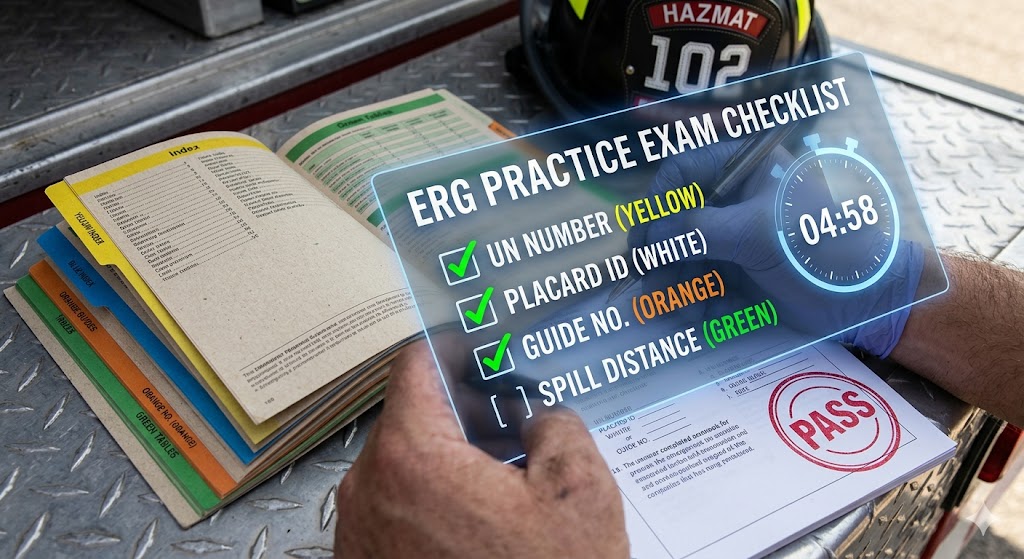
Additional Information
What the Course Entails and Exam Details
The training leading up to this practice test focuses entirely on the architecture, navigation, and application of the current Emergency Response Guidebook. The primary goal is to teach you how to extract vital information in seconds during the initial, chaotic phase of a hazmat incident. The course does not teach you how to become a full Hazmat Technician, but rather how to initiate safe defensive actions to protect yourself and the public.
Core topics and syllabus elements include:
ERG Layout and Architecture: Understanding the distinct purpose of each color-coded section: White, Yellow, Blue, Orange, and Green pages.
Identification Methods: Learning the four ways to identify a hazardous material: using the 4-digit UN/NA ID number, the material name, the placard, or a railcar/trailer silhouette.
Navigating to the Right Guide: Transitioning from the Yellow (ID number) or Blue (name) index to the critical Orange-bordered "Guides."
Implementing Protective Actions: Utilizing the Orange guides for initial response and the Green-bordered tables to determine precise Isolation and Protective Action Distances for spills.
Hazard Classes and Division: Mastering the nine Department of Transportation (DOT) hazard classes and their corresponding placards.
Safety and Isolation: Understanding the hierarchy of controls and prioritizing responder safety above all else during an initial response.
What to Expect in the Final Exam
While there is no universal "official" ERG exam, training providers (such as state fire academies, authorized online schools, or OSHA-compliant training firms) use a standardized assessment model. The practice test you are preparing for is designed to mirror this final exam.
Here is what you can typically expect:
Format: The exam is almost exclusively multiple-choice, but with a high emphasis on practical scenario-based questions. Instead of just asking definition questions, you will be given a situation and must find the answer using a copy of the ERG.
Open Book: In nearly every case, you are encouraged to use the ERG itself during the exam. The test assesses your ability to find information quickly, not your ability to memorize the entire guidebook.
Scenario-Based Questions: You might be given a problem like: "You arrive on scene at 2:00 PM and see a overturned tanker with a red diamond placard displaying '1203'. What is the initial isolation distance for a large spill?" (The correct path would involve knowing '1203' is Gasoline, finding Guide 128, and checking the Green table because 1203 is a 'spill').
Time Limit: A significant challenge of the final assessment is time pressure. First responders do not have hours to lookup data. You can expect a tight time limit per question, reinforcing the need for speed and accuracy.
Passing Score: Standard passing scores are typically 70% or higher.
How to Study and Exam Centers
The key to success is practice. Passive reading of the guidebook will not prepare you for the time-sensitive, procedural nature of the assessment.
Actionable Study Strategies:
Know the Flow: Memorize the order of operations. First, Identify (UN, Name, or Placard). Second, go to the appropriate Orange Guide. Third, always check the Green pages if the material is highlighted (indicated as a spill/inhalation hazard).
Scenario Drilling: Create your own scenarios or use online practice tests. Find random UN numbers (e.g., 1005, 1830, 2426) and time how quickly you can find the correct isolation distance, potential fire/explosion hazard, and public safety guide number.
Master the White Pages: The White section is often overlooked but contains the critical instructions, railroad/trailer charts, and the full list of GHS pictograms and hazard classes. Know where to find this auxiliary information.
Use the Digital ERG App: While you may be tested with a physical book, the official PHMSA ERG mobile app is an incredible study tool. Its search functions are faster, helping you verify answers quickly during practice.
Exam Centers:
Since this assessment is component-based, you won't take it at a center like Pearson VUE. The "exam center" is the institution providing your broader Hazmat training:
State Fire Academies and EMS Training Centers: These are the primary providers for first responders.
Authorized Online Training Providers: Many accredited companies offer OSHA-compliant online Hazmat Awareness or Operations training that includes the ERG assessment.
University and Community College Programs: Often part of a degree in Fire Science or Emergency Management.
Job Opportunities from the Course
Proficiency in the Emergency Response Guidebook is a mandatory, non-negotiable prerequisite for entry-level and advanced roles in public safety and industrial sectors. While the ERG assessment isn't a standalone job qualification, it unlocks the path to certifications that are required for these careers.
This proficiency is required for:
Firefighter (all levels)
Law Enforcement Officer / Police Officer
Emergency Medical Technician (EMT)
Paramedic
Commercial Driver's License (CDL) Holder with a Hazardous Materials (Hazmat) Endorsement
Environmental Health and Safety (EHS) Specialist / Manager
Hazardous Materials / Dangerous Goods (DG) Specialist (Industry)
Warehouse and Transportation Manager
Emergency Management Specialist / Director
Industrial Spill Response Team Member## Emergency Response Guidebook (ERG) Practice Test Practice Exam
Frequently Asked Questions
Reviews
5.0
Based on 0 reviews
Leave a Review
No reviews yet. Be the first to review!