
Emergency Triage Practice Exam
$69.00
- Buy to unlock unlimited access to all Quiz questions and Answers in this Quiz.
- After purchase you can print a PDF of the whole quiz at any point. The PDF will contain the questions and the correct answers.
About this Exam
The Emergency Triage Practice Exam is an essential tool designed to prepare healthcare professionals and emergency responders for the critical, fast-paced task of prioritizing patient care. Emergency triage is the vital process of rapidly assessing and categorizing patients based on the urgency of their medical needs, ensuring that those requiring immediate, life-saving interventions receive care first. This practice exam is designed for a wide range of personnel, including registered nurses, emergency medical technicians (EMTs), paramedics, and other allied health professionals who work in emergency departments, urgent care centers, and pre-hospital settings. It provides a realistic simulation of the types of knowledge-based and scenario-driven questions encountered in official certification exams, helping candidates build the confidence and speed necessary for success in real-world triage situations.
Ready to test your knowledge?
Buy Now to Access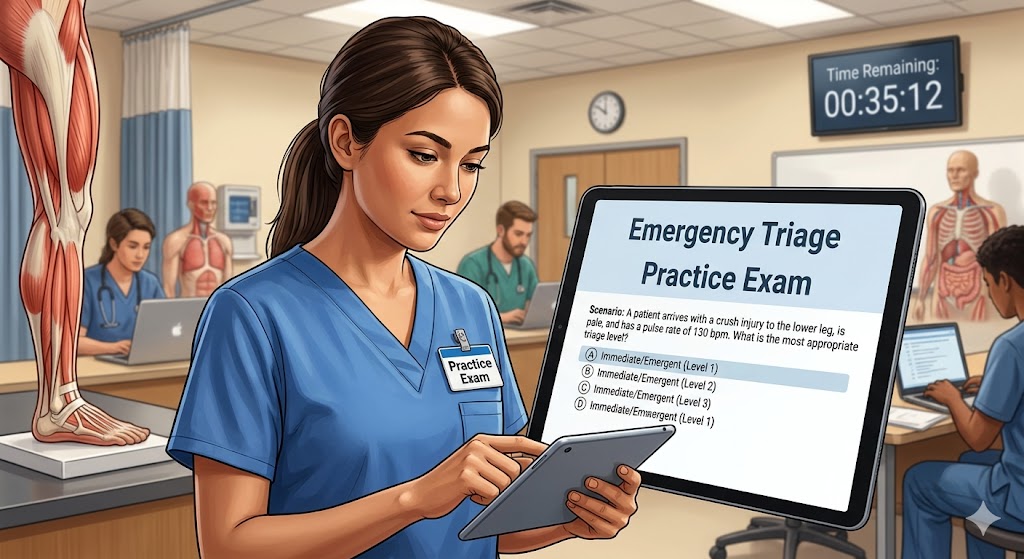
Additional Information
What the Course Entails and Exam Details
While a practice exam is not a substitute for a full training course, it tests the core knowledge and skills covered in comprehensive emergency triage programs. Candidates will find that the exam content reflects the global standards and protocols used in emergency medicine.
Key areas covered include:
Understanding Triage Systems: Questions will test familiarity with standardized 5-level or 3-level triage systems, such as the Emergency Severity Index (ESI), the Manchester Triage System (MTS), or similar accredited models.
Rapid Physical Assessment: Testing your ability to perform focused, efficient head-to-toe primary and secondary surveys using protocols like ABCDE (Airway, Breathing, Circulation, Disability, Exposure).
Symptom-Based Categorization: You will need to differentiate between emergent, urgent, and non-urgent presentations for common complaints like chest pain, respiratory distress, abdominal pain, and trauma.
Vital Signs and Physiological Indicators: Assessing the interpretation of vital signs, consciousness scales (GCS), and other critical data points.
Red Flags and High-Risk Conditions: Identifying specific signs and symptoms that necessitate immediate escalation and intervention, regardless of initial triage score.
Ethical and Legal Considerations: Testing knowledge of documentation requirements, patient confidentiality (HIPAA), and protocols for specific populations, such as pediatric, geriatric, or psychiatric patients.
What to Expect in the Final Exam
The actual certification exam you are preparing for often takes a standardized format, and our practice exam is structured to reflect this. You can expect a professional, timed environment that challenges your mental stamina.
Question Format: The vast majority of questions are multiple-choice. They range from direct recall of protocols to complex, scenario-based vignettes. These vignettes describe a patient's presentation and ask you to select the correct triage category, immediate intervention, or critical observation.
Time Limit: Most official exams have a strict time limit, typically allowing 1-2 minutes per question. Our practice exams include an integrated timer to help you train your speed and manage your time effectively.
Passing Score: Requirements vary by certifying body, but a pass mark is commonly set between 75% and 85%.
Practical Component: While less common in a digital practice exam, many full certifications also require a hands-on or face-to-face practical skill assessment to demonstrate competent triage decision-making with a standard "patient."
How to Study and Exam Centers
Effective study for the Emergency Triage Exam requires a combination of rote learning and simulated application.
1. Study Strategies:
Master the Flowcharts: Memorize the triage algorithms and decision trees for your chosen system. Flowcharts are the backbone of effective triage.
Practice with Real Scenarios: Don't just learn theory. Create or find patient case studies and practice assigning triage categories to them.
Use Acronyms: Utilize mnemonics like ABCDE, SAMPLE (Symptoms, Allergies, Medications, Past history, Last oral intake, Events leading to illness), and OPQRST (Onset, Provocation, Quality, Region, Severity, Timing) to structure your assessments.
Timed Practice: Regularly take timed practice exams. This is the only way to build the mental speed needed for the real test.
2. Finding Your Exam Center:
Once you are confident, you must take your final official exam through an authorized testing entity.
Official Accrediting Bodies: The best way to find a center is through the official website of the organization providing the certification. They maintain databases of approved locations or partner with professional testing networks like Pearson VUE.
Workplace Training Departments: Many hospitals, ambulance services, and large healthcare organizations are authorized to conduct the training and final testing for their staff. Check with your educator or supervisor.
Online Proctored Exams: An increasing number of certifications offer secure, online-proctored exams you can take from home, though you may still need to find a physical location for a practical skill assessment.
Job Opportunities from the Course
Successfully passing an emergency triage certification opens doors to specialized roles across the healthcare continuum. This credential signals to employers that you possess the critical thinking skills required for high-stakes environments.
Key job opportunities include:
Triage Nurse (Emergency Department)
Emergency Room Nurse
Accident & Emergency (A&E) Nurse
Flight Nurse / Critical Care Transport Nurse
Paramedic
Emergency Medical Technician (EMT)
Urgent Care Clinical Staff
Trauma Team Member
Disaster Response Medical Personnel
Cruise Ship or Remote Location Medical Officer
Frequently Asked Questions
Reviews
5.0
Based on 0 reviews
Leave a Review
No reviews yet. Be the first to review!