
EMS History, Communications, and Wellness Practice Test
$69.00
- Buy to unlock unlimited access to all Quiz questions and Answers in this Quiz.
- After purchase you can print a PDF of the whole quiz at any point. The PDF will contain the questions and the correct answers.
About this Exam
This foundational certification module is an essential stepping stone for anyone pursuing a career in pre-hospital emergency medicine.
It is expertly designed for aspiring Emergency Medical Technicians, paramedics, and first responders who are entering the healthcare field.
The primary goal of this assessment is to ensure that future providers understand the rich history of emergency services and the critical evolution of patient care standards.
Furthermore, it focuses on teaching professionals how to maintain their own physical and mental well-being while operating in highly stressful environments.
By mastering these core concepts, candidates prove they are ready to handle the rigorous demands of emergency medical response with professionalism and resilience.
Ready to test your knowledge?
Buy Now to Access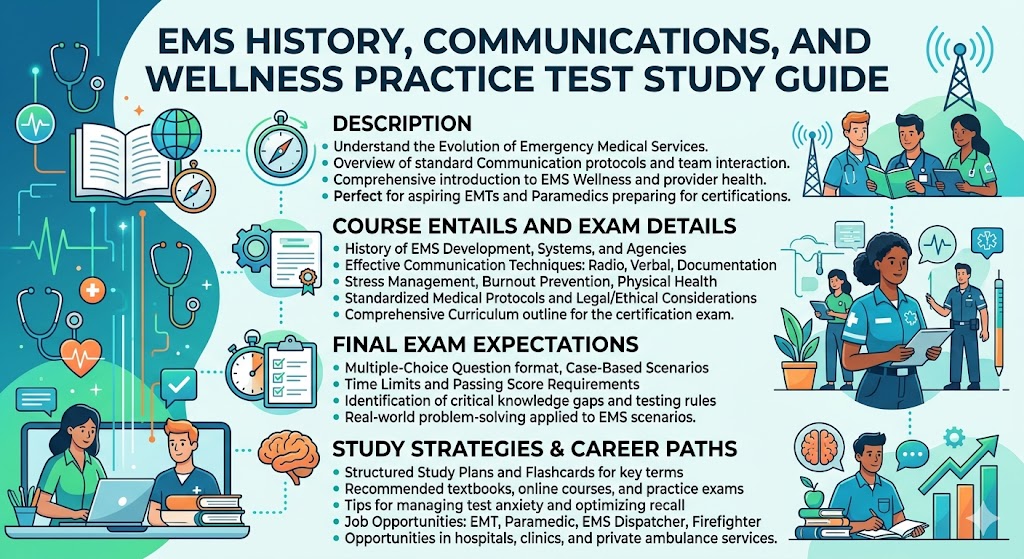
Additional Information
What the Course Entails and Exam Details
This course curriculum covers the critical building blocks required for safe and effective emergency medical operations.
Students will deeply explore the history of EMS, tracing its origins from early battlefield medicine to modern, sophisticated trauma care systems.
The communications component entails mastering radio etiquette, understanding medical terminology, and learning how to deliver concise patient handover reports to hospital staff.
Wellness training is a major focus, teaching candidates crucial techniques for stress management, burnout prevention, and proper body mechanics for lifting patients.
Additionally, the syllabus thoroughly covers scene safety, the correct use of Personal Protective Equipment, and protocols for preventing infectious disease transmission.
What to Expect in the Final Exam
The final practice and certification exam will rigorously test your theoretical knowledge and your ability to apply it to real-world scenarios.
You can expect a multiple-choice format featuring scenario-based questions that require critical thinking rather than just simple memorization.
The passing score requirement is typically set at seventy to eighty percent, depending on the specific state or national registry standards.
Students will be subjected to strict time limits, usually allowing about one to two minutes per question, to simulate the fast-paced nature of emergency medical decisions.
Standard testing rules apply, meaning no outside materials are permitted, and the exam utilizes adaptive testing software to accurately measure your competency level.
How to Study and Exam Centers
To succeed on this exam, active recall and scenario-based studying are your most powerful strategies.
Students are highly encouraged to use flashcards for memorizing medical terminology, radio codes, and historical milestones.
Taking multiple timed practice exams is also crucial, as it builds your test-taking stamina and helps you manage anxiety under pressure.
When you are ready to test, examinations are typically administered through authorized third-party testing organizations like Pearson VUE.
You can schedule your test at approved physical testing centers found at local community colleges, specialized EMS academies, or through securely proctored online portals.
Job Opportunities from the Course
Successfully passing this foundational exam opens the door to numerous rewarding careers in the healthcare and public safety sectors.
Emergency Medical Technician
Paramedic
Emergency Medical Responder
Emergency Medical Dispatcher
Emergency Room Technician
Field Training Officer
Industrial Safety First Responder
Search and Rescue Team Member
Frequently Asked Questions
Reviews
5.0
Based on 0 reviews
Leave a Review
No reviews yet. Be the first to review!