
EMT Airway and Breathing Practice Exam
$69.00
- Buy to unlock unlimited access to all Quiz questions and Answers in this Quiz.
- After purchase you can print a PDF of the whole quiz at any point. The PDF will contain the questions and the correct answers.
About this Exam
The Emergency Medical Technician (EMT) certification is a foundational milestone for individuals aspiring to enter the dynamic field of Emergency Medical Services (EMS). This course is meticulously designed for compassionate, resilient individuals who are eager to provide critical, life-saving care to patients in pre-hospital settings. The EMT course equips candidates with the knowledge and hands-on skills required to respond to a spectrum of medical and trauma emergencies. Among the most vital components of an EMT’s training is the mastery of airway management and respiratory support. An "EMT Airway and Breathing Practice Exam" serves as a crucial preparatory tool, focusing on these high-stakes, life-and-death scenarios. It is designed to help students reinforce their understanding and demonstrate their ability to assess, maintain, and manage a patient's breathing, which is the absolute highest priority in any medical intervention.
Ready to test your knowledge?
Buy Now to Access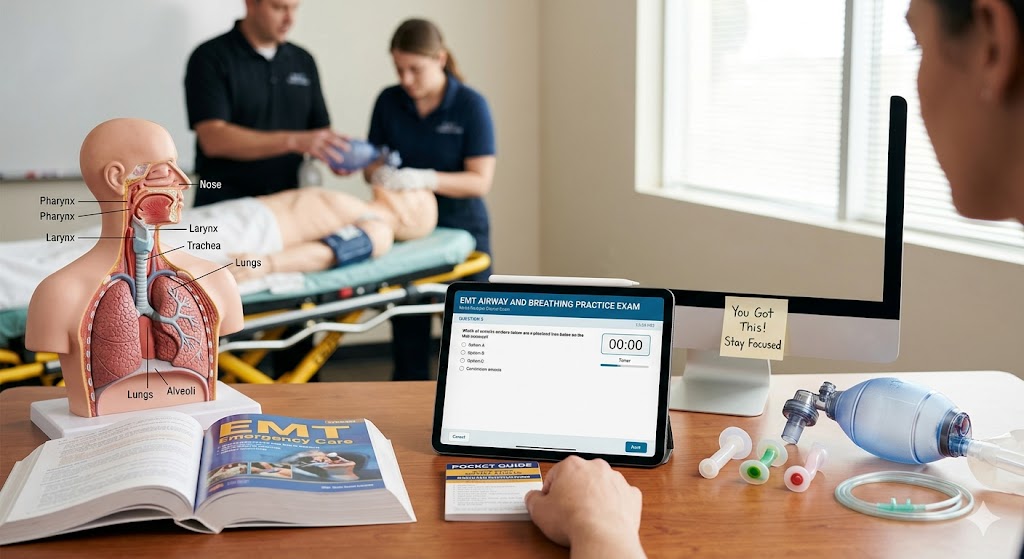
Additional Information
What the Course Entails and Exam Details
An EMT course comprehensive curriculum covers a vast array of medical topics, but the airway and breathing modules are central to student success.
The core topics covered within this domain include:
Respiratory Anatomy and Physiology: Understanding the entire respiratory pathway for both adult and pediatric patients, including the differences in their upper and lower airways.
Pathophysiology of Respiration: Recognizing the underlying causes and mechanisms of common respiratory conditions like asthma, COPD, pneumonia, and pulmonary edema.
Airway Assessment: Rapidly and accurately assessing for airway patency, adequate ventilation, and signs of respiratory distress, failure, or arrest.
Airway Management Techniques: Mastering essential maneuvers such as the head-tilt, chin-lift, and jaw-thrust; and the use of airway adjuncts like oropharyngeal (OPA) and nasopharyngeal (NPA) airways.
Oxygen Therapy: Understanding the indications, contraindications, dosage, and delivery methods for supplemental oxygen, including nasal cannulas, non-rebreather masks, and bag-valve masks (BVM).
Ventilation Support: Perfecting the skill of artificial ventilation using a BVM, including one- and two-rescuer techniques.
Suctioning: Knowing when and how to clear an obstructed airway using portable and fixed suction units.
Special Populations: Applying assessment and management principles specifically to pediatric and geriatric patients.
What to Expect in the Final Exam
The actual EMT certification exam, administered by the National Registry of Emergency Medical Technicians (NREMT), consists of two mandatory parts: the Cognitive Exam and the Psychomotor Exam. The "EMT Airway and Breathing Practice Exam" you are taking is highly optimized to help you prepare for the airway-specific questions and skills you will encounter in both components.
Cognitive Exam Details
The NREMT Cognitive Exam is a Computer Adaptive Test (CAT), meaning the test adapts to your performance. You can expect:
Number of Questions: Between 70 and 120 multiple-choice questions.
Time Limit: Two hours.
Content: Questions are distributed across key EMS domains, with Airway, Respiration, and Ventilation accounting for a significant percentage.
Passing Score: You must demonstrate an entry-level competency standard, which generally equates to a score of 70% or higher, to pass.
Psychomotor Exam Details
The Psychomotor Exam measures your ability to physically apply your knowledge in a series of hands-on skill stations. Specifically for the airway and breathing requirements, you will likely be tested at multiple stations, such as:
Bag-Valve Mask Ventilation of an Apneic Patient: You must demonstrate the ability to ventilate an unresponsive, non-breathing patient with a pulse, using the correct rate, volume, and adjuncts.
Oxygen Administration: Correctly setting up, troubleshooting, and administering oxygen to a patient using various delivery devices.
Suctioning: Demonstration of clearing an obstructed upper airway.
How to Study and Exam Centers
Successfully passing the EMT Airway and Breathing exam requires a combination of robust knowledge and honed practical skills.
How to Study
Use Practice Exams: This cannot be overemphasized. Taking a dedicated "EMT Airway and Breathing Practice Exam" multiple times helps you identify weaknesses, understand question formats, and build your stamina.
Anatomy and Physiology Mastery: Use flashcards, anatomical charts, and study groups to cement your understanding of the respiratory system. You must know the path of a molecule of oxygen.
Hands-on Practice: Perfect your skills in the classroom and during your required clinical rotations. Rehearse every step of BVM ventilation, OPA insertion, and oxygen setup until it becomes second nature.
Review Pathophysiology: Understand why certain interventions are necessary for different respiratory diseases.
Stay Encouraged: EMT training is rigorous. Break your studying into manageable chunks, take regular breaks, and stay focused on your end goal.
Exam Centers
Cognitive Exam: You must register for the cognitive exam through the official NREMT website (nremt.org) after completing your EMT course. Upon approval, you will receive an Authorization to Test (ATT) letter, which you will use to schedule your exam at a Pearson VUE professional testing center. These centers are located in almost every major city and offer a standardized, proctored environment.
Psychomotor Exam: The practical skills exam is typically coordinated by your EMT training program or a state-authorized educational institution. Your program will provide specific details on where, when, and how this component will be administered.
Job Opportunities from the Course
Earning your EMT certification by passing the NREMT exam unlocks a diverse and rewarding career path with numerous job opportunities:
Emergency Medical Technician (EMT) - Ambulance Services
Firefighter/EMT (Dual Role)
Emergency Room (ER) Technician
Private Ambulance Transport EMT
Event Medical Staff (Concerts, Festivals, Sports)
Flight EMT (Requires advanced certification, e.g., AEMT or Paramedic)
Industrial or Corporate Medic
Law Enforcement Medic (Tactical EMS)
Medical Assistant (Some settings recognize EMT certification)
EMS Educator or Instructor
Frequently Asked Questions
Reviews
5.0
Based on 0 reviews
Leave a Review
No reviews yet. Be the first to review!