
EMT Medical Terminology Practice Test
$69.00
- Buy to unlock unlimited access to all Quiz questions and Answers in this Quiz.
- After purchase you can print a PDF of the whole quiz at any point. The PDF will contain the questions and the correct answers.
About this Exam
Mastering medical terminology is absolutely critical for anyone embarking on a career in emergency medical services.
This dedicated EMT Medical Terminology Practice Exam is meticulously designed to provide students with a realistic, low-stakes environment to test their comprehension of the specialized language used daily in pre-hospital care.
It is an indispensable resource for current EMT candidates, AEMT and Paramedic students, and any healthcare professional seeking to solidify their foundational knowledge of anatomical, physiological, and clinical terms.
Clear communication during high-stress patient situations saves lives, and understanding this terminology is the first step toward effective teamwork and accurate patient documentation.
By taking this practice exam, you are not just preparing for a test; you are ensuring you have the vocabulary necessary to succeed in a demanding field.
Ready to test your knowledge?
Buy Now to Access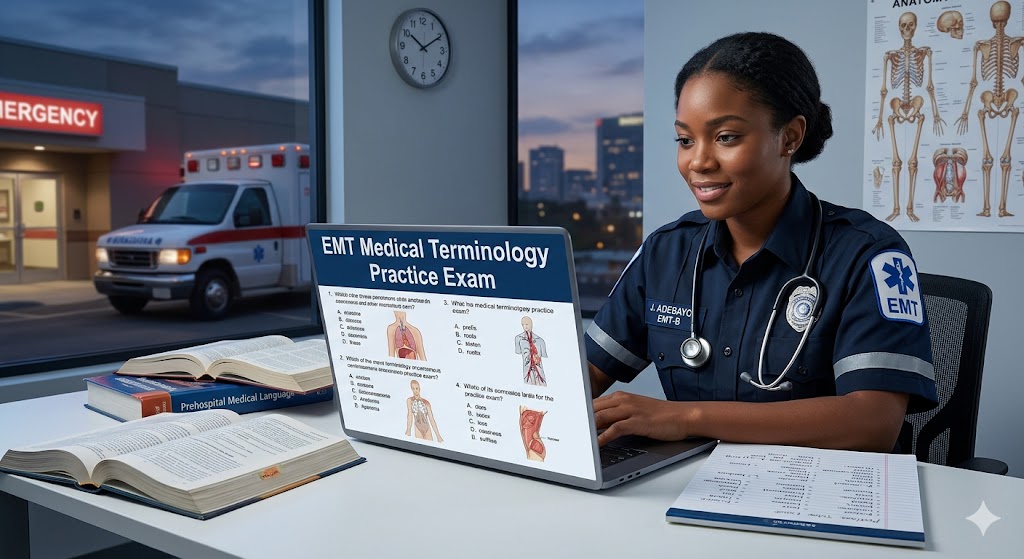
Additional Information
What the Course Entails and Exam Details
A foundational understanding of medical language is required before diving deep into emergency procedures.
This practice exam covers the essential building blocks that structure thousands of medical terms across multiple categories.
The core areas you must understand include:
Word Structure: Deconstructing terms into their prefixes, suffixes, root words, and combining forms.
Anatomical Terminology: Precise terms describing body positions, planes, directions, and regions.
Body Systems (Overview): Key terms relating to the musculoskeletal, cardiovascular, respiratory, nervous, digestive, endocrine, urinary, and reproductive systems.
Common Abbreviations: Mastering the standardized symbols and acronyms frequently used in EMS reports.
Diagnostic and Procedural Terms: Understanding terminology associated with assessments, imaging, and common emergency interventions.
While a practice test itself isn't a comprehensive course, these topics reflect the breadth of knowledge required to correctly interpret patient charts and communicate with hospital staff.
What to Expect in the Final Exam
When you are ready to take a formalized EMT Medical Terminology exam—whether it's part of a graded EMT course or a standalone competency check—the structure will likely be standardized.
The format is typically multiple-choice questions, requiring you to choose the single best answer.
These questions test your ability to define specific roots, identify the correct term for a given anatomical structure, interpret a scenario involving movement or positioning, and decipher commonly used EMS abbreviations.
While the exact passing score and time limit can vary slightly by institution or software provider, the goal of any practice test should be mastery and building confidence rather than just "squeaking by" a threshold.
Practice exams are usually untimed and unproctored, allowing you to learn from your mistakes at your own pace.
The "real" certification or state licensure exams (like the NREMT) that require this knowledge are proctored, strictly timed, and have fixed, standardized passing criteria, making these practice tests a crucial diagnostic tool in your preparation strategy.
How to Study and Exam Centers
Effective study methods are key to cementing complex medical vocabulary in your memory.
We recommend creating your own medical terminology flashcards (digital or paper), focusing intensely on one word part at a time before combining them.
Break down words visually: split a term like "gastroenteritis" into gastro- (stomach), -enter- (intestines), and -itis (inflammation).
Mnemonic devices can also be helpful for memorizing long lists of body parts or functions.
Take this practice test repeatedly; the questions you get wrong provide the perfect roadmap for your further study.
The crucial distinction regarding where to take these tests must be made:
Practice Tests: You can take this specialized medical terminology practice exam right here online, or through various dedicated education portals, apps, and study guide websites. They are accessible from any device.
Certification Exams: The actual final proctored cognitive exam for EMT certification (the NREMT) or specific state-level tests are never taken online unproctored. These require visiting a designated physical testing center, such as Pearson VUE, or other authorized state/school-specific facilities after you have formally completed your recognized EMT course.
Job Opportunities from the Course
A strong command of medical terminology is a universal prerequisite for virtually all roles in the clinical and allied healthcare industries.
Solidifying this foundational knowledge, especially when validated by certifications, opens many diverse career paths, including:
Emergency Medical Technician (EMT)
Advanced EMT (AEMT)
Paramedic
Firefighter/EMT
EMS Dispatcher
Emergency Room Technician
Patient Transporter
Medical Scribe
Hospital Admissions Specialist
CNA (Certified Nursing Assistant)
Flight Paramedic
Search and Rescue (SAR) Technician
Clinical Research Assistant
In essence, fluency in medical language is the passport required to advance in countless careers focused on patient care and health systems.
Here is your comprehensive SEO-optimized study guide and the matching generated image.
EMT Medical Terminology Practice Exam
Description
Mastering medical terminology is absolutely critical for anyone embarking on a career in emergency medical services.
This dedicated EMT Medical Terminology Practice Exam is meticulously designed to provide students with a realistic, low-stakes environment to test their comprehension of the specialized language used daily in pre-hospital care.
It is an indispensable resource for current EMT candidates, AEMT and Paramedic students, and any healthcare professional seeking to solidify their foundational knowledge of anatomical, physiological, and clinical terms.
Clear communication during high-stress patient situations saves lives, and understanding this terminology is the first step toward effective teamwork and accurate patient documentation.
By taking this practice exam, you are not just preparing for a test; you are ensuring you have the vocabulary necessary to succeed in a demanding field.
What the Course Entails and Exam Details
A foundational understanding of medical language is required before diving deep into emergency procedures.
This practice exam covers the essential building blocks that structure thousands of medical terms across multiple categories.
The core areas you must understand include:
Word Structure: Deconstructing terms into their prefixes, suffixes, root words, and combining forms.
Anatomical Terminology: Precise terms describing body positions, planes, directions, and regions.
Body Systems (Overview): Key terms relating to the musculoskeletal, cardiovascular, respiratory, nervous, digestive, endocrine, urinary, and reproductive systems.
Common Abbreviations: Mastering the standardized symbols and acronyms frequently used in EMS reports.
Diagnostic and Procedural Terms: Understanding terminology associated with assessments, imaging, and common emergency interventions.
While a practice test itself isn't a comprehensive course, these topics reflect the breadth of knowledge required to correctly interpret patient charts and communicate with hospital staff.
What to Expect in the Final Exam
When you are ready to take a formalized EMT Medical Terminology exam—whether it's part of a graded EMT course or a standalone competency check—the structure will likely be standardized.
The format is typically multiple-choice questions, requiring you to choose the single best answer.
These questions test your ability to define specific roots, identify the correct term for a given anatomical structure, interpret a scenario involving movement or positioning, and decipher commonly used EMS abbreviations.
While the exact passing score and time limit can vary slightly by institution or software provider, the goal of any practice test should be mastery and building confidence rather than just "squeaking by" a threshold.
Practice exams are usually untimed and unproctored, allowing you to learn from your mistakes at your own pace.
The "real" certification or state licensure exams (like the NREMT) that require this knowledge are proctored, strictly timed, and have fixed, standardized passing criteria, making these practice tests a crucial diagnostic tool in your preparation strategy.
How to Study and Exam Centers
Effective study methods are key to cementing complex medical vocabulary in your memory.
We recommend creating your own medical terminology flashcards (digital or paper), focusing intensely on one word part at a time before combining them.
Break down words visually: split a term like "gastroenteritis" into gastro- (stomach), -enter- (intestines), and -itis (inflammation).
Mnemonic devices can also be helpful for memorizing long lists of body parts or functions.
Take this practice test repeatedly; the questions you get wrong provide the perfect roadmap for your further study.
The crucial distinction regarding where to take these tests must be made:
Practice Tests: You can take this specialized medical terminology practice exam right here online, or through various dedicated education portals, apps, and study guide websites. They are accessible from any device.
Certification Exams: The actual final proctored cognitive exam for EMT certification (the NREMT) or specific state-level tests are never taken online unproctored. These require visiting a designated physical testing center, such as Pearson VUE, or other authorized state/school-specific facilities after you have formally completed your recognized EMT course.
Job Opportunities from the Course
A strong command of medical terminology is a universal prerequisite for virtually all roles in the clinical and allied healthcare industries.
Solidifying this foundational knowledge, especially when validated by certifications, opens many diverse career paths, including:
Emergency Medical Technician (EMT)
Advanced EMT (AEMT)
Paramedic
Firefighter/EMT
EMS Dispatcher
Emergency Room Technician
Patient Transporter
Medical Scribe
Hospital Admissions Specialist
CNA (Certified Nursing Assistant)
Flight Paramedic
Search and Rescue (SAR) Technician
Clinical Research Assistant
Frequently Asked Questions
Reviews
5.0
Based on 0 reviews
Leave a Review
No reviews yet. Be the first to review!