
EMT Module 1 Practice Exam
$69.00
- Buy to unlock unlimited access to all Quiz questions and Answers in this Quiz.
- After purchase you can print a PDF of the whole quiz at any point. The PDF will contain the questions and the correct answers.
About this Exam
Embarking on a career as an Emergency Medical Technician (EMT) is a rewarding journey, and your very first checkpoint is often foundational knowledge covered in the EMT Module 1. This crucial module sets the stage, introducing you to the fundamental principles and practices essential for any entry-level EMS professional. Whether you are aiming to eventually become a Paramedic, work in a busy 911 system, or provide essential medical transport services, understanding this foundational material is imperative. The EMT Module 1 Practice Exam is designed specifically for students currently enrolled in or preparing for an EMT-Basic certification course. It serves as an excellent diagnostic and preparatory tool, allowing you to gauge your understanding of the initial, critical concepts before you face the real graded assessments in your program and, eventually, the national cognitive exam. By utilizing this practice exam, you can identify areas of strength and weakness, build your confidence, and sharpen your test-taking skills, all while reinforcing the core knowledge needed to excel in your subsequent EMT training and career.
Ready to test your knowledge?
Buy Now to Access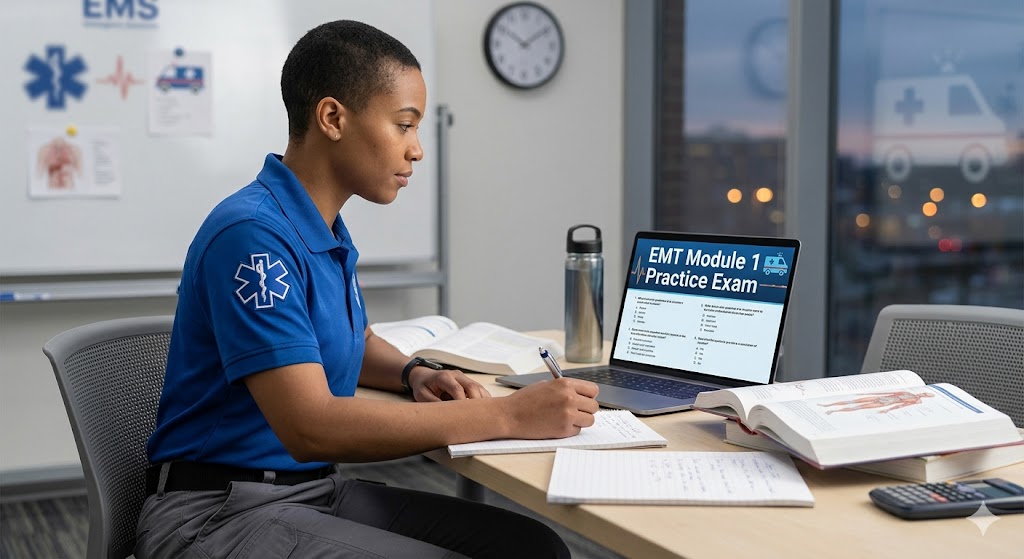
Additional Information
What the Course Entails and Exam Details
The foundational topics covered in a typical EMT Module 1 can vary slightly by program and training provider, but you can generally expect comprehensive coverage of the following essential areas. These are the building blocks upon which all your subsequent practical skills and advanced medical knowledge will be constructed.
A comprehensive EMT Module 1 Practice Exam will likely test your knowledge in these key categories:
EMS Systems and Overview: History of EMS, roles and responsibilities of the EMT, quality improvement, and the broader healthcare system context.
Safety and Well-being of the EMT: Protecting yourself is paramount. This section covers personal safety, standard precautions, stress management, and workplace wellness.
Medical, Legal, and Ethical Issues: Understanding the legal and ethical landscape of EMS, including consent, refusal of care, HIPAA, and documentation requirements.
Anatomy & Physiology Basics: A foundational understanding of the human body systems (circulatory, respiratory, nervous, skeletal, etc.) that you will soon be assessing and treating.
Medical Terminology: Mastering the basic language of healthcare is essential for effective communication with patients and medical professionals.
Lifting and Moving Patients: Safe and effective techniques for patient transport, crucial for avoiding injury to both yourself and the patient.
Patient Assessment and Scene Size-up: The initial steps of any call, including ensuring scene safety, determining the nature of illness or mechanism of injury, and performing a primary assessment to identify immediate life-threatening conditions.
Practice exams in this format mirror the structure and content of typical module knowledge checks within your EMT course. They are typically:
Multiple Choice Question Format: Each question will present a scenario or dynamic medical question with several possible answers, requiring you to select the best one.
A Diagnostic Tool: Their primary purpose is to help you understand your level of knowledge and focus your future study efforts.
Non-Graded/Low Stakes: Unlike your actual course exams, practice exams do not count towards your course grade, allowing you to learn without the pressure of a failing grade.
Accessible Online: Most high-quality practice exams are hosted on online portals, providing easy, self-paced access from anywhere with an internet connection.
Informative with Feedback: Look for exams that provide detailed explanations and rationales for both correct and incorrect answers, transforming your mistakes into learning opportunities.
What to Expect in the Final Exam
While the structure of your actual module exam within your EMT program will be determined by your school or training center, the EMT Module 1 Practice Exam is designed to simulate that experience as closely as possible. The actual graded module knowledge checks in your course will likely have these characteristics, and consistently scoring well on high-quality practice exams is a strong indicator of your readiness for that challenge.
You can typically expect your EMT Module 1 exam to include:
Multiple-Choice Questions: As with the practice exam, the main format will be multiple-choice, assessing your recall of facts, your ability to apply concepts, and your decision-making skills in clinical scenarios.
A Specific Time Limit: Each actual module exam will be timed, requiring you to read, analyze, and answer questions efficiently. Time limits are designed to be challenging but reasonable, pushing you to demonstrate mastery, not just lucky guesses.
Minimum Passing Score Requirements: Your EMT program will have a set minimum passing score for all module exams (e.g., 75%, 80%, etc.). Achieving this score is crucial for progressing to the next module and completing your course successfully.
Specific Testing Environments: Module exams are typically administered in a controlled setting, often online through the school's specific secure testing portal, or in-person at the training center. Proctoring (human or digital) is common to ensure academic integrity.
Unlimited, Individual Efforts: Unlike some larger standardized tests, initial module exams in many programs allow you only a specific number of attempts, and it's essential to understand your school's specific policy. Always complete these tests individually.
Immediate Feedback (Possibly): Depending on the school's system, you may or may not receive immediate feedback, so it's always critical to carefully review your mistakes and understand why you missed a question.
It is critical to treat the actual graded exam with the seriousness and preparation it requires. Consistently performing well on the EMT Module 1 Practice Exam will build your knowledge and confidence for this important assessment.
How to Study and Exam Centers
Effective study strategies are your key to success in not just Module 1, but your entire EMT course. Here is an actionable approach to ensure you are fully prepared for both your practice efforts and the graded assessments to come:
Comprehensive Textbook Review: Your EMT textbook is your primary knowledge source. Don't just skim! Read chapters thoroughly, highlight key concepts, take detailed notes, and actively engage with the material.
Active Recall with Flashcards: Convert key terms, anatomical diagrams, protocols, and critical concepts into digital (e.g., Quizlet) or physical flashcards. Use spaced repetition to reinforce your memory.
Multiple Practice Tests: This is where the EMT Module 1 Practice Exam shines. Take it multiple times, treat it like a real test, and always meticulously review any questions you got wrong, understanding the why behind the correct answer and your own error.
Study Groups: Collaborate with fellow EMT students. Discussing concepts, teaching each other, and quizzing one another can deepen your understanding and expose you to different perspectives.
Integrate Skills Practice: While Module 1 focuses heavily on knowledge, connect it to the practical skills you will be learning. Think about how the knowledge of anatomy or assessment impacts the doing of a physical exam.
Stay Physically and Mentally Ready: Don't neglect your well-being. Ensure you are getting enough sleep, eating well, and managing stress. A clear mind is essential for optimal performance.
Where to Take the Practice and Actual Exams:
EMT Module 1 Practice Exam: High-quality practice exams are typically hosted online. Your EMT training provider may offer their own, or you can find reputable third-party practice test platforms that align with the national standard curriculum. You can take these at home or on the go on your own schedule.
Course Module Exams: These are administered directly by your EMT school or training center. They will provide specific instructions, locations (often online via their secure portal, or in-person at the center), and proctoring details.
Final EMT Certification Exam (NREMT): Remember, this is different! Once you complete your entire EMT course, you must take the National Registry Cognitive Exam at an authorized Pearson VUE testing center or through their specific, securely proctored online platform, for final national certification. These locations are physical centers throughout the country.
Job Opportunities from the Course
Completing the EMT course and obtaining your certification is the essential first step that unlocks a variety of career paths in emergency services and beyond. While Module 1 itself is just the beginning of your training, successfully mastering its content is critical for progressing through the program and reaching your ultimate goal. Here is a clear list showing the types of job opportunities that this full certification can enable, allowing you to visualize the potential of your new career path:
EMT-Basic: Providing emergency medical care on ambulances responding to 911 calls.
Medical Transporter (BLS): Transferring patients between facilities for non-emergency reasons.
Event Standby EMT: Offering first aid and emergency care at concerts, sporting events, and large gatherings.
Corporate or Site EMT: Providing on-site medical coverage in industrial, corporate, or recreational settings.
Foundational Role for Further Careers: Your EMT certification is a common prerequisite and excellent foundation for pursuing roles as a:
Paramedic
Firefighter/EMT
Emergency Room Technician
Flight Paramedic (after advanced training and experience)
Medical or Nursing Student
Frequently Asked Questions
Reviews
5.0
Based on 0 reviews
Leave a Review
No reviews yet. Be the first to review!