
EMT Module 2 Practice Exam
$69.00
- Buy to unlock unlimited access to all Quiz questions and Answers in this Quiz.
- After purchase you can print a PDF of the whole quiz at any point. The PDF will contain the questions and the correct answers.
About this Exam
The Emergency Medical Technician (EMT) certification is a vital milestone for aspiring pre-hospital healthcare providers. This intensive course equips students with the foundational knowledge and hands-on skills required to respond to and manage medical emergencies. Given the complexity of the program, most accredited training institutions divide the curriculum into specific modules.
This EMT Module 2 Practice Exam is meticulously designed to help students currently enrolled in an EMT program assess their readiness for a pivotal hurdle. Passing each module's final written and practical exams is essential for advancing to the next stage of training. This practice tool simulates the format and content that students can expect to encounter, providing a focused review of core concepts before the real high-stakes test. It is not an official NREMT exam but a localized preparation resource to ensure course progression.
Ready to test your knowledge?
Buy Now to Access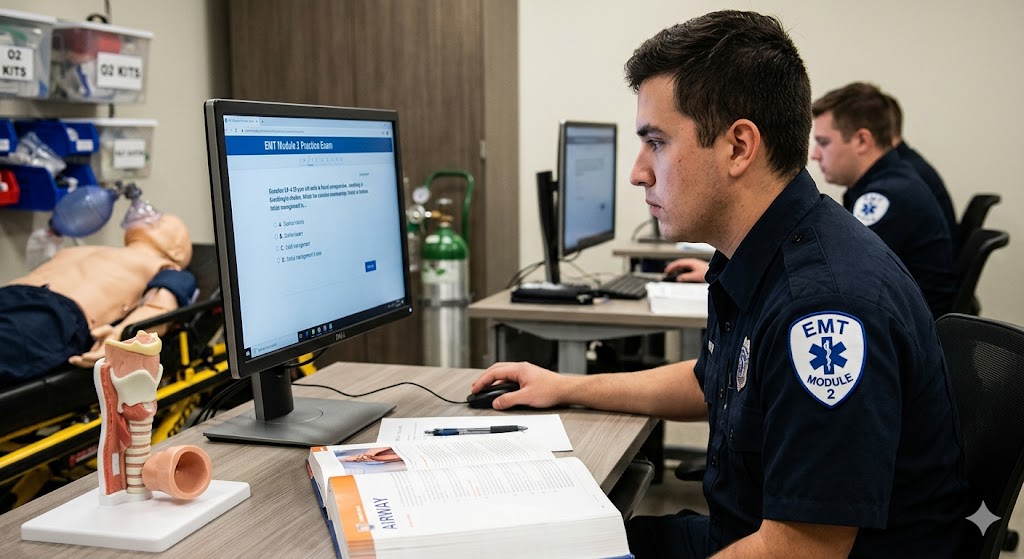
Additional Information
What the Course Entails and Exam Details
A standard EMT training program, based on the National EMS Education Standards, utilizes a modular structure. While specific breakdown can vary slightly by state or institution, Module 2 often focuses deeply on foundational concepts that are critical for patient survival. This practice exam aligns with those crucial educational pillars.
The core topics and skills typically covered in this phase include:
Airway Management: In-depth knowledge of anatomical structures and techniques to open and maintain an open airway (e.g., OPA, NPA, head-tilt/chin-lift, jaw-thrust).
Respiration and Ventilation: Understanding the physiology of breathing and providing artificial ventilation using a Bag-Valve Mask (BVM) for patients in respiratory failure or arrest.
Oxygen Administration: Correct use of oxygen cylinders, regulators, and delivery devices, such as nasal cannulas and non-rebreather masks, for various patient conditions.
Suctioning: The application of mechanical and manual suction devices to clear upper airway obstructions.
Initial Patient Assessment: Principles of forming a general impression, assessing responsiveness (AVPU scale), and identifying immediate life threats during the primary survey.
The formal Module 2 written exam at your training center is generally a high-stakes, computer-based or paper-and-pencil test. This practice exam mimics that format to ensure students are comfortable with multiple-choice questions that test critical thinking and clinical decision-making.
What to Expect in the Final Exam
The actual end-of-module exam administered by your EMT instructor will be a standardized, graded test. While specific details depend on the school, there are common characteristics that every student should anticipate.
Format: The primary component is a written exam, which almost universally uses a multiple-choice format. Questions often present clinical scenarios and ask students to choose the single best course of action or the correct underlying anatomical or physiological concept.
Length: A typical module exam consists of 30 to 70 questions, depending on the breadth of the material covered in the unit.
Time Limit: Expect a strict time limit, requiring quick and accurate recall and application of knowledge. Students might be allotted 45 to 90 minutes.
Practical Component: In some programs, Module 2 testing also includes a separate psychomotor (skills) evaluation. This involves demonstrating core competencies like BVM ventilation on a mannequin, which is proctored by an instructor. This practice guide focuses on preparing you for the written portion.
Passing Score: Your institution will set a minimum required passing grade, often around 70% to 80%. Failing a module test frequently requires a retest and can delay progression in the program.
How to Study and Exam Centers
Preparation for this module exam must be both structured and dynamic. Here are actionable strategies and a clear path to taking the test.
Actionable Study Strategies:
Master Your Textbook: Do not rely solely on lecture notes. Thouroughly read and review the relevant chapters from the official EMT text (e.g., the AAOS "Emergency Care and Transportation of the Sick and Injured"). Focus on bolded terms, key concepts, and skill performance checklists.
Practice Testing: Use the EMT Module 2 Practice Exam frequently. Take it under timed conditions and review every question you missed. Understand why the correct answer was chosen over the others. Look for similar questions in NREMT test preparation apps or localized school materials.
Use Active Recall: Turn your notes into flashcards or teach a complex concept (like the cascade of shock) to a peer or study partner. This cements understanding more effectively than passive rereading.
Skills and Scenarios: Even when studying for the written test, visualize the steps of a skill lab. If the question asks about managing a hypoxemic patient with shallow breathing, think, "Assisted ventilations with a BVM and oxygen." Use skills checklists to guide your thinking.
Exam Centers:
It is crucial to understand that the final Module 2 exam is a localized "school exam," not the final national certification (NREMT) exam. You must complete all training before challenging the National Registry test.
Your Authorized School: You will take this module test at your specific EMS training institute, community college, or fire academy.
Format at Your Center: It is typically administered as a supervised test within your regular classroom or a dedicated computer testing lab. Some institutions use a remote-proctoring service for online exams within their learning management system (like Canvas or Blackboard). Check with your instructor for the exact logistics.
Job Opportunities from the Course
Successfully navigating and passing EMT Module 2 is a foundational requirement. It is a critical milestone that allows you to continue your studies and eventually complete your full EMT training program. After completing all course requirements and passing both school-level cognitive and psychomotor tests, you will be eligible to take the National Registry (NREMT) or state-specific certification exam.
Passing this module test does not directly lead to licensure. However, upon full EMT certification, a wide array of career opportunities and advanced educational paths are unlocked.
A complete EMT license opens doors to professional roles such as:
Emergency Medical Technician (EMT) with private ambulance services
Ambulance EMT for municipal or county EMS systems
Event Medic, providing medical coverage at concerts, sports events, and festivals
Emergency Room Technician (ER Tech) in hospital emergency departments
Firefighter/EMT, a requirement for many fire departments
Medical Responder for large corporate offices, factories, or construction sites
Rescue Team Member for specialized search and rescue or technical rescue units
Frequently Asked Questions
Reviews
5.0
Based on 0 reviews
Leave a Review
No reviews yet. Be the first to review!