
EMT Module 3 Practice Exam
$69.00
- Buy to unlock unlimited access to all Quiz questions and Answers in this Quiz.
- After purchase you can print a PDF of the whole quiz at any point. The PDF will contain the questions and the correct answers.
About this Exam
The EMT Module 3 Practice Exam is a crucial diagnostic tool designed for students currently enrolled in an accredited Emergency Medical Technician (EMT-Basic) training program.
EMT certification is the foundational stepping stone for a career in emergency medical services (EMS), and most training programs divide their extensive curriculum into several distinct modules, finishing each with a comprehensive exam.
It is important to understand that there is no single, universally standardized "Module 3" content required by the National Registry of EMTs (NREMT); instead, the specific topics covered in Module 3 are determined by each individual authorized training center’s chosen syllabus.
This practice exam mimics the style, difficulty, and time constraints of the module exams you will face within your program, allowing you to gauge your readiness for your internal test and identify weak areas that need focused study before you proceed further in your course.
Regardless of your specific school’s curriculum, this practice exam most commonly focuses on one or two core domains, such as Medical Emergencies, Trauma Management, or a combined assessment block, serving as a critical checkpoint before the final phases of your training.
Ready to test your knowledge?
Buy Now to Access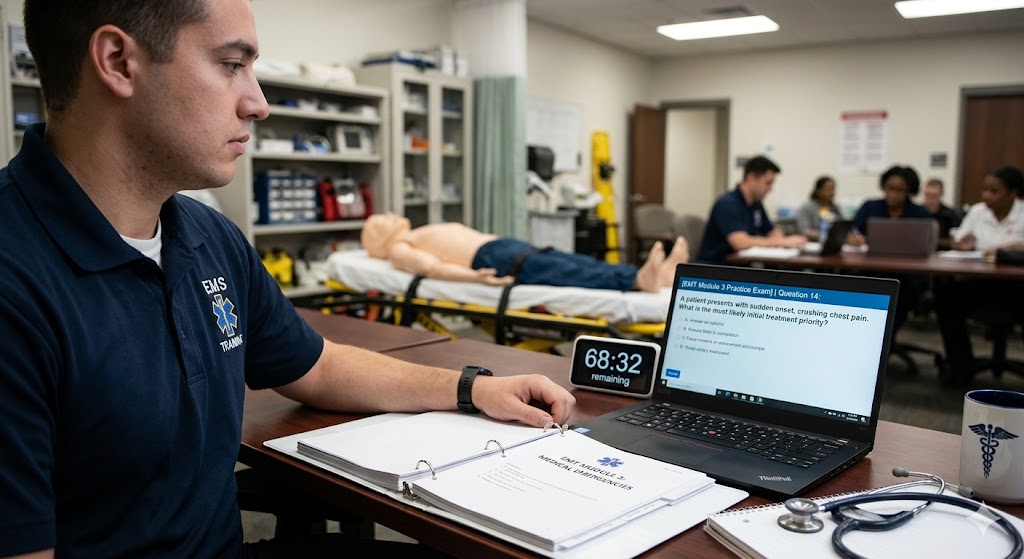
Additional Information
What the Course Entails and Exam Details
Because "Module 3" is not a national standard, the syllabus depends entirely on your specific EMT program. However, most accredited curricula are built upon the National EMS Education Standards.
A typical EMT program will cover foundational topics (preparatory, airway) first. Module 3 often focuses on applying those principles to specific patient populations or types of injury/illness. The following are the two most common areas tested in a program's "Module 3" block.
Most Common Module 3 Content Area: Medical Emergencies
If your course follows a common linear structure, Module 3 is highly likely to cover Medical Emergencies. This massive section tests your ability to recognize, assess, and manage patients suffering from internal, non-traumatic illnesses.
You must possess a deep understanding of the pathophysiology, signs, and symptoms of conditions across key body systems, including:
Respiratory Emergencies: Dyspnea, asthma, COPD, pneumonia, pulmonary edema, and pulmonary embolism.
Cardiovascular Emergencies: Acute Coronary Syndrome (ACS), myocardial infarction (heart attack), angina, congestive heart failure, and hypertensive emergencies.
Neurological Emergencies: Altered Mental Status (AMS), stroke, seizures, and syncope.
Endocrine Emergencies: Diabetes (hypoglycemia and hyperglycemia) and related crises.
Allergic Reactions and Anaphylaxis: Recognizing and treating severe systemic reactions.
Toxicology: Poisonings, substance abuse, and overdoses.
Abdominal Emergencies: Assessing acute abdomen, including appendicitis, pancreatitis, and GI bleeds.
Behavioral Emergencies: Safe management of psychiatric crises.
Alternative Common Content Area: Trauma Management
In other program structures, Module 3 might be dedicated exclusively to Trauma Management. This area tests your ability to manage patients who have suffered physical injury.
Content generally includes:
Bleeding and Shock: Recognizing and treating external/internal bleeding and managing hypovolemic shock.
Soft Tissue Injuries: Burns, lacerations, and avulsions.
Head, Neck, and Spine Trauma: Managing traumatic brain injuries (TBI) and ensuring spinal immobilization.
Chest and Abdominal Trauma: Pneumothorax, hemothorax, and blunt or penetrating injuries to solid and hollow organs.
Orthopedic Trauma: Fractures, dislocations, and splinting techniques.
What to Expect in the Final Exam
You should expect the format of your internal Module 3 Final Exam at your EMT school to be rigorous and designed to prepare you for the NREMT cognitive exam. While specific rules are set by your program director, here are the general expectations for a Module 3 Final.
Exam Format: The primary format is a computer-based, timed, linear, multiple-choice exam. Some programs may also require a separate, hands-on practical skills component for the topics covered (e.g., a "Medical Patient Assessment" skill station).
Number of Questions: For a specific module, the number of questions typically ranges from 50 to 100, focusing deeply on the covered syllabus.
Time Limit: You will be given a specific time limit, often averaging about one minute per question (e.g., a 75-question exam may have a 75-minute limit), to simulate the pace of the national exam.
Passing Score: The required passing score is set by the state EMS office or your program's accrediting body, commonly requiring a grade of 70% to 80% to successfully pass the module.
Rules: Standard testing protocols are enforced. No study materials, textbooks, phones, or smartwatches are allowed in the testing area.
How to Study and Exam Centers
Successfully passing Module 3 requires actionable study strategies, but it also requires understanding exactly where and how you are expected to take the actual exam.
Strategic Study Methods
Focus on Your Syllabus: Your primary directive is to study the specific content outline provided by your instructor for Module 3. If your program defines Module 3 as "Trauma," your study time must be 100% focused on trauma topics.
Use Spaced Repetition: Do not cram. Use flashcards for medical terminology, signs and symptoms, and dosages of EMT-assisted medications (like nitroglycerin or albuterol) if relevant to your medical module.
Prioritize Patient Assessment: For both Medical and Trauma modules, the key is the flow of the Patient Assessment skills sheet. When studying a disease, ask: "Where does this finding show up in my Primary or Secondary Assessment?" Practice exams are designed to test your clinical application of the assessment flow.
Group Study/Scenario Practice: Work with classmates to verbalize the treatment steps for specific scenarios. For example, have a partner describe a patient with "sudden crushing chest pain" and talk through your entire response, from scene size-up to transport decision.
Exam Centers: Where to Take the Test
It is essential to distinguish between a practice exam, your program's module exams, and the NREMT final licensing exam.
Taking the Practice Exam: You can take the EMT Module 3 Practice Exam right here on this online platform. These are diagnostic tools designed for you to use on your own time to study and prepare.
Taking the Actual Program Module 3 Exam: This exam is not taken at a public center like Pearson VUE. The official final exam for your Module 3 is administered internally by your authorized training institute. It will typically be given on-site at your physical EMS school or through your school’s secure, proctored learning management portal (like Canvas or Moodle).
The NREMT Final Exam: The only exam that unlocks full national certification and is taken at Pearson VUE testing centers is the ultimate NREMT cognitive exam, which you will schedule only after successfully completing all modules of your program.
Job Opportunities from the Course
Passing Module 3 is a mandatory milestone, but it does not independently grant license to work. Your training institute will confirm you have passed all course modules, final exams, and your psychomotor (skills) final before you can sit for the NREMT final. Once you have finished your entire course and gained your state license as an EMT-Basic, you are qualified for the following career paths.
911 Emergency Ambulance EMT: Responding to high-priority calls for municipal, county, or private 911 providers.
Interfacility Transport (IFT) EMT: Providing specialized medical care during pre-arranged transfers between hospitals, nursing facilities, or clinics.
Emergency Room Technician (ER Tech): Assisting doctors and nurses with patient care in a hospital emergency department.
Firefighter/EMT: Pursuing a dual career path where EMT certification is often a mandatory prerequisite for fire academy employment.
Event Medicine EMT: Providing standby medical coverage for concerts, professional sporting events, festivals, and large public gatherings.
Industrial/Occupational First Responder: Ensuring safety and providing initial medical response in large-scale manufacturing, construction, or remote job sites.
Frequently Asked Questions
Reviews
5.0
Based on 0 reviews
Leave a Review
No reviews yet. Be the first to review!