
EMT Module 4 Practice Exam
$69.00
- Buy to unlock unlimited access to all Quiz questions and Answers in this Quiz.
- After purchase you can print a PDF of the whole quiz at any point. The PDF will contain the questions and the correct answers.
About this Exam
The EMT Module 4 designation is a critical point within a comprehensive Emergency Medical Technician (EMT) training program.
It represents the transition from foundational preparatory modules—like anatomy, physiology, and legal issues—into the deep, diagnostic-heavy world of medical emergencies.
This specific exam is designed for students who are actively enrolled in an EMT-Basic or advanced EMT course and are preparing to master the assessment, pathophysiology, and management of non-traumatic medical conditions.
Successfully passing this practice exam demonstrates a student's readiness to integrate their knowledge of body systems with the real-world clinical skills required to treat a patient suffering from conditions like cardiac arrest, a severe allergic reaction, or a diabetic emergency.
Ready to test your knowledge?
Buy Now to Access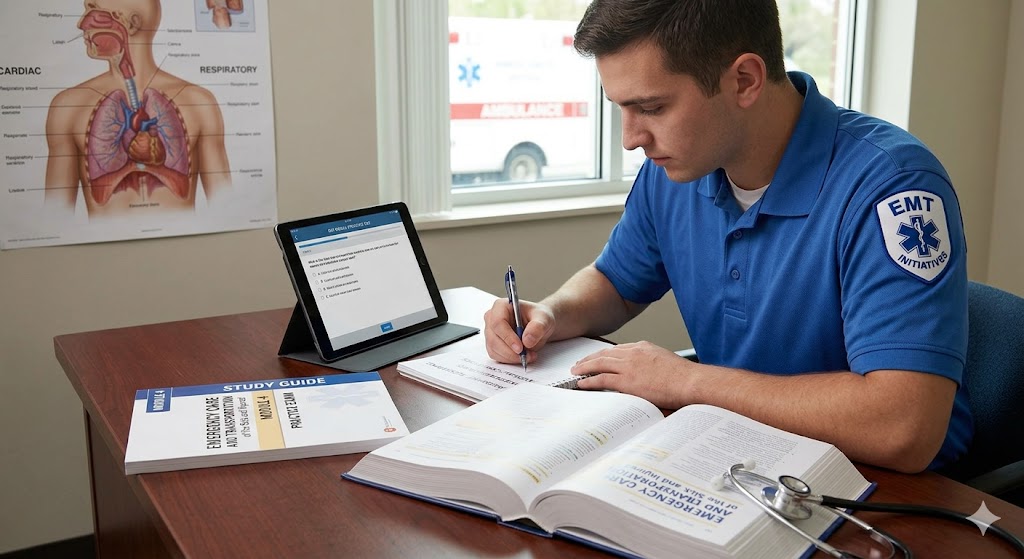
Additional Information
What the Course Entails and Exam Details
While the exact structure of "Module 4" can vary by state and individual training institution, it universally represents the core "Medical Emergencies" syllabus.
A comprehensive EMT Module 4 course typically covers the critical pathophysiology, signs, symptoms, and current, protocol-based management of the following body systems and non-traumatic conditions:
Respiratory Emergencies: Assisting patients with asthma, COPD, pneumonia, pulmonary edema, and respiratory arrest, including the use of inhaled medications and CPAP.
Cardiovascular Emergencies: Recognizing acute coronary syndrome (ACS), managing chest pain, understanding myocardial infarction (heart attack), and executing the entire chain of survival for cardiac arrest, including high-quality CPR and Automated External Defibrillator (AED) operation.
Neurological Emergencies: Assessing and managing strokes (using scales like Cincinnati Prehospital Stroke Scale), seizures, and altered mental status.
Endocrine and Hematologic Emergencies: Focusing heavily on diabetic emergencies (hypoglycemia vs. hyperglycemia) and the administration of oral glucose.
Immunologic Emergencies: Recognizing the signs and symptoms of anaphylaxis and administering epinephrine via an auto-injector.
Toxicology and Substance Abuse: Managing accidental overdoses, poisonings, and adverse drug reactions.
Medical Overview: Integrating all knowledge into a seamless, priority-based medical patient assessment algorithm.
What to Expect in the Final Exam
The actual EMT Module 4 exam—whether administered by your training institution or as part of a state-specific cognitive testing process—typically models the structure of the National Registry of Emergency Medical Technicians (NREMT) cognitive exam, though it focuses specifically on the medical content.
Students should expect a rigorous multiple-choice test format.
Key details you should confirm with your program include:
Format: Multiple-choice questions (MCQs), which can number from 50 to over 100, designed to test not only recall but also critical clinical application of protocols and assessment findings.
Time Limit: Usually structured to require you to answer each question within approximately one minute, mirroring the NREMT’s timed environment.
Passing Score: Most accredited programs require a 70% to 80% to pass and proceed to the next phase of training (often trauma or operations).
Practical Skill Integration: Some programs link the Module 4 cognitive exam with the completion of a "Medical Patient Assessment" practical skills station. In this scenario, you must demonstrate proficiency in the full verbal and physical assessment and management sequence on a standardized patient simulator.
How to Study and Exam Centers
Preparation for the Module 4 exam requires a blend of deep conceptual understanding and practical, algorithmic thinking. A "Module 4" exam often tests a student’s ability to "think like an EMT."
Effective Study Strategies
Master the Assessment Algorithms: Do not just memorize the list of medical emergencies; memorize the order of operations for a Medical Assessment. When presented with a case study, you must know what to check first (e.g., scene safety, initial impression, primary survey, life threats).
Use Active Recall for Pharmacology: Create flashcards for every medication an EMT can carry or assist with (oxygen, oral glucose, aspirin, nitroglycerin, epinephrine, albuterol). For each drug, you must know the Indications, Contraindications, Actions, Dosage, Route of Administration, and Side Effects.
Analyze Practice Questions: Take timed practice quizzes that are specifically categorized for "Medical." Do not just look for the correct answer; analyze why the other three options are incorrect (they may be treatments for a similar but different condition, or the wrong next step in the assessment algorithm).
Utilize Physical Textbooks: Your foundational text (like Emergency Care and Transportation of the Sick and Injured) is your ultimate source of truth. Re-read the chapters corresponding to the covered systems, focusing on pathophysiology and differential diagnosis.
Exam Centers
The Module 4 exam is typically an internal, course-specific test rather than a standardized national exam. It will be scheduled and administered by your authorized EMT training program or local EMS region office.
Most often, this occurs in two formats:
Physical Testing Center: Within your authorized training institution (a community college, fire academy, or dedicated EMT school) under instructor proctoring.
Secure Online Portal: Many programs now use secure, proctored online learning management systems (e.g., JBLearning Navigate, Jones & Bartlett, or customized Moodle/Canvas portals) that require secure browsers.
Job Opportunities from the Course
Upon complete certification as an EMT-Basic or advanced EMT, which this Module 4 exam is a mandatory step toward achieving, a wide range of critical job opportunities within the public safety and healthcare sectors become available.
A dedicated professional with this credential can unlock career paths including:
Emergency Medical Technician (EMT-Basic)
Firefighter/EMT
Private Ambulance EMT (911 Response or Interfacility Transport)
Emergency Room Technician (ER Tech)
Hospital-Based EMT/AEMT
Tactical EMT (with additional training)
Industrial or Special Event EMT
Search and Rescue EMT
Flight EMT (usually requires advanced/paramedic certification, but EMT is the foundation)
Frequently Asked Questions
Reviews
5.0
Based on 0 reviews
Leave a Review
No reviews yet. Be the first to review!