
EMT Pediatric Emergencies Practice Test
$69.00
- Buy to unlock unlimited access to all Quiz questions and Answers in this Quiz.
- After purchase you can print a PDF of the whole quiz at any point. The PDF will contain the questions and the correct answers.
About this Exam
Welcome to your definitive guide on the EMT Pediatric Emergencies Practice Test. This resource is specifically designed for Emergency Medical Technicians (EMTs), Advanced EMTs, Paramedics, and other pre-hospital providers who are preparing for certification or want to solidify their knowledge in the critical, high-stakes field of pediatric care. This practice test focuses on the unique physiological, psychological, and developmental needs of infants and children, preparing you to provide expert care when every second counts. It is a vital tool for anyone taking a specialized pediatric care module or preparing for the NREMT exam's pediatric section.
Ready to test your knowledge?
Buy Now to Access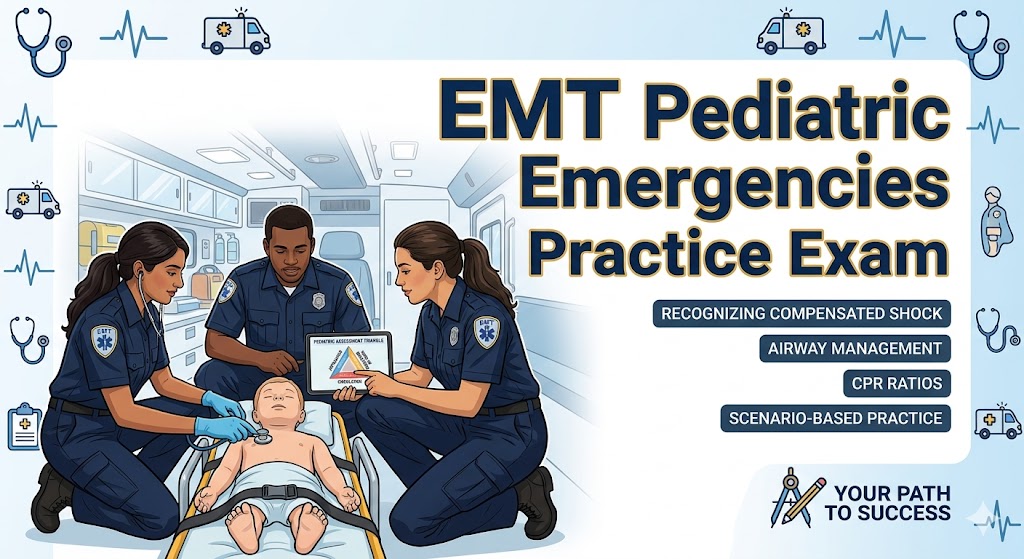
Additional Information
What the Course Entails and Exam Details
A comprehensive study of pediatric emergencies covers the entire spectrum of care from assessment to intervention. It goes beyond adult protocols, teaching you to "think small." Key topics you must master include:
The Pediatric Assessment Triangle (PAT): A rapid, visual assessment tool to establish the general impression, assessing Appearance, Work of Breathing, and Circulation to Skin.
Respiratory Emergencies: Differentiating and treating croup, epiglottitis, asthma, bronchiolitis, respiratory distress, failure, and arrest. You must understand the anatomical differences of the pediatric airway.
Shock and Resuscitation: Recognizing the subtle signs of compensated shock in children and managing decompensated shock. This includes newborn and pediatric CPR, with a focus on proper compression-to-ventilation ratios for one and two rescuers.
Medical Emergencies: Managing seizures (especially febrile seizures), altered mental status, dehydration, meningitis, and poisonous ingestions.
Trauma: Assessing and treating head injuries, fractures, and blunt force trauma, recognizing that children's bodies react differently to impact than adults'.
Special Considerations: Identifying and reporting child abuse and neglect, managing children with special healthcare needs, and family-centered communication.
A practice test simulates this depth, ensuring you are comfortable applying these concepts to diverse scenarios.
What to Expect in the Final Exam
When you face the final examination for a course like NAEMT's Emergency Pediatric Care (EPC) or a similar state-certified pediatric module, you should expect a comprehensive evaluation divided into two main parts:
Written Examination: This part typically consists of a rigorous multiple-choice exam that tests your cognitive knowledge of pediatric pathophysiology, assessment techniques, and treatment protocols. You must achieve a minimum passing score (often around 75% or 80%, depending on the certifying body).
Practical/Skills Evaluation: This is a crucial, hands-on portion where you must demonstrate your proficiency in managing pediatric scenarios. You will be evaluated on your ability to use the PAT, manage an airway, perform CPR, and use specific pediatric equipment (like length-based resuscitation tapes). This is usually a pass/fail component.
The time limit for the written exam is often between 1 to 2 hours, and you must complete all practical skills to receive your certification.
How to Study and Exam Centers
Effective study strategies are the key to success.
How to Study:
Simulate the Exam: Use the EMT Pediatric Emergencies Practice Test multiple times. Focus not just on the right answer, but on understanding why other options are incorrect.
Master the PAT: Be able to describe the components of the Pediatric Assessment Triangle and what findings in each category indicate.
Use Scenarios: Practice with a study partner using scenario-based questions. Role-play assessing and treating a "patient" (like a teddy bear or fellow student).
Know Your Doses and Equipment: Create flashcards for pediatric drug dosages, equipment sizes (e.g., OPA/NPA/BVM), and vital sign ranges by age group.
Focus on Differentiation: Understand the subtle differences in presentation, such as distinguishing compensated from decompensated shock and a foreign body obstruction from croup.
Exam Centers:
You can take specialized pediatric courses and their exams at:
NAEMT Authorized Training Centers: These accredited centers are the primary locations for taking the Emergency Pediatric Care (EPC) course and final exam.
EMS Schools and Community Colleges: Many of these institutions integrate pediatric certifications into their EMT programs or offer them as continuing education.
State EMS Offices: Check your specific state’s EMS website for a list of approved training courses and authorized testing locations for a state-specific pediatric module.
Job Opportunities from the Course
Mastering pediatric emergency care makes you a more competent and versatile first responder, which is highly attractive to employers. Obtaining specialized certifications derived from this course can advance your career in several ways:
Emergency Medical Technician (EMT)
Paramedic
Flight Paramedic / Critical Care Transport
Pediatric Transport Specialist
EMS Field Supervisor / Training Officer
Emergency Room Technician
Firefighter / EMT
Pediatric Nurse (with additional nursing training)
Tactical EMS Provider
Frequently Asked Questions
Reviews
5.0
Based on 0 reviews
Leave a Review
No reviews yet. Be the first to review!