
EMT Special Populations Practice Exam
$69.00
- Buy to unlock unlimited access to all Quiz questions and Answers in this Quiz.
- After purchase you can print a PDF of the whole quiz at any point. The PDF will contain the questions and the correct answers.
About this Exam
This comprehensive study guide is designed to empower Emergency Medical Technicians (EMTs) at all levels—including EMT-Basic, Advanced EMT, and Paramedic—with the knowledge and confidence to master the critical area of special patient populations. Whether you are preparing for your initial certification exam, a specific continuing education (CE) module, or looking to sharpen your skills for real-world interactions, understanding the unique needs of diverse groups is paramount. This area covers a wide spectrum of patients who require specialized assessment techniques and tailored care due to factors such as age, chronic conditions, disabilities, or unique physiological and psychological differences. Completing training in special populations ensures you are equipped to provide effective, compassionate, and life-saving emergency medical services to every member of your community.
Ready to test your knowledge?
Buy Now to Access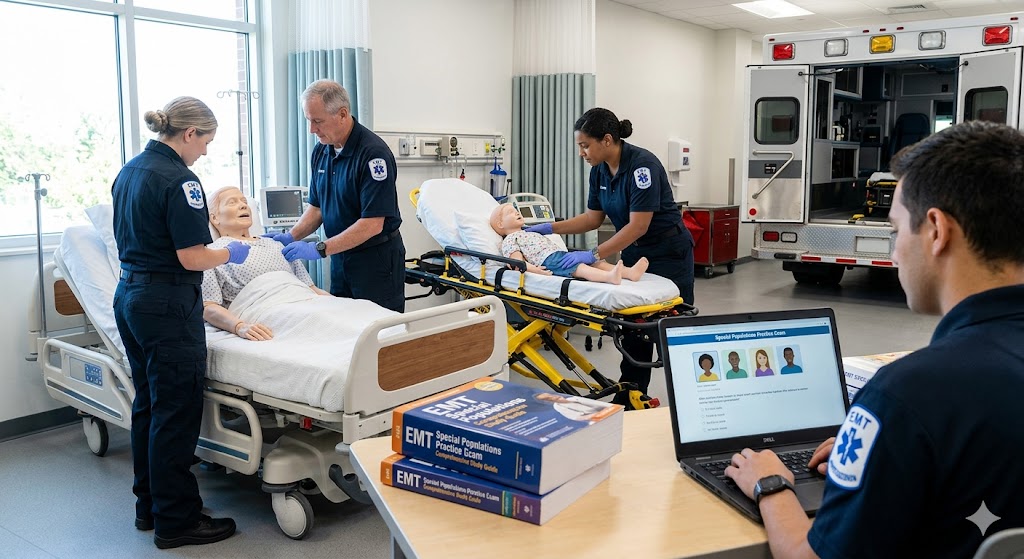
Additional Information
What the Course Entails and Exam Details
This specialized area of study typically delves deeply into several key domains, and a practice exam will rigorously assess your understanding of each:
Pediatric Emergencies: This is a substantial component, covering anatomical and physiological differences in children of varying ages, common childhood illnesses, traumatic injuries, pediatric assessment tools (like the Pediatric Assessment Triangle), respiratory distress, and effectively managing pediatric emergencies, including neonatal care.
Geriatric Patient Care: You will cover the specific challenges of assessing and treating older adults, considering communication strategies, multiple chronic medical conditions, medication interactions, cognitive decline, sensory deficits, and altered physiology. This section focuses on typical presentations of disease, polypharmacy, and common geriatric emergencies like falls, stroke, and cardiovascular issues.
Patients with Disabilities and Special Needs: This domain equips you with communication techniques and adapted assessment methods for interacting with patients who have dynamic disabilities, sensory impairments, developmental delays, or rely on specialized medical technology (e.g., tracheostomies, ventilators).
Obstetric and Neonatal Care: Covering maternal physiological changes, common complications of pregnancy (e.g., pre-eclampsia, placenta previa), assisting with emergency childbirth, and immediate care for the newborn.
Behavioral Emergencies: Understanding different types of behavioral issues, effective de-escalation techniques, safe restraint practices, and caring for patients in crisis while ensuring scene safety.
Bariatric Patients: Addressing specific assessment and movement challenges associated with treating severely obese patients, with a focus on dignity and safety.
Diverse Cultural Backgrounds: Practical strategies for providing culturally sensitive care, considering language barriers, different healthcare beliefs, and community resources.
The EMT Special Populations Practice Exam is designed to mirror the structure and content of official certification modules or continuing education assessments. Expect numerous scenario-based questions that test your ability to apply theoretical knowledge to complex, real-life patient situations involving these diverse populations. It typically focuses on understanding the specific care guidelines and differences for each group, not just general EMT protocols.
What to Expect in the Final Exam
While exact details depend heavily on the specific course, provider, or state requirements, a typical concluding exam on special patient populations often features the following:
Exam Format: The dominant format is typically multiple-choice questions, which may include scenario-based analysis, knowledge recall, and applying protocols to specific patient profiles. Some comprehensive courses might incorporate a practical or scenario simulation component as well.
Passing Score: Requirements for continuing education often demand a passing score in the range of 70% to 80% to receive credit. Standard certification exams generally have their own established passing criteria, which you should confirm with the specific board or provider.
Time Limit: Expect a time limit for the exam, likely ranging from one to two hours, depending on the length and complexity. Efficient time management is key.
Rules: For online exams, ensure you have a stable internet connection and are familiar with the platform. Specific rules regarding the use of materials (sometimes open book for continuing education, strictly closed book for official certification) vary, so always review the guidelines before beginning. You may be required to complete the exam in one sitting.
How to Study and Exam Centers
Maximizing your success on the Special Populations module and exam involves strategic preparation:
Leverage Accredited Resources: Review the dedicated sections on special populations in your official EMT or paramedic textbook. Many reputable continuing education (CE) providers offer specific online modules and practice tests, which are excellent for targeted study and simulation.
In-Depth Review: Focus on understanding why specific populations require adjusted care. For instance, memorize differences in pediatric vitals and airway anatomy compared to adults, the signs of labor, or common complications of chronic geriatric conditions. Create detailed notes and flashcards for quick review of key facts, protocols, and specialized equipment.
Utilize Practice Exams: Actively engage with comprehensive practice tests like this one. Not only does this assess your knowledge, but it also familiarizes you with common question styles, particularly scenario-based questions, and helps you identify areas needing further review. Analyze incorrect answers to understand the rationale.
Simulate Scenarios: Practice applying your knowledge in mock scenarios. Even if your study is cognitive, mentally walking through or discussing complex patient interactions with diverse special needs can sharpen your clinical reasoning. Focus on effective communication techniques for every age and ability level.
Exam Center Information:
For individual continuing education (CE) courses or practice exams, you will almost exclusively access and complete these through online portals provided by accredited EMS training organizations. There isn't typically a single central "exam center" specifically for this single module outside of continuing education.
If this material is part of a larger initial certification or recertification process, the comprehensive test might be taken at an authorized physical testing center, which often includes locations like Pearson VUE centers for national cognitive exams, or specific facilities designated by your state EMS office or training school.
Always verify with your specific course provider or state regulatory body regarding the exact method and location (online or physical) for taking any official or CE exam related to special populations.
Job Opportunities from the Course
While "Special Populations EMT" isn't a separate, distinct job title, completing this crucial continuing education and demonstrating expertise through exams significantly enhances your value and effectiveness in numerous roles across the emergency medical services and healthcare spectrum. Advanced competency in special populations can lead to:
Emergency Medical Technician (EMT, all levels) – Enhanced effectiveness and demand in all ambulance service settings
Paramedic – Deepened specialized knowledge, increasingly vital in comprehensive field care and critical care transport
Firefighter/EMT or Firefighter/Paramedic – Improved patient care outcomes on scene
Hospital Emergency Room Technician – Better able to assist in diverse patient presentations within the ER
Private Ambulance Transport EMT/Paramedic – Specialized capability, particularly relevant for diverse population transfers
Community Paramedic – Enhanced ability to provide proactive and responsive care in diverse communities
Flight Paramedic/EMT – Critical knowledge for handling diverse high-acuity patients during transport
Remote/Offshore EMT/Paramedic – Crucial versatility for managing various patients in isolation
Tactical EMT/Paramedic – Ability to handle diverse medical needs in high-stress, diverse scenarios
Clinical Research/Educational Roles – Opportunities to contribute to special populations research or teach others
Home Healthcare/Long-Term Care Settings – Roles where specialized knowledge of geriatrics, disabilities, and complex conditions is highly valued (especially if combined with other relevant certifications)
Specific Hospital Department Roles – Opportunities in departments like Pediatrics or Geriatrics with appropriate training and experience
Frequently Asked Questions
Reviews
5.0
Based on 0 reviews
Leave a Review
No reviews yet. Be the first to review!