
Energy Resources – Fossil Fuels, Renewables, and Emerging Technologies Practice Test
$69.00
- Buy to unlock unlimited access to all Quiz questions and Answers in this Quiz.
- After purchase you can print a PDF of the whole quiz at any point. The PDF will contain the questions and the correct answers.
About this Exam
The Energy Resources Practice Test is a rigorous self-assessment tool meticulously crafted for anyone aiming to demonstrate proficiency in the full spectrum of energy generation and management. This is not just a test; it is a roadmap to understanding the history, current state, and future innovations of global energy production. It is specifically designed for students, environmental scientists, policy analysts, engineers, and career-changers who need to prove their knowledge base across three primary domains: traditional fossil fuels, established renewable sources, and cutting-edge emerging technologies. By successfully navigating this practice exam, you will confirm your readiness for academic finals or advanced professional certifications in the energy sector.
Ready to test your knowledge?
Buy Now to Access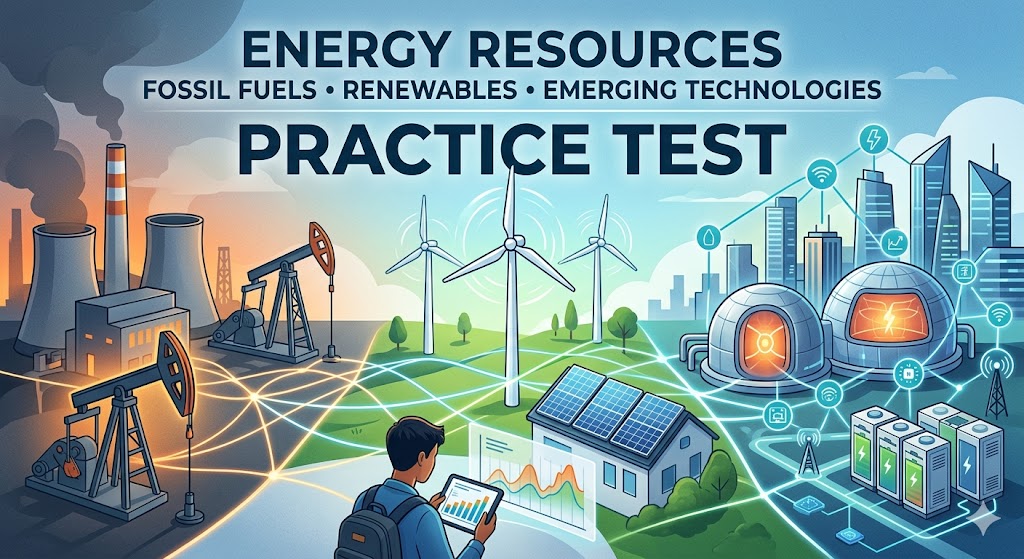
Additional Information
What the Course Entails and Exam Details
The syllabus covered by this practice test is extensive, mirroring the curriculum of top-tier energy management and environmental science programs. You will be tested on your ability to:
Analyze Fossil Fuels: Understand the formation, extraction, processing, and distribution of coal, oil, and natural gas. You must be able to discuss the environmental impact of their combustion, including greenhouse gas emissions, and evaluate strategies for carbon capture and sequestration (CCS).
Evaluate Renewable Energy: Demonstrate comprehensive knowledge of solar, wind, hydroelectric, geothermal, and biomass energy. This includes understanding the principles of energy conversion, the technical specifications of generation systems (e.g., photovoltaic cells, wind turbines), and the challenges of grid integration and intermittency.
Assess Emerging Technologies: Explore the latest innovations that are reshaping the energy landscape. This section requires knowledge of advanced battery storage solutions, hydrogen fuel production (green, blue, and gray), advanced nuclear concepts like fusion and small modular reactors (SMRs), and smart grid technologies for efficient energy management.
Understand Energy Policy and Economics: Be prepared to answer questions about global energy markets, levelized cost of energy (LCOE), energy efficiency measures, and the impact of national and international policies (like carbon pricing or renewable energy mandates).
What to Expect in the Final Exam
The format of the Energy Resources Practice Test is designed to simulate a high-stakes professional certification environment. You should expect the following when you begin:
Question Format: The exam consists primarily of multiple-choice questions (MCQs), which test your recall, application, and analysis skills. Some questions may also use scenario-based problem-solving.
Number of Questions: The full practice test typically contains 100 to 120 questions.
Time Limit: You will have a strict time limit, usually between 120 and 150 minutes, forcing you to manage your time effectively and think quickly.
Passing Score: A passing score is set to reflect a high level of proficiency, typically requires achieving 70% or higher.
Instant Feedback: Unlike a physical exam, one of the greatest benefits of this practice test is receiving instant feedback. You will get a detailed score report showing which domains you mastered and where you need further study, allowing for efficient revision.
How to Study and Exam Centers
Preparing for this test requires a dedicated and multifaceted approach. Here is an optimized study strategy:
Take Multiple Practice Tests: This is the most crucial step. Do not just take this test once; treat every attempt as a full dress rehearsal. Review every incorrect answer and understand why the correct answer was optimal. This will help you identify weak spots and improve your test-taking speed.
Consult Primary Resources: Do not rely on summarize content alone. Study from respected textbooks in energy science, renewable technology handbooks, and the latest reports from organizations like the International Energy Agency (IEA) or the Intergovernmental Panel on Climate Change (IPCC).
Review Case Studies: Be familiar with major global energy projects, both successful and unsuccessful. Understanding real-world examples of grid integration or carbon capture helps cement theoretical knowledge.
Understand Online Exam Portals: This practice test, and many actual certification exams, are delivered entirely online through specialized testing platforms. You can take this test from the comfort of your own home or office, provided you have a stable internet connection. Note: Actual professional certifications may sometimes require taking the final exam at authorized physical testing centers like Pearson VUE or specific university test centers, but this practice test is designed for flexible, online self-assessment.
Job Opportunities from the Course
Achieving a high score on the Energy Resources – Fossil Fuels, Renewables, and Emerging Technologies Practice Test and subsequent certification opens doors to diverse and impactful careers in a rapidly growing sector. The knowledge you validate is highly sought after across private industry, government agencies, and non-profit organizations. Here are some key career paths you can unlock:
Renewable Energy Engineer: Design and implement solar farms, wind parks, or geothermal systems.
Energy Analyst: Analyze market trends, consumption data, and policy impacts to guide business decisions.
Sustainability Consultant: Advise companies on reducing their carbon footprint and adopting sustainable energy practices.
Grid Operations Manager: Overs see the reliable distribution of power, managing the mix of conventional and renewable sources.
Environmental Compliance Specialist: Ensure energy projects adhere to environmental regulations and sustainability standards.
Project Manager (Energy Sector): Lead large-scale projects from traditional pipeline construction to new hydrogen facility development.
Energy Policy Advisor: Work with government bodies to draft legislation that promotes energy security and transition.
Energy Trader: Buy and sell energy commodities (power, gas, carbon credits) in competitive markets.
Frequently Asked Questions
Reviews
5.0
Based on 0 reviews
Leave a Review
No reviews yet. Be the first to review!