
Engine Construction & Installation Practice Test
$69.00
- Buy to unlock unlimited access to all Quiz questions and Answers in this Quiz.
- After purchase you can print a PDF of the whole quiz at any point. The PDF will contain the questions and the correct answers.
About this Exam
The Engine Construction & Installation Practice Test is an essential preparatory tool for aspiring automotive technicians, heavy-duty mechanics, and engineering students. This assessment is designed to gauge a candidate's readiness for official certification exams, such as those offered by ASE (Automotive Service Excellence) or specific manufacturer training programs. It targets individuals who want to validate their knowledge of internal combustion engine components, assembly procedures, and proper installation techniques. Mastering these concepts is crucial for ensuring vehicle performance, reliability, and safety. This practice test provides an excellent opportunity to identify knowledge gaps and build confidence before the high-stakes final exam.
Ready to test your knowledge?
Buy Now to Access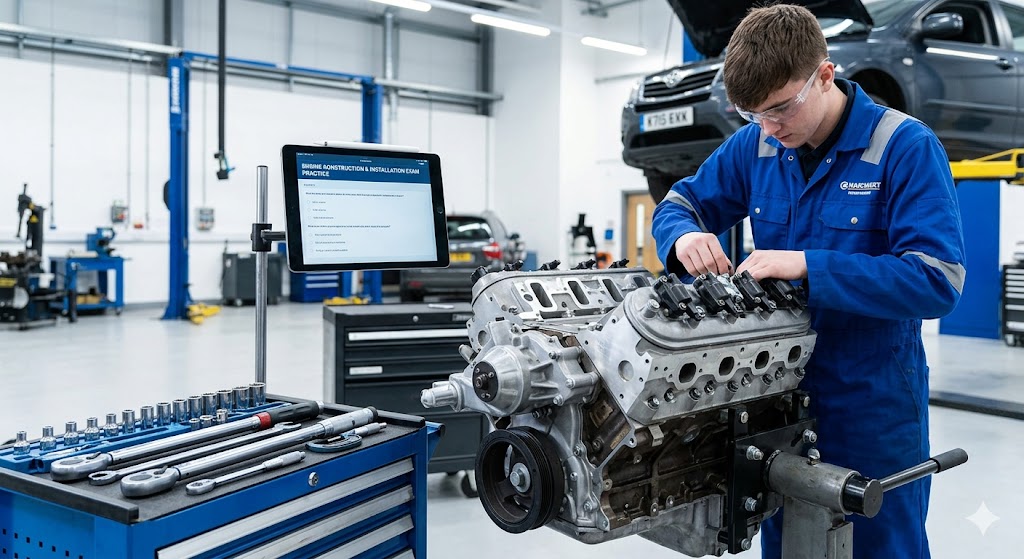
Additional Information
What the Course Entails and Exam Details
The comprehensive curriculum covering Engine Construction & Installation involves a deep dive into the mechanical heart of a vehicle. It entails understanding the specific functions and manufacturing materials of all core engine components, including the cylinder block, pistons, connecting rods, crankshaft, camshaft, and cylinder heads. The syllabus also details complex subsystems like the valvetrain, lubrication, and cooling systems. Crucial skills covered include engine precision measurement using micrometers and dial indicators, proper torque sequences, and diagnostic procedures for identifying internal engine failures. Furthermore, the course focuses on the critical step-by-step procedures for safely removing and installing engines in various chassis configurations.
What to Expect in the Final Exam
While the exact structure can vary depending on the certifying body, the final Engine Construction & Installation exam is typically a computer-based test (CBT). You should expect a timed exam, often allowing between 60 and 90 minutes to complete the assessment. The format consists primarily of 50 to 75 multiple-choice questions designed to test both theoretical knowledge and practical application scenarios. A passing score is generally around 70% to 80%. Questions will cover a range of difficulty, from straightforward recall of component names to complex scenario-based questions requiring you to troubleshoot installation errors or interpret precise measurements. It is vital to manage your time effectively during the exam to ensure all questions are answered.
How to Study and Exam Centers
The most effective way to prepare is to utilize multiple-choice Engine Construction & Installation Practice Tests repeatedly to familiarize yourself with the question formatting and time constraints. Supplement this practice by studying official textbooks, repair manuals, and review guides provided by industry leaders. Engaging in hands-on experience in a workshop setting is invaluable, as physically assembling engine components reinforces theoretical concepts. Create flashcards for critical specifications, torque values, and measurement conversion formulas. When you are ready to take the official certification exam, you will need to locate an authorized testing center. Most major certifications are administered through secure testing networks like Pearson VUE or Prometric, which have physical centers globally. Additionally, many community colleges and dedicated vocational schools serve as authorized testing sites for their students.
Job Opportunities from the Course
Earning a certification in Engine Construction & Installation opens doors to diverse and stable career paths in the automotive and transportation sectors. Successful completion demonstrates a high level of technical competence to potential employers.
Career opportunities unlocked by this certification include:
Automotive Service Technician
Diesel Engine Specialist
Heavy Equipment Mechanic
Marine Engine Technician
High-Performance Engine Builder
Engine Remanufacturer
Field Service Technician
Quality Control Inspector for Automotive Manufacturing
Frequently Asked Questions
Reviews
5.0
Based on 0 reviews
Leave a Review
No reviews yet. Be the first to review!