
Engineering Economics and Management, Laws and Ethics Practice Test
$69.00
- Buy to unlock unlimited access to all Quiz questions and Answers in this Quiz.
- After purchase you can print a PDF of the whole quiz at any point. The PDF will contain the questions and the correct answers.
About this Exam
The Engineering Economics Management Laws Practice Exam is designed to evaluate candidates' understanding of foundational engineering principles, economic decision-making, effective management practices, legal frameworks, and ethical responsibilities in the engineering profession. This practice assessment is tailored for engineering students preparing for final university exams, prospective Professional Engineers (PE) seeking licensure, and industry professionals looking to validate their professional knowledge and compliance skills.
Ready to test your knowledge?
Buy Now to Access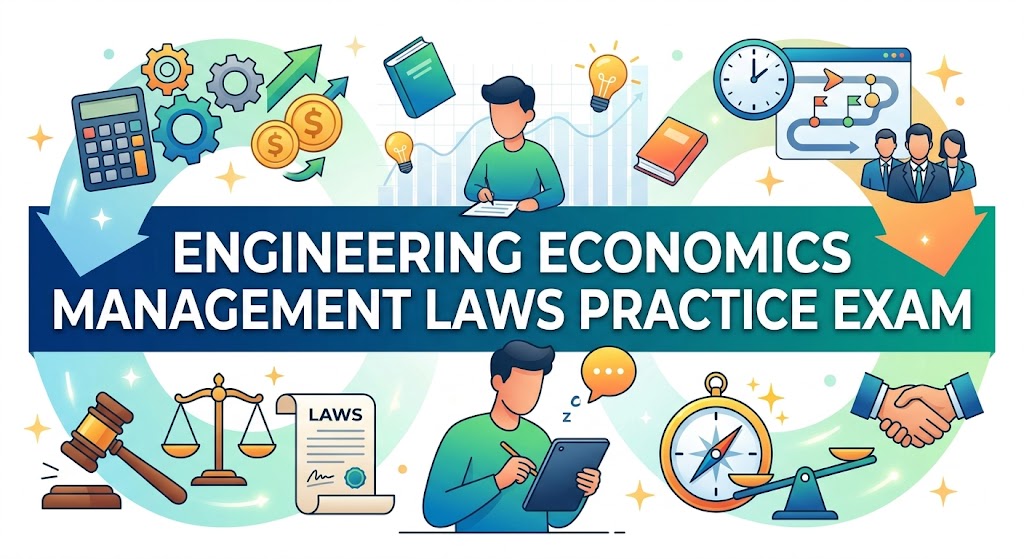
Additional Information
What the Course Entails and Exam Details
This comprehensive practice exam covers a diverse array of essential topics crucial for success in modern engineering roles. The curriculum and content of the final exam typically encompass:
Engineering Economics: Fundamental concepts of time value of money, cash flow analysis, present worth, future worth, annuity calculations, benefit-cost ratios, depreciation methods, and life-cycle costing.
Engineering Management: Principles of project management, team leadership, organizational structure, human resource management, budgeting, scheduling, risk assessment, and decision-making strategies.
Legal Frameworks: Overview of contract law, intellectual property (patents, copyrights, trademarks), environmental regulations, tort law (negligence, liability), labor laws, and occupational health and safety standards.
Professional Ethics: Examination of ethical codes (e.g., ABET, NSPE), conflict of interest policies, sustainable practices, public safety obligations, and ethical considerations in engineering design and business practices.
What to Expect in the Final Exam
While the exact structure may vary by institution or licensing body, the actual exam this practice test simulates generally involves a rigorous and thorough evaluation. Candidates can typically expect:
Format: A balanced combination of multiple-choice questions, true/false statements, and perhaps short problem-solving or essay questions designed to test both theoretical understanding and practical application.
Time Limit: A standard duration for such exams is often between two to four hours, demanding efficient time management and a strong grasp of the material.
Passing Score: The required passing grade varies but often ranges between 60% and 75%, depending on the specific program or examination board.
Rules and Regulations: Exams are typically conducted in a proctored environment, whether in a physical testing center or through an online proctoring service. Calculators and specific reference materials may be permitted under strict guidelines.
How to Study and Exam Centers
Effective preparation is key to achieving success on this exam. Utilize these proven study strategies:
Review Foundation Concepts: Thoroughly study the core principles of engineering economics, management, law, and ethics using textbooks, lecture notes, and reliable academic sources. Focus on understanding the relationships between different concepts.
Practice Problem Solving: Engage in solving numerous practice problems and case studies related to each topic area. This practice enhances critical thinking skills and helps to apply theoretical knowledge to practical scenarios.
Utilize Study Guides and Resources: Take advantage of study guides, sample exams, online courses, and review materials offered by universities, professional engineering societies, or standardized test preparation services.
Collaborate and Discuss: Join study groups or discussion forums to share knowledge, discuss complex concepts, and learn from other candidates' perspectives. Teaching others is also an effective way to reinforce your own understanding.
Simulation Exams: Regularly take simulated practice exams, simulating the actual exam conditions (time limit, environment) as closely as possible. This helps to build exam endurance, improve time management, and identify weak areas that require further review.
Regarding exam locations, candidates should consult their respective educational institutions, engineering licensing boards, or testing service providers. Physical testing centers (such as university campuses or authorized private centers like Pearson VUE) and secure online testing platforms with remote proctoring are common venues for these exams.
Job Opportunities from the Course
Successfully demonstrating proficiency in Engineering Economics, Management, Laws, and Ethics through this practice exam opens doors to a wide range of career opportunities across various engineering disciplines. Employers highly value candidates who possess this unique combination of technical expertise and business acumen. Potential job roles and career paths include:
Project Engineer
Engineering Manager
Construction Manager
Process Engineer
Consulting Engineer
Operations Manager
Quality Assurance Manager
Environmental Engineer
Regulatory Compliance Officer
Contract Administrator
Risk Analyst
Frequently Asked Questions
Reviews
5.0
Based on 0 reviews
Leave a Review
No reviews yet. Be the first to review!