
Enlisted Surface Warfare Specialist (ESWS) Operations Practice Test
$69.00
- Buy to unlock unlimited access to all Quiz questions and Answers in this Quiz.
- After purchase you can print a PDF of the whole quiz at any point. The PDF will contain the questions and the correct answers.
About this Exam
The Enlisted Surface Warfare Specialist (ESWS) qualification is one of the most prestigious and essential certifications available to enlisted personnel in the United States Navy.
This qualification demonstrates a Sailor’s complete mastery of surface ship operations, combat systems, engineering, and damage control.
Specifically, the ESWS Operations practice test is designed to prepare Sailors for the operations section of the common core knowledge, which focuses on the intricate processes and knowledge required to keep a surface vessel functional, ready, and able to execute its mission.
It is designed for all enlisted Sailors serving aboard surface ships, regardless of their rating, who are working toward their "Silver Dolphins."
Ready to test your knowledge?
Buy Now to Access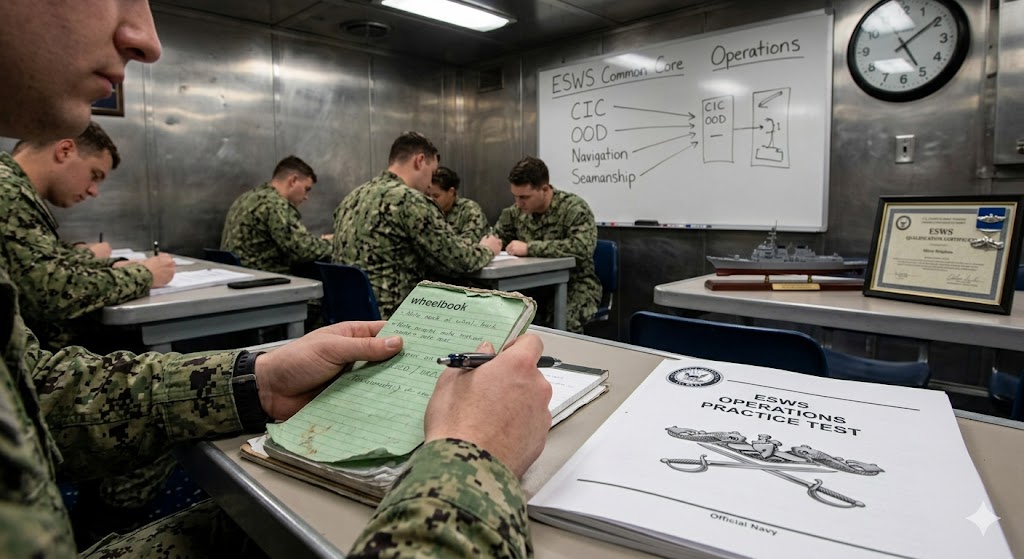
Additional Information
What the Course Entails and Exam Details
The ESWS program is not a traditional "course" with a set classroom schedule but a rigorous, self-paced Personnel Qualification Standard (PQS) system.
The common core material, which this practice test focuses on, covers a broad spectrum of naval knowledge.
Key topics you must master within the "Operations" designation include:
Naval Doctrine and Operations: Understanding the strategic and tactical functions of naval forces, including command and control (C2) and communication systems.
Watchstanding: Knowledge of key operations watchstations, including the Officer of the Deck (OOD), Combat Information Center (CIC) roles, and lookout procedures.
Navigation and Seamanship: Fundamentals of coastal and open-ocean navigation, understanding charts, and standard shiphandling practices.
Aviation and Amphibious Operations: Procedures for handling aircraft, such as helicopters and AV-8Bs, and conducting surface and vertical amphibious assaults.
Intelligence and Cryptology: Overview of how intelligence is gathered, analyzed, and used, and the function of cryptologic teams on board.
Electronic Warfare and Combat Systems: Fundamental principles of electronic warfare (EW), radar systems, and the integration of combat systems.
What to Expect in the Final Exam
After successfully completing the ESWS common core and platform-specific PQS and obtaining all necessary signatures, you will face the qualification exam.
The process typically involves two major components.
The Written Test: This is often the first gate. It is a comprehensive, multiple-choice or short-answer exam administered by your command. The common core exam will test your retention of the knowledge outlined in the PQS. While specific requirements may vary slightly by command, a passing score is generally 80% or higher. There may be a time limit, typically 60 to 90 minutes.
The Oral Board: Upon passing the written test, you will appear before a board of senior qualified Sailors, typically Chief Petty Officers and experienced ESWS coordinators. This is a rigorous, face-to-face interview where they will test your practical application and split-second knowledge by asking situational questions, scenario-based problems, and specific, detailed "how and why" questions on all ESWS topics. Your ability to speak confidently and accurately is critical to passing the board.
Failure in either part usually requires a waiting period and remedial study before you can retest.
How to Study and Exam Centers
Preparation is the key to success for the ESWS program. It is a journey, not just a test.
Effective Study Strategies:
Utilize Your PQS: Treat your PQS book as your Bible. Write notes, highlight key information, and don't just get a signature—ensure you truly understand the knowledge behind it.
Leverage Qualified Shipmates: The single best resource is your fellow Sailors who already wear the ESWS pin. They can offer insights, clarify complex topics, and provide mock questions.
Use Study Guides and Apps: While unofficial, many online study guides, flashcard apps like Anki, and dedicated Navy advancement websites can help with memorization. The practice test you are preparing for is an excellent example of a vital tool to assess your knowledge gaps.
Create or Join a Study Group: Working with other Sailors who are at the same stage of their qualification can divide the learning load and keep you motivated.
Take Detailed Notes: A dedicated "green wheelbook" to jot down procedures, acronyms, and systems is a time-tested study aid.
Exam Center Location:
Unlike civilian certifications, there is no physical "exam center" like Pearson VUE. The ESWS exam is entirely command-managed and administered on-site. You will take the written test and face the oral board within your own command's spaces, typically aboard your ship or within designated training areas on a naval base. Your command’s ESWS Coordinator handles scheduling and testing.
Job Opportunities from the Course
Earning the Enlisted Surface Warfare Specialist qualification is a significant milestone in a Navy career and unlocks numerous opportunities for advancement and leadership within the Fleet.
While it does not transfer directly to a specific civilian job title, it demonstrates management, technical competence, and leadership skills that are highly valued by all employers.
Within the U.S. Navy, earning the ESWS designator "(SW)" is often a prerequisite for:
Key Leadership Roles: Including Leading Petty Officer (LPO), Divisional LCPO, or Command Master Chief (CMC).
Advancement in Rating: Highly competitive sailors are often required to be warfare-qualified to be considered for promotion to Senior Chief Petty Officer (E-8) and Master Chief Petty Officer (E-9).
Special Programs and Assignments: Opportunities in highly desired billets, special commands, and instructor roles frequently require warfare qualification.
Commissioning Programs: Programs that allow enlisted Sailors to become officers, such as the Seaman to Admiral (STA-21) program, view a completed ESWS qualification as a strong indicator of officer potential.
Frequently Asked Questions
Reviews
5.0
Based on 0 reviews
Leave a Review
No reviews yet. Be the first to review!