
Enriched Air Nitrox (SC-EAN) Practice Test
$69.00
- Buy to unlock unlimited access to all Quiz questions and Answers in this Quiz.
- After purchase you can print a PDF of the whole quiz at any point. The PDF will contain the questions and the correct answers.
About this Exam
The Enriched Air Nitrox (SC-EAN) certification is one of the most popular continuing education scuba diving courses in the world.
This exam and its associated course are designed for certified divers who want to safely extend their no-decompression limits and maximize their time underwater.
By breathing a blend of air with a higher oxygen concentration and a lower nitrogen concentration, divers can safely enjoy longer bottom times and shorter surface intervals.
This study guide is tailored to help scuba enthusiasts, aspiring dive professionals, and underwater photographers thoroughly prepare for the theoretical requirements of the Enriched Air Nitrox certification.
Ready to test your knowledge?
Buy Now to Access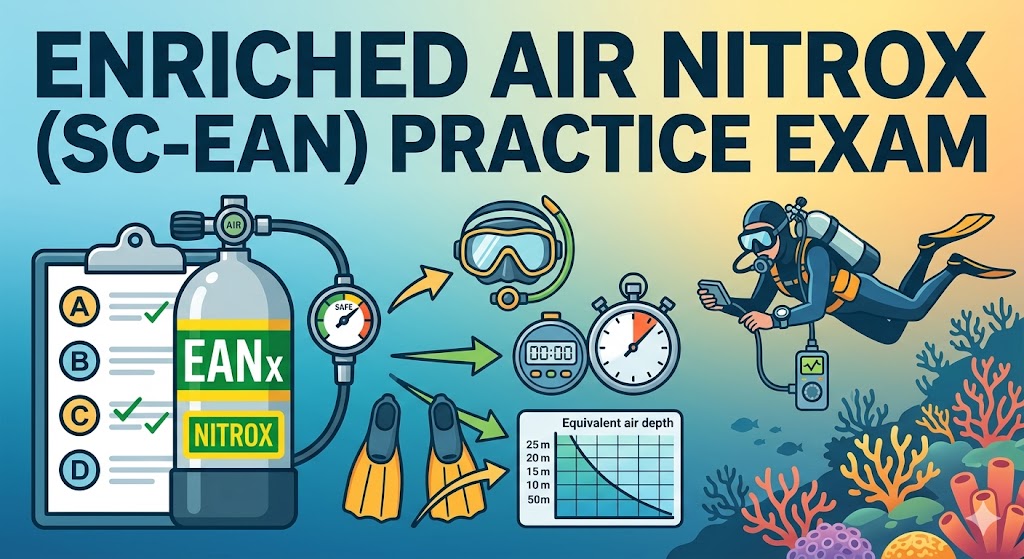
Additional Information
What the Course Entails and Exam Details
The Enriched Air Nitrox course focuses heavily on the science, equipment, and safety protocols necessary for diving with oxygen-enriched air.
Students will delve into the physiological effects of breathing varying oxygen partial pressures, specifically focusing on how to manage and prevent central nervous system (CNS) oxygen toxicity.
A core component of the syllabus involves learning how to personally analyze the oxygen content in a scuba cylinder using an oxygen analyzer.
Additionally, you will learn how to accurately fill out an enriched air fill log to verify your cylinder's contents.
The coursework also emphasizes calculating Equivalent Air Depth (EAD) and learning how to properly set your personal dive computer to match the specific Nitrox blend you will be breathing.
What to Expect in the Final Exam
The SC-EAN final exam assesses your understanding of Nitrox diving principles through a multiple-choice format.
Depending on your specific certification agency, the exam generally consists of 25 to 50 questions.
To achieve certification, candidates are typically required to secure a passing score of 75% or higher.
While there is usually no strict time limit for the written exam, most students complete it within one to two hours.
The exam is conducted in a closed-book format, meaning you must rely entirely on your retained knowledge of dive tables, computer settings, and gas analysis procedures.
Alongside the written theoretical test, candidates must also complete a practical application session, which involves correctly analyzing two Nitrox cylinders and properly logging the results under the supervision of a certified instructor.
How to Study and Exam Centers
Effective preparation requires a combination of reading, practical repetition, and taking practice exams.
Start by thoroughly reading your official Enriched Air Diver manual or completing the assigned digital eLearning modules provided by your agency.
Take special care to master the mathematical concepts related to partial pressure limits and oxygen exposure limits.
Utilizing Enriched Air Nitrox SC-EAN practice exams is one of the best strategies to familiarize yourself with the phrasing of the questions and the logic behind the answers.
When you are ready, the final written exam is typically administered either online through the authorized digital portals of major training agencies (like PADI or SSI) or in person.
Physical testing takes place at authorized local dive shops, scuba schools, or designated training centers under the proctored supervision of a qualified diving instructor.
Job Opportunities from the Course
Earning your Enriched Air Nitrox certification is a critical stepping stone that unlocks numerous professional underwater career paths.
Divemaster: A crucial leadership role where Nitrox certification is often mandatory for guiding deep or repetitive dives on liveaboard vessels.
Scuba Instructor: To teach Nitrox courses and safely conduct multiple training dives per day, instructors must hold this certification themselves.
Scientific Diver: Marine biologists and oceanographers frequently rely on Nitrox to maximize their underwater research and data collection times.
Underwater Photographer and Videographer: Extended bottom times are essential for waiting for the perfect shot, making Nitrox an industry standard for underwater media professionals.
Commercial and Public Safety Diver: Police search and rescue teams, as well as commercial inspectors, utilize enriched air to increase safety margins and operational time during complex underwater missions.
Frequently Asked Questions
Reviews
5.0
Based on 0 reviews
Leave a Review
No reviews yet. Be the first to review!