
Enterprise MQT Practice Test
$69.00
- Buy to unlock unlimited access to all Quiz questions and Answers in this Quiz.
- After purchase you can print a PDF of the whole quiz at any point. The PDF will contain the questions and the correct answers.
About this Exam
The Enterprise MQT Practice Exam is a crucial stepping stone for IT professionals aiming to master the intricacies of modern message queuing and middleware technologies. As businesses increasingly rely on distributed, asynchronous systems to ensure reliability, scalability, and seamless integration, expertise in this domain is in high demand. This practice exam is designed for system architects, integration engineers, DevOps professionals, and software developers who work with enterprise-grade messaging solutions.
Ready to test your knowledge?
Buy Now to Access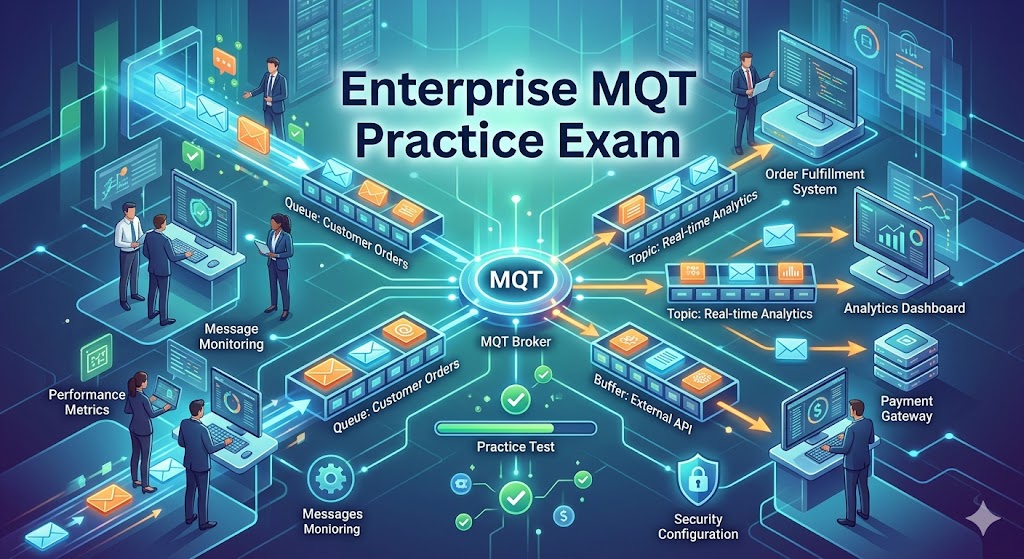
Additional Information
What the Course Entails and Exam Details
The comprehensive curriculum covers the fundamental and advanced concepts of enterprise message queuing systems. Students who utilize this study guide and practice test will find they can effectively demonstrate proficiency in a variety of essential domains. The core topics, syllabus, and skills assessed by this exam include:
Core Concepts of Asynchronous Messaging: Understanding decoupled architecture, message producers and consumers, queues, and topics (publish-subscribe).
Architecture of Leading MQ Systems: In-depth knowledge of popular messaging middleware platforms (e.g., Apache Kafka, RabbitMQ, ActiveMQ, IBM MQ).
Message Properties and Delivery Guarantees: Mastering data serialisation, message routing, persistence, and guaranteeing delivery (at-least-once, at-most-once, exactly-once).
Scalability, High Availability, and Fault Tolerance: Techniques for clustering, replication, load balancing, and implementing robust disaster recovery scenarios.
Enterprise Integration Patterns (EIPs): Application of common design patterns like Content-Based Router, Message Filter, Scatter-Gather, and Idempotent Consumer.
Security and Compliance: Implementing authentication, authorization, and encryption for secure message transport and storage.
Monitoring, Performance Tuning, and Troubleshooting: Practical skills for assessing system health, optimising throughput, and diagnosing common failure points in complex MQT deployments.
The "Enterprise MQT" typically is a professional-level, multiple-choice assessment designed to validate a candidate's practical and theoretical knowledge of these topics.
What to Expect in the Final Exam
Navigating the final Enterprise MQT exam requires not just knowledge, but an understanding of the test's structure and rules. While specific formats can vary depending on the certifying body (if applicable), typical exams adhere to these parameters:
Exam Format: Candidates should prepare for a computer-based test consisting primarily of multiple-choice and scenario-based questions. Some higher-level exams may include performance-based tasks, requiring candidates to interact with virtual environments to solve practical integration problems.
Number of Questions: The final exam usually comprises 60 to 80 questions.
Time Limit: Professionals will typically have 90 to 120 minutes to complete the test.
Passing Score Requirements: A passing score is generally set around 70% to 75%.
Exam Rules: The test is usually proctored, whether in-person or online. Candidates may be prohibited from using external notes, a search engine, or physical aids.
Successful completion of the exam often grants a certification that is valid for a specific period, after which recertification or continuing education may be required.
How to Study and Exam Centers
Effectively preparing for the Enterprise MQT exam involves a balanced approach of theoretical study and practical hands-on experience. Candidates should adopt a strategic study plan to maximise their chances of success.
Actionable Study Strategies
Utilise Practice Exams: Engaging with comprehensive practice tests, like the one this guide is based upon, is the single most effective way to identify knowledge gaps and get comfortable with the exam format. Use the feedback to focus your study time on weak areas.
Read Official Documentation and Books: Deep-dive into the official documentation of at least one major messaging platform. Complement this with highly-rated textbooks on Enterprise Integration Patterns and distributed systems.
Build a Lab Environment: Theory only goes so far. Set up a local or cloud-based lab using free or trial versions of queuing systems. Practice installing, configuring, clustering, and troubleshooting real MQ clusters.
Complete Hands-On Projects: Implement sample applications that use messaging for complex integration, such as a simulated e-commerce system that handles orders asynchronously or a real-time data ingestion pipeline.
Where to Take the Exam
The process for registering and taking the exam depends on the context, as "Enterprise MQT" may refer to a specific vendor-agnostic standard or a tailored internal enterprise assessment.
Authorized School or Physical Testing Centers: Many formal technical certifications are administered through global testing networks, such as Pearson VUE or Prometric. Candidates can register for a specific date and time to take the proctored exam at an authorized facility.
Online Proctored Portals: A popular and convenient option is to take the exam remotely via an online proctoring service. This requires a reliable internet connection, a private room, and a computer with a webcam. The candidate is monitored in real-time by a live proctor.
Before registering, candidates must verify the exact steps for their specific chosen pathway.
Job Opportunities from the Course
Gaining an Enterprise MQT certification or demonstrating equivalent proficiency significantly enhances an IT professional’s career prospects. The ability to design, implement, and manage robust messaging infrastructure is a critical skill in modern enterprise architecture.
This certification or a demonstrated equivalent opens clear career paths in the following specialized roles:
Integration Architect: Design the overall integration strategy for complex enterprise systems, ensuring reliable and scalable communication.
Cloud Integration Engineer: Implement and manage messaging solutions in cloud environments (AWS, Azure, Google Cloud).
Middleware Administrator: Maintain and troubleshoot high-availability messaging clusters for critical business applications.
DevOps Engineer (Integration Focus): Automation of deployment, scaling, and monitoring of enterprise integration pipelines.
Senior Software Developer (Distributed Systems): Develop applications that leverage asynchronous messaging for enhanced performance and resilience.
Solutions Architect (Middleware): Advise organizations on the best messaging and middleware technologies to meet their business needs.
Frequently Asked Questions
Reviews
5.0
Based on 0 reviews
Leave a Review
No reviews yet. Be the first to review!