
Entry Level Firefighter Practice Exam
$69.00
- Buy to unlock unlimited access to all Quiz questions and Answers in this Quiz.
- After purchase you can print a PDF of the whole quiz at any point. The PDF will contain the questions and the correct answers.
About this Exam
The Entry Level Firefighter Practice Exam is designed for individuals aspiring to begin a vital and rewarding career in the fire service.
This comprehensive guide serves as a foundational assessment, mirroring the core competencies required to succeed in the official written examination for recruits.
It is specifically tailored for prospective firefighters, emergency medical technicians (EMTs), and paramedics looking to enter public safety.
By successfully utilizing this resource, candidates can identify knowledge gaps, build testing confidence, and understand the mental aptitude needed for emergency response scenarios.
Ready to test your knowledge?
Buy Now to Access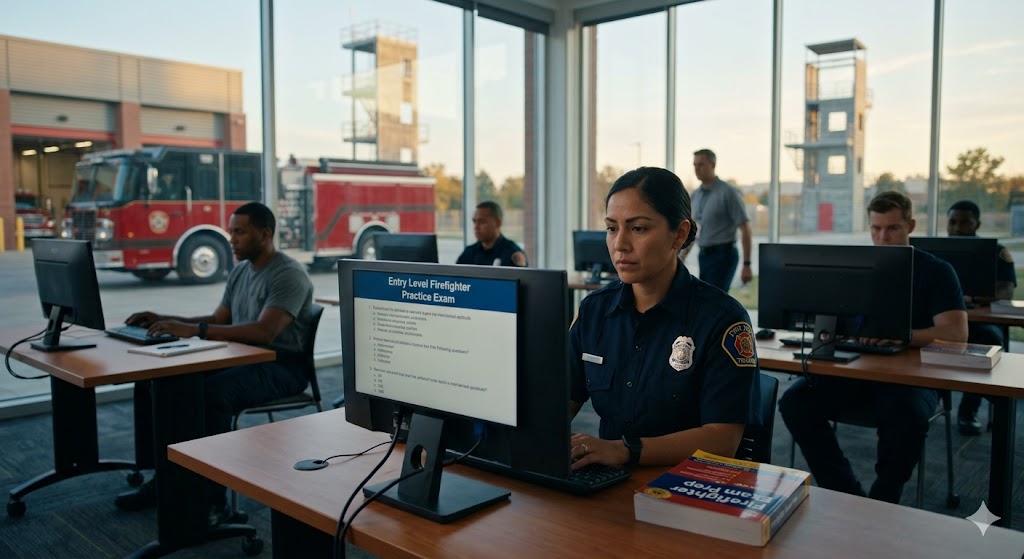
Additional Information
What the Course Entails and Exam Details
The Entry Level Firefighter Practice Exam focuses on the essential cognitive skills rather than specific fire suppression knowledge, as recruits will be taught technical skills in the academy.
The primary domains covered within this practice assessment include reading comprehension, mathematical reasoning, and situational judgment.
You will encounter problems designed to test logical reasoning, mechanical aptitude, and your ability to process information quickly under pressure.
Additionally, some variations of this exam include sections dedicated to human relations, observation skills, and simple spatial orientation to simulate real-world navigation tasks.
Understanding these core areas is vital, as they form the basis of the cognitive ability tests utilized by standardizing bodies like the National Firefighter Selection Inventory (NFSI).
What to Expect in the Final Exam
The actual final written exam is typically a multiple-choice assessment that must be completed within a strict, proctored environment.
Depending on the specific jurisdiction and test version, the number of questions generally ranges from 100 to 150.
You will face a rigorous time limit, often requiring you to maintain a steady pace throughout the two to three-hour testing window.
While passing scores vary slightly by agency, a result of 70% or higher is commonly the minimum threshold required to continue in the hiring process.
However, many departments prioritize top-tier candidates, meaning a higher score significantly improves your ranking on the eligibility list.
It is critical to remember that this written portion is usually just the first phase of a multi-stage selection process that includes physical agility, interviews, and background checks.
How to Study and Exam Centers
The most effective way to prepare is to utilize a combination of standard study guides and timed practice examinations to simulate actual test-day conditions.
Review basic mathematics—including fractions, decimals, and basic algebra—as these are frequent hurdles for many candidates.
Additionally, you should practice active reading by summarizing complex texts, which helps sharpen reading comprehension and information retention skills.
When you are ready to take the official exam, you will likely do so through a computerized testing portal or at a designated physical center.
These official exams are usually administered either directly by the hiring fire department, local civil service commissions, or standardized testing centers like Pearson VUE.
Candidates must register for the exam in advance through their specific municipality's human resources department or the appropriate civil service website.
Job Opportunities from the Course
Successfully passing this entry-level written assessment is the critical first hurdle that opens the door to numerous impactful careers in the fire and emergency services sector.
Completion of the entire recruitment process (including the academy) leads to direct job titles such as:
Probationary Firefighter
Career Firefighter
Volunteer Firefighter
Firefighter/EMT (Emergency Medical Technician)
Firefighter/Paramedic
Industrial Firefighter
Wildland Firefighter
Airport Firefighter (Aircraft Rescue and Firefighting)
Frequently Asked Questions
Reviews
5.0
Based on 0 reviews
Leave a Review
No reviews yet. Be the first to review!