
Environment in Humanitarian Action Practice Test
$69.00
- Buy to unlock unlimited access to all Quiz questions and Answers in this Quiz.
- After purchase you can print a PDF of the whole quiz at any point. The PDF will contain the questions and the correct answers.
About this Exam
The Environment in Humanitarian Action (EHA) certification and its corresponding practice test are designed for humanitarian practitioners, logisticians, program managers, and technical specialists who work in disaster response and early recovery. As 80% of humanitarian crises now involve environmental triggers or consequences, this certification provides essential knowledge on how to effectively integrate environmental considerations into all phases of humanitarian action. The goal is to maximize sustainable reconstruction, build long-term resilience, and ensure that aid efforts do not cause further environmental degradation. This is a critical credential for anyone committed to do-no-harm principles and forward-thinking, effective humanitarian response.
Ready to test your knowledge?
Buy Now to Access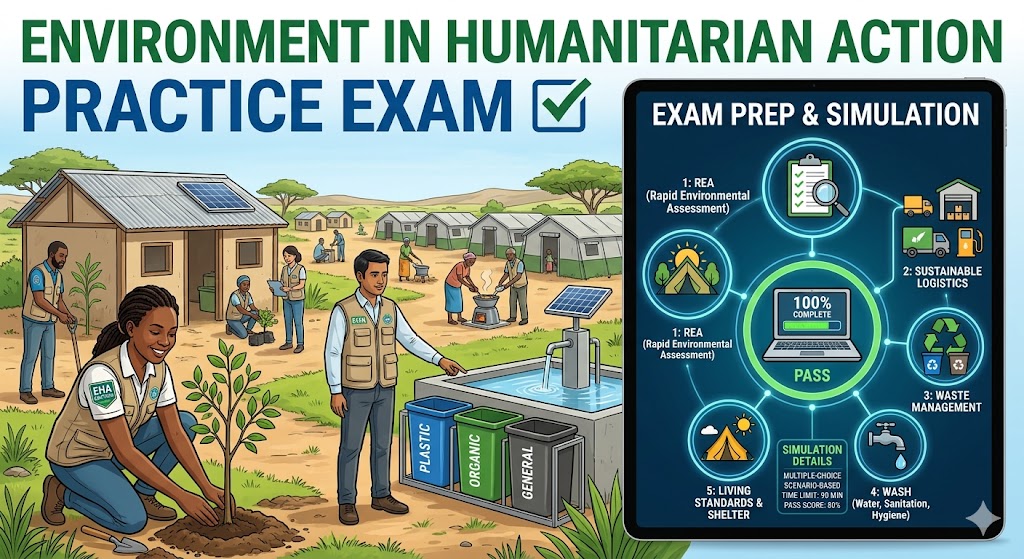
Additional Information
What the Course Entails and Exam Details
A comprehensive Environment in Humanitarian Action course covers a diverse range of technical and mainstreaming topics. The syllabus focuses on providing tools and methodologies to assess and mitigate the environmental impact of relief operations.
Core topics typically include:
Environmental Mainstreaming: Integrating environment across all humanitarian sectors (WASH, Shelter, Food Security, etc.).
Rapid Environmental Assessments (REA): Learning to use tools like the MIRA (Multi-Cluster Initial Rapid Assessment) with an environmental lens.
Sustainable Logistics and Supply Chain: Reducing carbon footprint, efficient waste management, and sustainable procurement in emergencies.
WASH and the Environment: Safeguarding water sources and managing waste in camp and non-camp settings.
Shelter and Settlement: Sustainable materials, site selection, and minimizing ecosystem disruption.
Livelihoods: Promoting green and climate-resilient economic recovery.
Policy and Legal Frameworks: Understanding the environmental responsibilities of humanitarian organizations.
What to Expect in the Final Exam
The final Environment in Humanitarian Action certification exam is typically delivered in an online, multiple-choice format. It is designed to test both theoretical understanding and practical application of environmental tools.
Key details of the exam standard:
Format: 30–50 multiple-choice and scenario-based questions.
Delivery: Online proctored exam via a designated organizational portal.
Passing Score: Typically requires a score of 70–80% to pass.
Time Limit: Usually 60–90 minutes.
Attempts: Most platforms offer multiple attempts with a waiting period in between.
Certification: Successful completion results in a digital, verifiable certificate often from a UN body (like UNEP/OCHA), a large International NGO, or an accredited training platform (e.g., Kaya or FutureLearn).
How to Study and Exam Centers
To prepare for the exam, a systematic approach is essential. Your primary study resource is the course material provided by the certifying body.
Effective study strategies:
Complete the Core Modules: Go through all video lessons, readings, and interactive activities in the official course.
Utilize the Practice Test: Use this practice test as a diagnostic tool. Identify weak areas and return to the specific module to review.
Study Key Concepts and Tools: Focus on mastering the purpose and application of environmental assessment tools (like REA).
Scenario Practice: Many questions are scenario-based. Think through how to apply principles in real-world relief situations.
Exam Centers: This exam is typically delivered through an online platform. You do not need to visit a physical testing center like Pearson VUE. Organizations that offer this certification have their own established secure portals, making the exam globally accessible to humanitarian staff and volunteers working in any location with an internet connection.
Job Opportunities from the Course
Earning the Environment in Humanitarian Action certification unlocks specific career paths within the international aid and development sectors. It demonstrates a rare and sought-after dual competence in emergency response and sustainability.
This certification is highly valuable for the following job titles and career paths:
Environmental Affairs Officer (in humanitarian or UN context)
Programme Manager/Project Coordinator
WASH Specialist (with environmental focus)
Logistics Officer/Supply Chain Manager
Shelter and Settlements Officer
M&E (Monitoring and Evaluation) Officer (environmental indicators)
Disaster Risk Reduction (DRR) Specialist
Climate Change Adaptation Advisor
Livelihoods and Economic Recovery Officer
NGO Environmental Advisor
Frequently Asked Questions
Reviews
5.0
Based on 0 reviews
Leave a Review
No reviews yet. Be the first to review!