
Environmental Awareness 1 Practice Test
$69.00
- Buy to unlock unlimited access to all Quiz questions and Answers in this Quiz.
- After purchase you can print a PDF of the whole quiz at any point. The PDF will contain the questions and the correct answers.
About this Exam
The Environmental Awareness 1 Practice Test is designed as a foundational stepping stone for individuals seeking to validate their core knowledge of environmental issues, sustainability principles, and individual responsibility. This examination is typically an introductory-level assessment used by corporations, educational institutions, and vocational training centers to ensure a baseline understanding of how human activities affect the planet. It is suitable for a wide audience, including entry-level employees across all sectors, students in environmental science or sustainability programs, and anyone interested in demonstrating their commitment to eco-friendly practices. By focusing on fundamental concepts, it prepares candidates for further, more specialized environmental training.
Ready to test your knowledge?
Buy Now to Access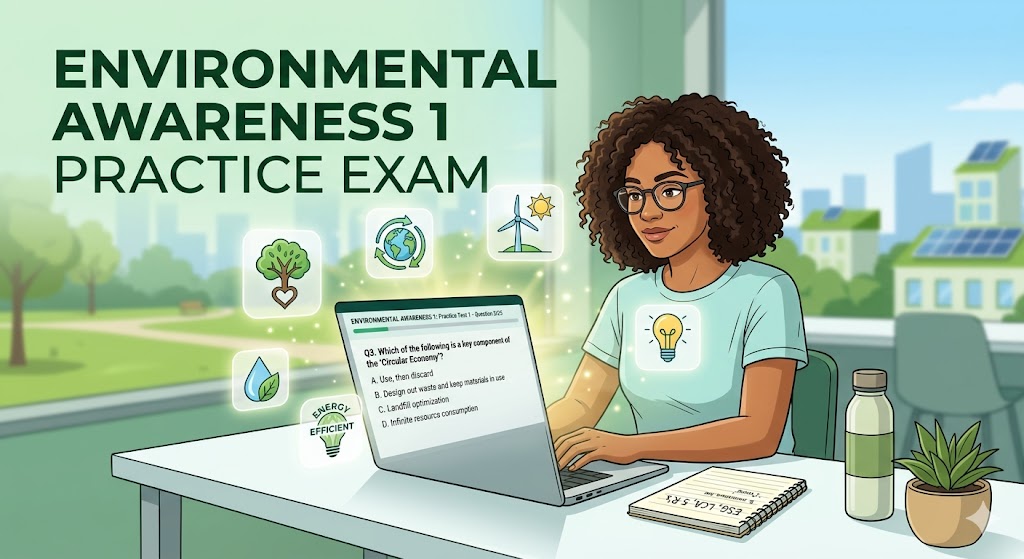
Additional Information
What the Course Entails and Exam Details
This comprehensive course and the subsequent practice test cover critical topics essential for fostering environmental stewardship. While specific curricula may vary slightly by institution, you can expect the Environmental Awareness 1 framework to include:
Environmental Impacts: Understanding the core concepts of the environment, ecosystem services, and the major global environmental challenges such as climate change, biodiversity loss, and habitat destruction.
Sustainability Principles: Definitions of sustainability, the three pillars (environmental, social, and economic), and the principles behind the circular economy versus the linear model.
Pollution Prevention and Control: Identification of different types of pollution (air, water, land, plastic, noise) and their sources, alongside methods for reduction and mitigation.
Resource Efficiency: Techniques for reducing resource consumption, including energy efficiency, water conservation, and the importance of sustainable purchasing choices.
Waste Management: Understanding the waste hierarchy (reduce, reuse, recycle, recover, dispose) and practical, everyday actions to minimize waste in personal and professional settings.
Personal and Corporate Social Responsibility: Recognizing the role of individual actions (carbon footprint) and organizational policies in environmental protection.
What to Expect in the Final Exam
The actual Environmental Awareness 1 final exam is often structured to be accessible yet thorough, assessing knowledge retention from the associated course material. When you advance to the official certification, you can generally expect:
Exam Format: Most foundational environmental awareness exams are online-based and primarily utilize multiple-choice questions (MCQs), true/false, or matching exercises.
Question Count: The number of questions typically ranges from 10 to 50, designed to be completed efficiently.
Passing Score: A common standard for foundational workforce certifications is an 80% pass mark, ensuring a high level of competency. Some specialized technical certifications, like the core section of the EPA 608, might have different proctored and non-proctored passing requirements.
Time Limit: The exam is usually timed, often providing between 30 and 90 minutes, which is ample for the number of questions.
Rules: For introductory online corporate training, the test is often unproctored and may allow for retakes if the initial attempt is unsuccessful. However, for recognized industry certifications, the rules will be stricter.
How to Study and Exam Centers
Preparation is the key to success. To effectively study for the Environmental Awareness 1 exam, utilize a mix of strategies:
Review Course Material: Thoroughly go through any provided study guides, video modules, or text documents. Summarize key definitions and concepts.
Create Visual Aids: Use flashcards for environmental vocabulary, key regulations, and the waste hierarchy steps.
Engage with Practice Questions: Leverage this practice test and search for similar online resources. Analyze why a correct answer is correct and why the distractors are wrong.
Focus on Practical Application: Connect theoretical knowledge to real-world actions you can take at home or work to improve resource efficiency or reduce waste.
Taking the Exam: The Environmental Awareness 1 Exam is most frequently administered via online learning portals provided by your employer or educational institution upon completion of the mandatory training. Many providers offer 24/7 access, allowing you to take the test at your convenience in a suitable environment. For some widely recognized certifications, you might be directed to specialized online platforms or, in rare cases for advanced levels, proctored physical testing centers. Always consult your specific course provider for exact details on registration and access.
Job Opportunities from the Course
Successfully completing an Environmental Awareness 1 course and passing its assessment opens doors to diverse career paths where environmental knowledge is increasingly valued, particularly in organizations striving to improve their ESG (Environmental, Social, and Governance) metrics. While this is an foundational certification, it enhances employability for the following roles and serves as a prerequisite for advancement:
Sustainability Coordinator
Environmental Field Technician
Waste Management Officer
Facilities Manager (with a focus on sustainability)
Green Building Associate
Environmental Compliance Assistant
Corporate Social Responsibility (CSR) Associate
Eco-Tourism Guide
Sustainable Purchasing Officer
Entry-Level Forester or Conservation Worker
Frequently Asked Questions
Reviews
5.0
Based on 0 reviews
Leave a Review
No reviews yet. Be the first to review!