
Envoy General Emergency KV Practice Test
$69.00
- Buy to unlock unlimited access to all Quiz questions and Answers in this Quiz.
- After purchase you can print a PDF of the whole quiz at any point. The PDF will contain the questions and the correct answers.
About this Exam
The Envoy General Emergency Knowledge Validation (KV) is a critical, mandatory safety certification for all flight crew members employed by Envoy Air, a major regional carrier for American Airlines. This examination validates that Pilots and Flight Attendants possess the essential, life-saving knowledge and practical skills required to manage aircraft emergencies. It ensures that every crew member can flawlessly execute safety protocols, operate emergency equipment, and lead an evacuation under the most high-pressure scenarios. Whether you are entering initial training or undergoing recurrent qualification, passing the General Emergency KV is a foundational requirement to continue your career as a commercial aviation professional at Envoy Air.
Ready to test your knowledge?
Buy Now to Access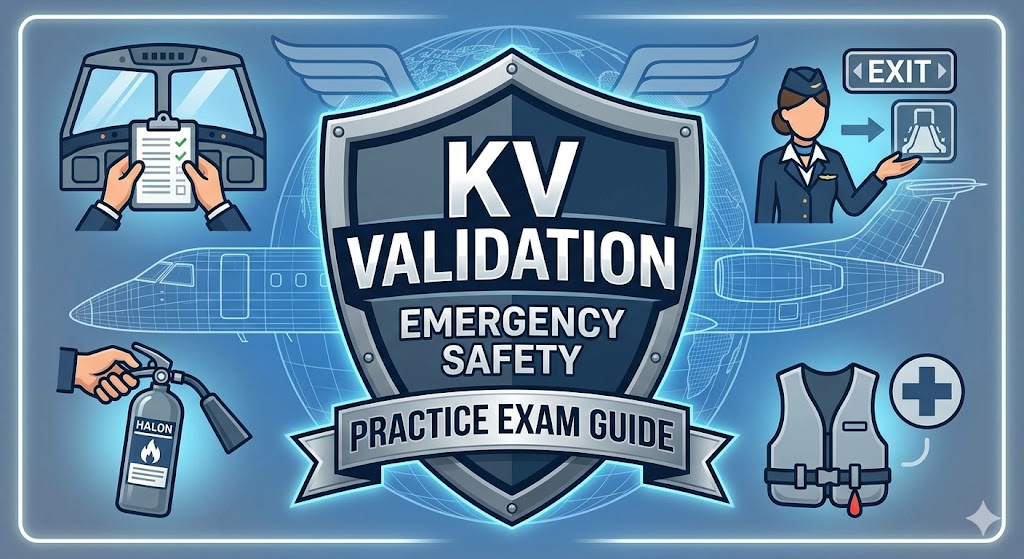
Additional Information
What the Course Entails and Exam Details
The General Emergency KV course is not merely theoretical; it is a rigorous, hands-on program designed to make safety second nature. It prepares crew members to react instantly and correctly to a wide array of anticipated and unanticipated emergency situations.
The core syllabus covers the following critical domains:
Emergency Equipment Pre-flight: Master the precise locations and inspection procedures for every piece of emergency equipment on the Envoy fleet (e.g., ERJ-170/175, Embraer 140/145), including fire extinguishers (Halon, Water), Protective Breathing Equipment (PBE), Automated External Defibrillators (AED), First Aid Kits, Grab 'n Go Kits, and life vests.
Standard Operating Procedures (SOP): Rigorous review of standard, abnormal, and emergency checklists. This includes flight deck memory items for pilots and cabin management protocols for flight attendants.
Evacuation Procedures: Deep knowledge of evacuation commands, signals, exit operation (land and ditching), slide deployment (manual and automatic), and passenger management for ambulatory and non-ambulatory passengers.
Threat and Error Management (TEM): Understanding how to identify potential safety threats and implement effective countermeasures to prevent errors.
Medical Emergencies: Recognition and response protocols for common in-flight medical situations, including hypoxia, seizures, and unconscious passengers.
Fire Fighting: Precise, immediate procedures for fighting various types of in-flight fires (e.g., hidden fires, high-energy battery fires).
Security: Understanding security codes, signals between the flight deck and cabin, and response to security threats.
What to Expect in the Final Exam
The General Emergency KV is a comprehensive assessment that often consists of multiple components. You must demonstrate mastery in each area to achieve a passing grade, which is set at an exceptionally high standard to ensure safety.
Knowledge Validation (KV) Examination: This is a high-stakes, typically computer-based test that assesses your theoretical understanding of all emergency procedures, equipment operation, and SOPs.
Oral Knowledge Validation: For pilots, this component involves a face-to-face evaluation by a Check Airman. You will be asked to recite memory items, limitations, and standard procedures exactly as written.
Practical Performance (Checkride): This component is conducted in a full-motion flight simulator or a cabin mock-up. You will be evaluated on your ability to physically execute the procedures you learned—managing a fire, leading an evacuation, or commanding a complex simulator scenario.
Passing Score: The standard for safety is uncompromising. The required passing score on the written exam is often 100%, though some policies allow for minor errors if immediately corrected and revalidated. On practical evaluations, you must demonstrate proficiency in every required subtask; failing a single critical item can result in an unsatisfactory grade.
Time Limits and Specific Rules: The exams are structured with specific time constraints, reflecting the urgency of real-world emergencies. Memory items must be delivered instantly and accurately without reference to manuals.
How to Study and Exam Centers
Preparation for the General Emergency KV must be comprehensive and procedural. "Cramming" is not an option; procedural knowledge must be hard-wired into your memory.
Actionable Study Strategies
Master the Manuals: Your primary resources are your Envoy Air-issued manuals: the Flight Operations Manual (FOM), Flight Attendant Manual (FAM), and On Board Emergency Checklist (OEC). Know them inside and out.
Use Spaced Repetition: Use flashcard systems like Anki to memorize equipment pre-flight checks, memory items, and limitations. Review them daily.
Role-Play Mock Emergencies: Practice with colleagues. One person acts as the evaluator while the other runs through a mock evacuation command sequence or a fire drill. This physical repetition builds muscle memory.
Visualize the Process: Close your eyes and mental-rehearse the entire sequence of an emergency, from the initial signal to the successful evacuation. Visualize where every piece of equipment is located on your aircraft type.
Focus on Flow and Verbatim: Evaluators expect specific phrasing and an exact flow of procedures. Prioritize "saying the words" exactly as written in the approved checklists.
Exam Centers
The General Emergency KV is internal to Envoy Air. The examination does not take place at generic centers like Pearson VUE. It is administered directly at Envoy Air's official training facilities. The primary location is Envoy’s headquarters training center in Irving, Texas (near DFW Airport). Examinations and checkrides are conducted by authorized Envoy Air Check Airmen, Instructors, and Training Managers.
Job Opportunities from the Course
A satisfactory completion of the General Emergency KV is not a generalized certificate; it is the final validation required to perform specialized roles within the aviation industry, specifically for Envoy Air and its parent, American Airlines.
Successfully navigating this exam unlocks and secures the following primary career paths:
Commercial Airline Pilot: Specifically, First Officer or Captain roles for Envoy Air.
Airline Flight Attendant: Required safety qualification for all in-flight crew positions at Envoy Air.
Envoy Air Check Airman / Instructor: Highly skilled individuals who evaluate and train other crew members, a career path that opens after demonstrating exemplary performance as a Pilot or Flight Attendant.
Major Airline Employment: Passing this rigorous airline qualification program is viewed favorably by major carriers, facilitating advancement to mainline American Airlines or other legacy networks.
Aviation Safety Manager: Internal corporate safety roles overseeing training quality and operational risk management within Envoy Air.
Frequently Asked Questions
Reviews
5.0
Based on 0 reviews
Leave a Review
No reviews yet. Be the first to review!