
EPA Dental Nursing Interview Practice Test
$69.00
- Buy to unlock unlimited access to all Quiz questions and Answers in this Quiz.
- After purchase you can print a PDF of the whole quiz at any point. The PDF will contain the questions and the correct answers.
About this Exam
This [EPA Dental Nursing Interview Practice Test] guide is a vital resource designed specifically for aspiring dental nurses preparing for the End Point Assessment (EPA) interview stage of their dental nursing apprenticeship or qualification. The EPA interview is not just a formal chat; it's a critical, rigorous evaluation where a qualified assessor probes a candidate's knowledge, understanding, and real-world application of essential dental nursing principles, communication skills, professionalism, and commitment to the role. This comprehensive practice test and guide are meticulously crafted to simulate that challenging environment, helping candidates gain deep insights into the types of questions, the required level of detail, and the confident, articulate delivery expected for a successful assessment. It is the perfect tool for any dental nursing student or apprentice looking to build their confidence, sharpen their communication skills, and thoroughly practice articulating their clinical knowledge and professional attributes before the actual event.
Ready to test your knowledge?
Buy Now to Access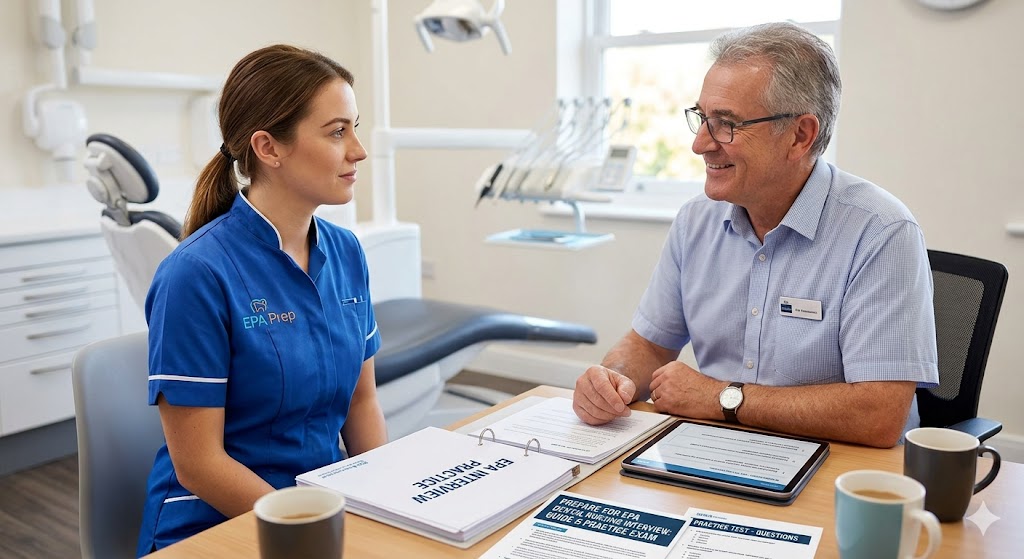
Additional Information
What the Course Entails and Exam Details
While this resource is focused on preparation and practice for the final assessment rather than being a formal course itself, it entails a deep dive into the practical application of your dental nursing knowledge. The actual EPA dental nursing interview is a comprehensive exploration and verification of a candidate's competency across numerous key areas defined by the relevant apprenticeship standards. Topics you can expect to be probed on include:
Clinical Knowledge: Demonstrating sound understanding of various dental procedures (from standard fillings and extractions to potential complex treatments or specialized dentistry), instruments, materials, and equipment, and your precise role and support in each.
Health and Safety: Explaining robust procedures for infection control (e.g., sterilization processes, decontamination protocols, use of PPE), hazardous waste management (e.g., handling sharps, mercury, clinical waste), radiation safety, and general workplace safety in a dental environment.
Patient Care and Communication: Articulating how you effectively communicate with diverse patient groups, children, anxious patients, or those with specific needs, explaining treatment processes, addressing concerns, and ensuring patient comfort and informed consent. Handling medical emergencies is a critical communication and action scenario often included.
Legal and Ethical Frameworks: Discussing the importance of patient confidentiality (GDPR/Data Protection), duty of care, safeguarding procedures, and understanding the ethical principles and professional standards set by regulatory bodies like the GDC.
Teamwork and Professionalism: Describing how you work effectively within the wider dental team, your understanding of different team member roles, conflict resolution, and the importance of ongoing professional development and reflection (e.g., maintaining CPD records).
What to Expect in the Final Exam
The actual EPA dental nursing interview is a structured, professional conversation between the candidate and an independent EPA assessor. This is not a multiple-choice or practical skills-based test (though those might form other parts of the overall EPA, like the multiple-choice exam or observation). This specific component will involve:
Format: A one-on-one, potentially prolonged, question-and-answer session.
Content: The assessor will ask a series of open-ended, scenario-based, and probing questions, requiring you to explain concepts in detail, provide specific examples from your training and experience, and demonstrate your critical thinking and communication skills.
Preparation: You may be asked about specific situations you’ve encountered, how you handled them (reflecting your portfolio or experiences), or hypothetical situations to gauge your understanding and judgement.
Time Limit: Interviews typically last between 30 to 60 minutes, and candidates must manage their time to provide comprehensive yet concise answers.
Passing Score/Requirements: There isn't a fixed "score" in the traditional sense, but assessors evaluate whether you have met all the specified knowledge, skills, and behavior criteria outlined in the dental nursing apprenticeship standard for the interview component. The passing standard is a demonstration of competent, professional, and safe practice across all these areas. You are typically graded as Pass, Distinction, or Fail, with clear criteria for each. Consistency and the depth of your answers are key.
How to Study and Exam Centers
Preparation for this interview component requires a blend of deep knowledge, reflective practice, and strong communication skills. Here’s how you can study effectively and where you will typically take the real assessment:
Study Strategies:
Thorough Review: Revisit all core topics of dental nursing: infection control, dental anatomy, charting, materials, procedures, health & safety regulations (GDC, CQC, GDPR, etc.), and patient care protocols.
Practice with Real-World Scenarios: Work through practice questions that present various situations – from dealing with an anxious child to explaining a complex procedure – and formulate detailed, articulated answers, drawing from your own experiences.
Reflect on Your Experience: Go back through your work placement or portfolio. Think about specific situations you encountered (challenging interactions, successful procedures, handling emergencies, learning moments) and be ready to discuss these as concrete examples. The STAR method (Situation, Task, Action, Result) is excellent for structuring your examples.
Use Practice Resources: Utilize practice questions, mock interview materials, and guides specifically tailored for the EPA dental nursing interview, ensuring they cover the relevant apprenticeship standards.
Peer-to-Peer Mock Interviews: Practice with fellow dental nursing students, mentors, or even colleagues. Have them act as the assessor, ask challenging questions, and provide constructive feedback on both your content and delivery.
Focus on Communication and Professionalism: It's not just what you know, but how you communicate it. Work on speaking clearly, confidently, and concisely. Practice active listening and presenting yourself professionally, even under potential pressure. Research typical assessor feedback points and avoid overly casual language or rambling.
Exam Centers and Formats: The final EPA interview is usually organized and facilitated by your training provider or the End Point Assessment Organisation (EPAO) appointed for your apprenticeship. Here’s what you need to know:
Format: The interview is most commonly conducted via a secure online video conferencing platform (like Microsoft Teams, Zoom, or a specific EPAO portal), allowing remote assessment from a suitable, quiet location with a strong internet connection. In some cases, depending on individual circumstances and EPAO policies, a face-to-face interview at a training center, workplace, or assessment center might be arranged.
Booking: Your training provider, in consultation with you and your employer, will generally manage the process of booking your EPA and coordinating the interview time and format once they determine you are ready. They will provide all necessary details, access links, and technical instructions.
Job Opportunities from the Course
A successful EPA dental nursing interview, and the subsequent completion of your dental nursing qualification and EPA, doesn't just unlock job opportunities; it signifies that you are a qualified and competent professional ready to embark on a fulfilling and respected career. A completed dental nursing course opens doors to diverse and rewarding pathways, including:
Qualified Dental Nurse (General Practice): The fundamental and widely available role, providing crucial support across a range of dental treatments in high-street practices.
Qualified Dental Nurse (Specialist Practice): Working in environments focused on specific areas like orthodontics (braces), endodontics (root canals), periodontics (gum health), prosthodontics (restorations), oral surgery, or paediatric dentistry.
Dental Nurse in a Hospital Environment: Often involving more complex cases, oral maxillofacial surgery assistance, or specialized care for patients with complex medical needs, typically in a multidisciplinary team.
Dental Nurse in Community or Public Health Services: Working to improve oral health in local communities, often involved in school screening programs, dental health promotion, and potentially providing dental care to vulnerable groups.
Dental Nurse in the Armed Forces: Serving as a dental nurse within the military, providing dental care to service personnel and potentially their families, both domestically and sometimes internationally.
Specialist Coordinator or Practice Manager (with further experience/training): Progressing to management roles within a dental practice, overseeing administrative functions, coordinating clinical teams, and potentially managing budgets and operations.
Dental Hygiene/Therapy (following additional qualification): Successful completion of a dental nursing course and experience is a common entry requirement for progression to study for a career as a dental hygienist or therapist.
Teaching/Assessing in Dental Nursing: Qualified and experienced dental nurses can progress to teaching, training, and assessing the next generation of dental nursing students.
Dental Receptionist/Administrator (often as a progression from nursing): Leveraging clinical knowledge to efficiently manage the front-of-house and administrative aspects of a dental practice.
Dental Equipment/Materials Sales or Support (with further development): Utilizing product knowledge to work for manufacturers or suppliers within the dental industry.
Frequently Asked Questions
Reviews
5.0
Based on 0 reviews
Leave a Review
No reviews yet. Be the first to review!