
EPA Lead Inspector Practice Exam
$69.00
- Buy to unlock unlimited access to all Quiz questions and Answers in this Quiz.
- After purchase you can print a PDF of the whole quiz at any point. The PDF will contain the questions and the correct answers.
About this Exam
The Environmental Protection Agency (EPA) Lead Inspector certification is a vital credential for environmental professionals dedicated to public health and safety.
This certification is designed for individuals who wish to conduct surface-by-surface investigations to determine the presence, location, and condition of lead-based paint in housing, child-occupied facilities, commercial buildings, and industrial structures.
Acquiring this certification demonstrates a high level of expertise in identifying potential lead hazards, which is essential for ensuring compliance with federal, state, and local regulations and for protecting vulnerable populations, especially children, from the detrimental health effects of lead exposure.
Ready to test your knowledge?
Buy Now to Access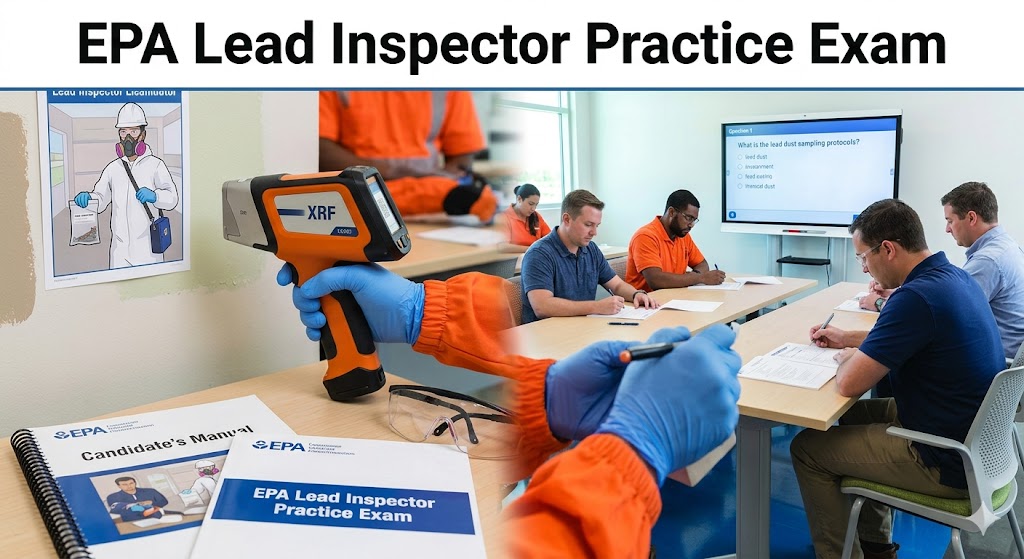
Additional Information
What the Course Entails and Exam Details
Before a candidate can take the official EPA Lead Inspector third-party exam, they must complete an accredited initial training course.
The comprehensive 24-hour course covers a specific syllabus designed to equip participants with the knowledge and skills necessary for the field.
Key areas of focus include:
Health Effects of Lead: Understanding the toxic properties of lead and how exposure impacts human health.
Regulatory Review: A deep dive into Federal (EPA, HUD), State, and local regulations pertaining to lead-based paint.
Roles and Responsibilities: Defining the specific duties of a certified Lead Inspector versus other disciplines like Risk Assessors or Supervisors.
Building Components: Learning building construction nomenclature and identifying elements that typically contain lead-based paint.
Inspection Methodologies: Mastery of non-destructive testing using X-ray Fluorescence (XRF) instruments, as well as destructive methods like paint chip collection.
Sampling Protocols: Proper techniques for collecting and submitting dust, soil, and water samples for laboratory analysis.
Clearance Standards: Understanding the criteria for post-abatement visual inspections and clearance testing.
Report Preparation: Formulating clear, accurate, and regulatory-compliant final inspection reports that summarize all findings and offer recommendations.
What to Expect in the Final Exam
The final step to certification is passing the EPA's "third-party" exam. This exam is a rigorous evaluation of the candidate's proficiency.
Candidates can expect the following details:
Format: The exam is entirely composed of 115 multiple-choice questions. Each question presents four distinct alternatives from which to choose.
Content Areas: The test covers several primary content areas, including:
Effects of Lead (approx. 10 questions)
Risk Assessment (approx. 20 questions)
Lead-Based Paint Inspection protocols, including XRF calibration and usage (approx. 25 questions)
Testing/sampling methods for lead in different media and interpretation of results (approx. 25 questions)
Abatement Options and their characteristics (approx. 10 questions)
Passing Score: A criterion-referenced approach is used, where a panel of Subject Matter Experts determines the minimum number of correct answers for a competent practice. While 70% is a common benchmark in similar tests, you should strive for excellence in all areas.
Rules: The exam is scheduled for a specific time slot and must be taken under proctored conditions. You may take it online or in person.
How to Study and Exam Centers
Effective preparation is the key to success. A multi-faceted approach will maximize your chances of passing the exam on your first attempt.
Study Strategies:
Review the Initial Course Materials: Your accredited training course provides the absolute foundation. Thoroughly review all manuals, lesson plans, and notes.
Utilize Practice Exams: This is one of the most effective study methods. A well-constructed practice exam, like the [EPA Lead Inspector Practice Exam], will familiarize you with the types of questions and the specific format, reducing anxiety and identifying knowledge gaps.
Flashcards: Create flashcards for critical definitions, clearance standards (e.g., dust-lead hazard levels), regulatory limits, and equations (for XRF data).
Hands-On Practice: Re-familiarize yourself with the XRF instrument and sampling equipment you used during your course.
Exam Centers:
To take the third-party exam, you must first complete your application for certification through the EPA's Central Data Exchange (CDX) online portal.
Upon approval, you will receive an "exam letter" with detailed instructions. EPA-authorized exams can be scheduled through a third-party testing vendor, currently including:
Online Proctored Exams: Accessible from a personal computer with a webcam and microphone, subject to technical and system requirements.
In-Person Testing Centers: Physical testing sites are located throughout the country. Your exam letter will guide you to a searchable locator of authorized testing centers in your region, such as Scantron or Meazure Learning.
Job Opportunities from the Course
A certified EPA Lead Inspector is a highly valued asset across many industries. This qualification unlocks diverse career paths, including:
Lead-Based Paint Inspector: Performing surface-by-surface inspections for residential and commercial properties.
Hazardous Building Material Inspector: A broader role that includes inspecting for asbestos, lead, mold, and other environmental hazards.
Environmental Technician: Conducting field sampling and data collection for environmental assessments.
Coatings Inspector: Evaluating the condition and content of industrial and commercial coatings.
Environmental Health and Safety (EHS) Manager: Overseeing compliance and safety programs for manufacturing, construction, and property management firms.
Project Manager: Leading abatement and remediation projects involving lead hazards.
Code Enforcement Officer: Working for local municipalities to enforce health and safety regulations related to lead.
Frequently Asked Questions
Reviews
5.0
Based on 0 reviews
Leave a Review
No reviews yet. Be the first to review!