
Epic Radiant Practice Test
$69.00
- Buy to unlock unlimited access to all Quiz questions and Answers in this Quiz.
- After purchase you can print a PDF of the whole quiz at any point. The PDF will contain the questions and the correct answers.
About this Exam
The Epic Radiant certification is designed for IT professionals and healthcare applications analysts who implement, configure, and support Epic's Radiology Information System (RIS). Radiant is the vital hub for managing the entire imaging workflow, from scheduling patient appointments and tracking their arrival to documenting contrast administration, facilitating radiologist reporting, and communicating critical results. This exam validates a candidate's knowledge of both the technical build of the system and the operational workflows within a radiology department.
Ready to test your knowledge?
Buy Now to Access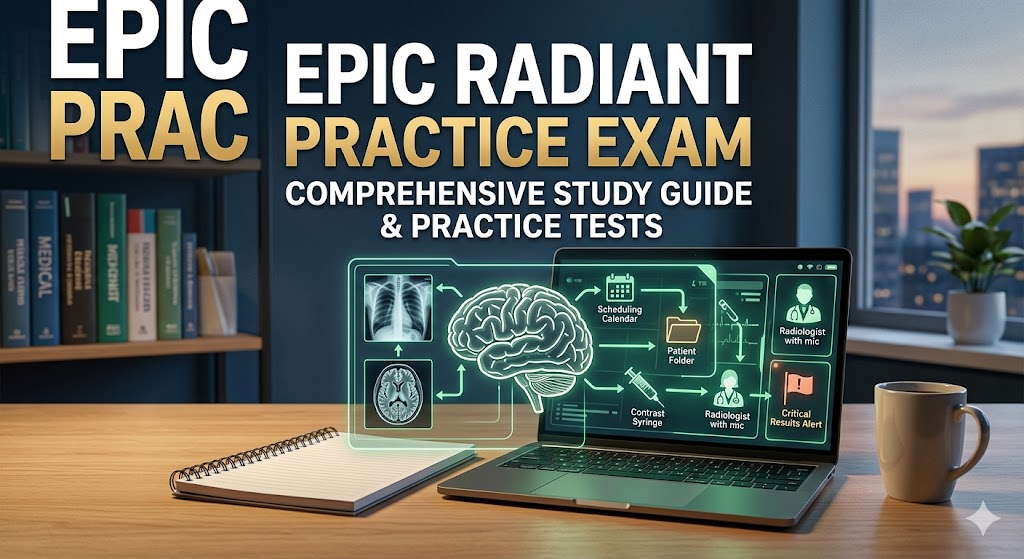
Additional Information
What the Course Entails and Exam Details
Preparation for this certification typically involves an in-depth training course, often six to eight weeks of classroom and practical instruction with Epic experts. The curriculum covers a broad range of topics, including:
Imaging Order Management: Understanding CPOE (Computerized Physician Order Entry) and transcription of paper orders for various modalities (e.g., CT, MRI, X-ray).
Radiology Workflows: Mastering patient flow monitoring, arrival, and scheduling template design.
Documentation and Tools: Proficiency with Epic’s unique SmartTools, including SmartText, SmartLinks, SmartLists, and Wildcards to streamline clinical and technical documentation.
Advanced Clinical Workflows: Handling invasive procedures, contrast administration, follow-up tracking, and documenting pre/post-procedure care.
Resulting and Communication: Learning the build and process for critical and abnormal result communication to ensuring efficient radiologist reporting.
Charge Capture and Integrity: Understanding how to ensure accurate billing and troubleshooting operational issues that impact modality operations.
What to Expect in the Final Exam
The actual Epic Radiant certification exam is a comprehensive assessment of your understanding. Here is a breakdown of what you can expect on test day:
Format: The exam predominantly consists of multiple-choice and multiple-select questions. In some instances, it may also include practical, scenario-based simulation questions that require you to navigate or perform a configuration within a simulated Epic Hyperspace environment.
Time Limit: Candidates are generally allotted two or more hours to complete the exam. It is crucial to manage your time effectively between reviewing questions and, if allowed, looking up information.
Open Book/Open Notes: A significant detail of Epic certification exams is that they are typically open-book and open-note. This means you can reference your authorized Epic training companions, manuals, and personal notes during the test.
Passing Score: To obtain certification, you must achieve a specific required passing score. While the exact score can vary by module and version, it represents a standard of mastery necessary to support the system.
How to Study and Exam Centers
Studying for an open-book exam requires a strategic approach focused on organization, not just memorization. Here are actionable study methods for success:
Master the Manuals: Thoroughly review all Epic training materials. Understand the structure of the training companion. Make liberal use of highlighting and sticky notes, or use the search function on PDF versions. Creating a comprehensive, annotated index or table of contents is a top strategy for quick reference during the timed exam.
Utilize Practice Tests: Engage with a high-quality Epic Radiant Practice Test. These exams, often containing hundreds of exam-style questions, are invaluable. Do not just find the right answer; understand the practical reasoning and system logic behind it. This builds the critical thinking skills needed for the official exam's scenario-based questions.
Hands-on Practice: Spend significant time in your Epic playground or training environment. Build, configure, and navigate workflows. The more familiar you are with Epic Hyperspace, the faster you can verify answers or complete simulation questions.
Form Study Groups: Collaborating with colleagues who are also preparing can provide new insights, clarify complex topics, and keep you motivated.
The official Epic Radiant certification exam is taken after the training process. The primary method is to take it at an Epic-authorized location or through a secure, online proctored portal. In many cases, it is proctored in a controlled environment provided by your employer (a healthcare facility that uses Epic) or at specific authorized testing centers, which may include organizations that partner with major testing services like Pearson VUE.
Job Opportunities from the Course
Earning your Epic Radiant certification unlocks a well-defined and lucrative career path in healthcare IT. Key job opportunities include:
Epic Radiant Analyst
Senior Clinical Applications Analyst (Radiology)
Epic Radiant/Cupid (Cardiology) Specialist
Epic Radiant Trainer or Instructional Designer
Epic Radiant Implementation Consultant
Radiology Informatics Manager
Healthcare IT Project Manager (with a Radiant focus)
Frequently Asked Questions
Reviews
5.0
Based on 0 reviews
Leave a Review
No reviews yet. Be the first to review!