
EPPP Clinical Psychology Practice Exam
$69.00
- Buy to unlock unlimited access to all Quiz questions and Answers in this Quiz.
- After purchase you can print a PDF of the whole quiz at any point. The PDF will contain the questions and the correct answers.
About this Exam
The Examination for Professional Practice in Psychology (EPPP) is the gold standard licensing examination for psychologists across the United States and Canada. This comprehensive assessment is designed for doctoral-level graduates in psychology who have completed their required supervised practice and are seeking independent licensure. Passing the EPPP demonstrates that a candidate possesses the foundational knowledge, clinical skills, and ethical understanding necessary to practice clinical psychology safely and effectively, protecting the public and advancing the field.
Ready to test your knowledge?
Buy Now to Access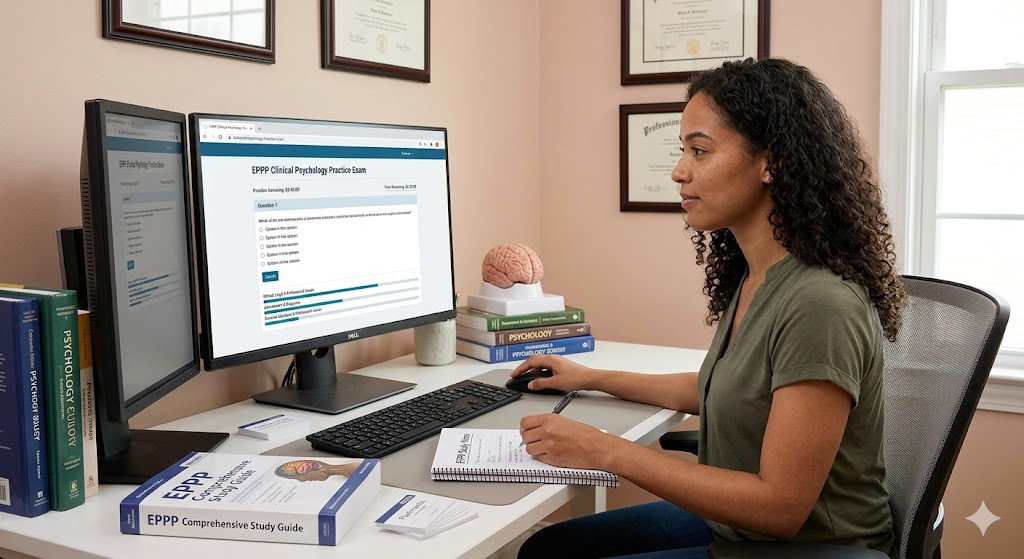
Additional Information
What the Course Entails and Exam Details
Preparing for the EPPP requires a mastery of a vast array of psychological principles. The EPPP is structured into two parts, with Part 1 being the primary knowledge component and Part 2, a newer addition, focusing on applied skills.
EPPP (Part 1—Knowledge) Domains and Weights
This section covers eight critical content areas, ensuring a well-rounded understanding of the discipline:
Biological Bases of Behavior (10%)
Example topics: Neurobiology, genetics, psychopharmacology, and brain imaging.
Cognitive-Affective Bases of Behavior (13%)
Example topics: Learning, memory, motivation, emotion, and executive functioning.
Social and Cultural Bases of Behavior (11%)
Example topics: Social cognition, group dynamics, cultural diversity, and sociopolitical psychology.
Growth and Lifespan Development (12%)
Example topics: Human development from conception to old age, family systems, and developmental theories.
Assessment and Diagnosis (16%)
Example topics: Psychometrics, diagnostic systems (e.g., DSM, ICD), and various assessment methods.
Treatment, Intervention, Prevention, and Supervision (15%)
Example topics: Evidence-based psychotherapies, intervention strategies, and supervision models.
Research Methods and Statistics (8%)
Example topics: Research design, statistical analysis, and interpreting data.
Ethical/Legal/Professional Issues (15%)
Example topics: Ethical codes, laws governing practice, and professional standards.
EPPP (Part 2—Skills) Domains and Weights
This section, adopted by some jurisdictions, focuses on the application of knowledge:
Scientific Orientation (6%)
Assessment and Intervention (33%)
Relational Competence (16%)
Professionalism (11%)
Ethical Practice (17%)
Collaboration, Consultation, and Supervision (17%)
What to Expect in the Final Exam
The EPPP is a rigorous, computer-based examination. It is crucial to understand the format and scoring to manage your time and expectations effectively.
EPPP (Part 1—Knowledge) Format
Total Questions: 225 multiple-choice questions.
Scored Questions: 175.
Pre-test Questions: 50 (unscored, used for future exam development).
Time Limit: 4 hours and 15 minutes to complete the test. Total time at the center is approximately 4 hours and 30 minutes, including tutorials and surveys.
Scoring: A scaled score ranging from 200 to 800.
Passing Score: The recommended passing score for independent practice is a scaled score of 500, which generally equates to answering approximately 70% of the scored questions correctly. Note that some individual states or provinces may have slightly different passing requirements.
EPPP (Part 2—Skills) Format
This part uses a variety of item types beyond multiple choice, including multiple-response, scenario-based, point-and-click, and drag-and-drop questions.
How to Study and Exam Centers
Preparation is key to conquering the EPPP. You must approach your studies with a structured plan.
Actionable Study Strategies
Utilize Practice Exams: This is the single most effective study method. Take multiple full-length, timed practice tests to familiarize yourself with the question style, pacing, and to identify your weak domains.
Focus on Weak Domains: Use practice test results to pinpoint content areas where you struggle. Dedicate more study time to these sections using textbooks, study guides, and flashcards.
Create a Study Schedule: Allocate dedicated study blocks over several months. Consistent, regular study is far more effective than cramming.
Simulate Exam Conditions: Periodically take practice tests in a quiet, distraction-free environment, strictly adhering to the time limits, to build your stamina for test day.
Join a Study Group: Collaborating with peers can provide support, motivation, and different perspectives on complex topics.
Exam Centers and Registration
The EPPP must be taken at an authorized Pearson VUE testing center. You cannot register directly; you must first apply for licensure through your specific state or provincial psychology licensing board. Once the board confirms your eligibility, they will pre-approve you in the EPPP system, and you will receive an email to begin the registration and scheduling process. There are hundreds of Pearson VUE centers available across North America, and you can take the exam at any authorized location, not just the one in your jurisdiction.
Job Opportunities from the Course
Passing the EPPP and obtaining licensure unlocks a wide array of career paths for doctoral-level psychology graduates. The credential is your passport to independent practice and a range of specialized roles:
Licensed Clinical Psychologist
Counseling Psychologist
School Psychologist (Doctoral Level)
Neuropsychologist
Forensic Psychologist
Health Psychologist
Psychology Professor / Academic
Research Psychologist
Organizational Consultant
Clinical Director
Program Evaluator
Psychology Board Administrator
Frequently Asked Questions
Reviews
5.0
Based on 0 reviews
Leave a Review
No reviews yet. Be the first to review!