
EPPP Physiology Practice Exam
$69.00
- Buy to unlock unlimited access to all Quiz questions and Answers in this Quiz.
- After purchase you can print a PDF of the whole quiz at any point. The PDF will contain the questions and the correct answers.
About this Exam
The Examination for Professional Practice in Psychology (EPPP) stands as a critical benchmark for psychology graduates, serving as a primary requirement for licensure across the United States and Canada. For those specifically aiming to master the biological foundations of behavior, the EPPP Physiology Practice Exam is a targeted study resource. Designed for aspiring clinical psychologists, neuropsychologists, and researchers, this guide focuses on the intricate physiological processes that underpin psychological theories and practice. By reinforcing your understanding of neuroscience and physiology, this practice exam prepares you to confidently approach the formal licensure examination and succeed in your professional journey.
Ready to test your knowledge?
Buy Now to Access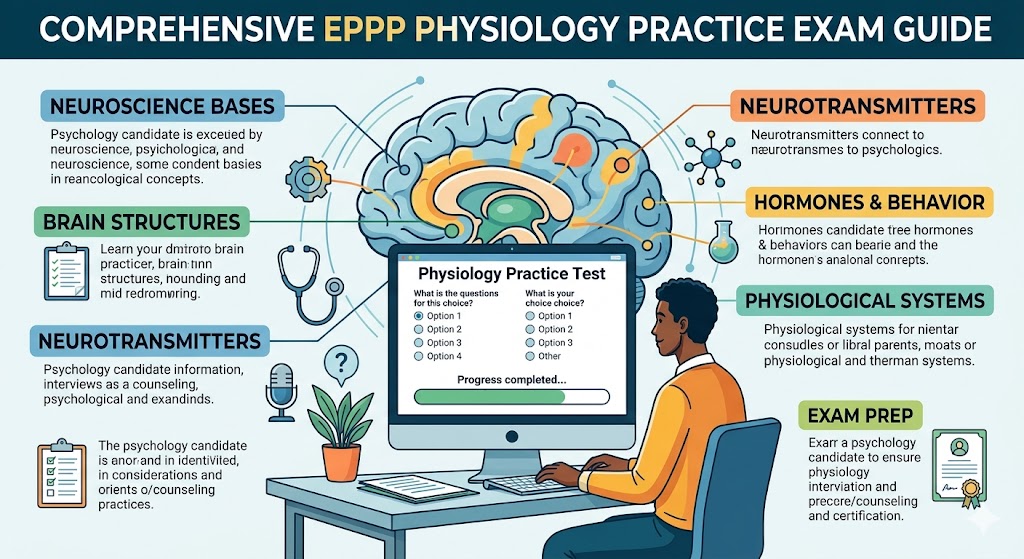
Additional Information
What the Course Entails and Exam Details
The content within the EPPP Physiology Practice Exam mirrors the core physiological domains necessary for psychological practice. Candidates will encounter questions that assess their understanding of the biological bases of behavior and related concepts. Key areas covered in this practice exam include:
Neuroanatomy and Neuroscience: Understanding brain structures, functions, neural pathways, and their relationship to cognitive and emotional processes.
Neurotransmitters and Endocrinology: Exploring the roles of chemical messengers and the endocrine system in regulating mood, behavior, and physiological responses.
Genetics and Evolutionary Psychology: Applying principles of heredity and evolution to behavioral patterns and psychopathology.
Psychopharmacology: Assessing knowledge of the physiological effects and mechanisms of psychotropic medications.
Physiological Systems: Integrating how cardiovascular, respiratory, and other systemic functions interact with psychological states.
While this specific resource focuses on physiology, candidates must remember that the actual EPPP covers eight broad content areas, with the biological bases of behavior being a significant segment.
What to Expect in the Final Exam
While this is a practice guide, the formal EPPP is administered as a computerized standardized exam. Here is what you should expect during the actual licensure test:
Format: The exam predominantly uses a multiple-choice format, designed to test comprehensive knowledge and critical application skills.
Passing Score: Requirements can vary by jurisdiction, but a scaled score of 500 (out of 800) is generally accepted as the passing standard.
Time Limit: Candidates are typically given 4 hours and 15 minutes to complete the EPPP, which requires both knowledge retention and careful time management.
Rules: The final exam must be taken at an authorized, secure testing center under strict proctoring conditions. No outside materials are permitted.
How to Study and Exam Centers
Preparation is the key to success. Utilize a multi-faceted approach to master the material in this EPPP Physiology Practice Exam.
Actionable Study Strategies: Combine extensive reading of foundational neuroscience and physiology textbooks with dedicated practice test sessions. Use the results from practice exams to identify knowledge gaps. Spaced repetition and active recall of definitions (e.g., specific brain regions, neurotransmitter functions) are highly effective. Forming study groups with fellow candidates can also offer diverse perspectives on complex topics.
Practice Methods: Take timed sections of this practice exam to build the stamina required for the full four-hour test. Review all incorrect answers to understand the rationale behind the correct choice.
Exam Centers: When you are ready to take the official EPPP, you must register through your state or provincial board. The exam is typically administered at Pearson VUE professional testing centers located throughout North America, ensuring a standardized and secure environment for all candidates.
Job Opportunities from the Course
A strong score on the EPPP Physiology section is crucial for achieving licensure, which in turn unlocks various professional career paths within psychology. Mastering this material allows you to excel in roles where understanding the biological underpinnings of behavior is essential. Career paths include:
Licensed Clinical Psychologist
Clinical Neuropsychologist
Health Psychologist
Research Psychologist (specifically in neuroscience or behavioral biology)
University Professor/Lecturer in Psychology
Consultant Psychologist (for medical or pharmaceutical organizations)
Sports Psychologist
Behavioral Health Administrator
Frequently Asked Questions
Reviews
5.0
Based on 0 reviews
Leave a Review
No reviews yet. Be the first to review!