
EPRI Heat Transfer & Fluid Flow Practice Test
$69.00
- Buy to unlock unlimited access to all Quiz questions and Answers in this Quiz.
- After purchase you can print a PDF of the whole quiz at any point. The PDF will contain the questions and the correct answers.
About this Exam
The EPRI Heat Transfer & Fluid Flow certification is a highly regarded industry benchmark designed for engineers, senior technicians, control room operators, and energy industry professionals who work in both nuclear and fossil fuel power generation facilities. This assessment validates a deep, practical understanding of fundamental thermal-fluid principles. By earning this certification, professionals demonstrate their competency in managing, troubleshooting, and optimizing the critical cooling, steam generation, and fluid transport systems that are the backbone of efficient power plant operations. It serves as a strong indicator of technical proficiency and commitment to safety and operational excellence.
Ready to test your knowledge?
Buy Now to Access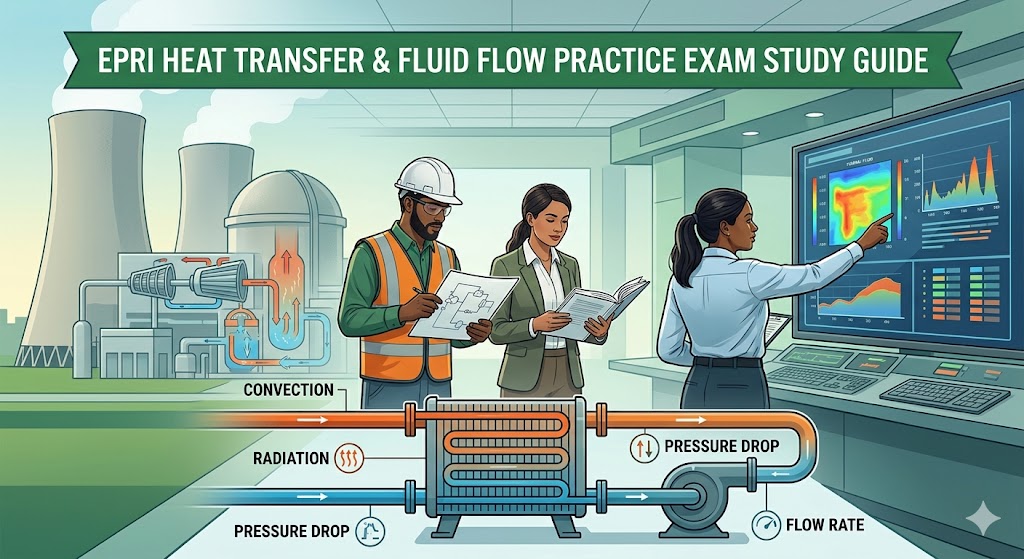
Additional Information
What the Course Entails and Exam Details
This examination is not merely theoretical; it tests the direct application of fundamental principles to real-world power plant scenarios. The core syllabus includes, but is not limited to:
Heat Transfer Principles: Master the three modes of heat transfer: Conduction (Fourier's Law), Convection (forced and natural, including Newton's Law of Cooling, Nusselt numbers, and heat transfer coefficients), and Radiation (Stefan-Boltzmann Law and view factors). Focus heavily on their application within heat exchangers, condensers, boilers, and reactor cores.
Fluid Flow Fundamentals: Study fluid properties, hydrostatics (buoyancy, pressure measuring devices), and the key governing equations of fluid dynamics: Continuity (mass conservation), the Bernoulli Equation (energy conservation), and the Momentum Equation. Be prepared to apply these to pipe flow, valves, flow meters, and nozzle calculations, both compressible and incompressible.
Thermodynamics & Cycles: Comprehend the properties of saturated and superheated steam using steam tables and diagrams like Mollier (h-s). Understand and calculate the efficiencies of thermodynamic cycles critical to power generation, such as the Rankine and Brayton cycles.
Applied Systems: Apply knowledge to specific power plant systems, including pump operations (pump curves, net positive suction head), piping network pressure drop calculations, and the thermal-hydraulic phenomena unique to reactor cooling processes, including boiling heat transfer and two-phase flow.
The physical exam is typically a cognitive, proctored, written assessment. Here is a summary of typical details, which may be subject to change based on the specific offering entity or alliance:
Format: Multiple-choice questions, often numbering near 100 to 200, designed to test both knowledge recall and complex problem-solving abilities.
Duration: Candidates are generally allotted substantial time, ranging from 3.5 to 4 hours, reflecting the rigorous nature of the mathematical problems and technical applications.
Passing Score: Requirements often set a minimum passing threshold between 75% and 80%, indicating a high standard of mastery is expected.
Open Book: Some EPRI written exams are open-book, allowing specific, published, non-hand-written references, which shifts the challenge to interpretation and applied calculation rather than raw memorization.
What to Expect in the Final Exam
When you arrive at the final proctored exam, expect a thorough technical challenge that prioritizes analytical skills and procedural knowledge over rote recall. The examination environment will be secure and strictly monitored. Questions will range from fundamental definitions to multi-step engineering calculations that test your understanding of how various systems interact. A key feature of this exam is its industry-specific context; instead of abstract problems, you will be solving scenarios relevant to a control room operator or system engineer, such as calculating the required pump head for a given flow rate or determining the thermal efficiency of a specific turbine configuration. Time management will be critical, as the calculation-heavy nature of the questions requires swift and accurate work. Success requires a calm demeanor and the ability to systematically work through technical problems under pressure.
How to Study and Exam Centers
Effective preparation is structured and practice-oriented. Follow this roadmap to build a robust foundation for the exam:
Master the Core Material: Start with fundamental textbooks on thermodynamics, fluid mechanics, and heat transfer. While these provide the theory, your primary study documents should be the specific EPRI training manuals and modules designed for this certification. These materials tailor the academic principles to the technical realities of the power generation industry.
Utilize Practice Tests: This is where the EPRI Practice Test proves invaluable. Treat practice exams as diagnostic tools to identify knowledge gaps and familiarize yourself with the question formats and required depth of calculation. Focus on understanding the technical explanations provided for both correct and incorrect answers.
Simulate Exam Conditions: Periodically attempt full practice tests under strict time constraints to build your stamina and pacing. This will help you manage your time effectively during the actual 4-hour assessment.
Practice Calculations: Become fluid with the required mathematics. This includes solving equations for flow, pressure drop, heat transfer rate, and thermodynamic properties. Ensure you can navigate steam tables and engineering diagrams quickly.
Review Industry Scenarios: Pay close attention to how theoretical principles manifest in power plant scenarios, such as the impacts of different boiling regimes on heat transfer in a boiler or the causes of cavitation in a feed pump.
Where to Take the Exam: The EPRI Heat Transfer & Fluid Flow examination is typically delivered through authorized industry partners and 'Host Facilities'. These are often localized power generation facilities, technical training centers, or proctored testing services affiliated with large utility companies or industry alliances. The specific registration process and testing location will be provided upon enrollment in the certification program. Candidates should inquire directly with their employer's training department or the certifying body for precise, up-to-date information on exam delivery methods and locations.
Job Opportunities from the Course
Earning the EPRI Heat Transfer & Fluid Flow certification signals to current and prospective employers that you possess advanced technical acumen. It is a powerful differentiator for a variety of critical roles within the utility and industrial power sectors:
Power Plant Operator (Senior & Lead Roles)
Control Room Operator (Nuclear and Fossil Fuel)
Nuclear Power Plant Operator
Power Generation Engineer (Mechanical, System, and Performance)
Operations Technician
Maintenance Technician (Fluid and Thermal Systems specialist)
Performance Optimization Specialist
Technical Trainer (Power Generation Systems)
Auxiliary Systems Operator
Frequently Asked Questions
Reviews
5.0
Based on 0 reviews
Leave a Review
No reviews yet. Be the first to review!