
Equipment Operator Second Class (EO2) Practice Test
$69.00
- Buy to unlock unlimited access to all Quiz questions and Answers in this Quiz.
- After purchase you can print a PDF of the whole quiz at any point. The PDF will contain the questions and the correct answers.
About this Exam
The Equipment Operator Second Class (EO2) rating in the U.S. Navy is a pivotal position within the Naval Construction Force, famously known as the Seabees.
Sailors in this rating are the driving force behind vital construction, maintenance, and repair projects around the globe, operating a diverse fleet of heavy machinery from bulldozers and cranes to excavators and asphalt pavers.
This advancement to Second Class Petty Officer represents a significant milestone, acknowledging not only technical proficiency but also leadership potential.
The EO2 Practice Test is an essential tool designed specifically for EO3s who are eligible for advancement, providing a simulated exam environment to evaluate their readiness for the real Navy-Wide Advancement Exam (NWAE).
Ready to test your knowledge?
Buy Now to Access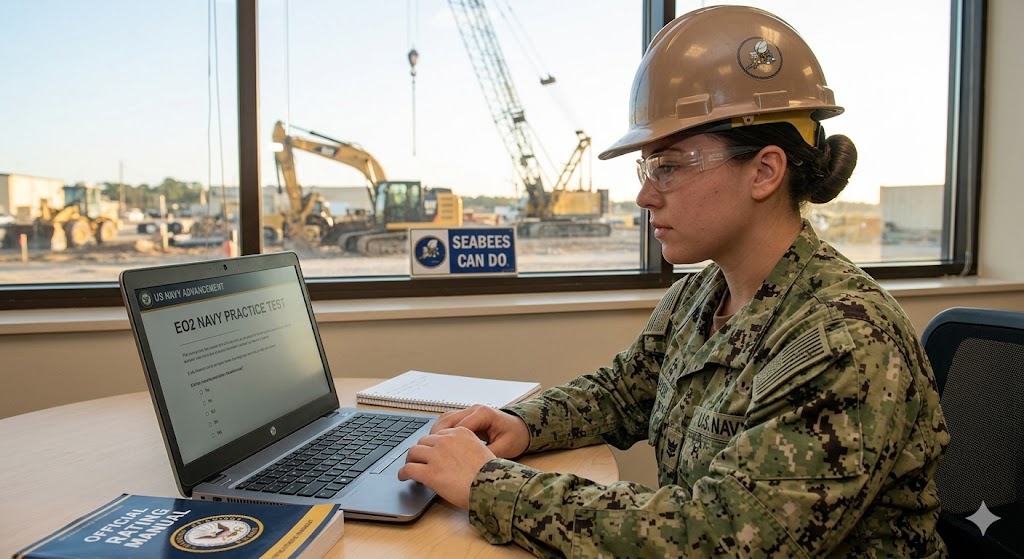
Additional Information
What the Course Entails and Exam Details
While there isn't a single "course" that culminates in the EO2 exam, the test itself assesses a wide range of rating-specific knowledge and practical skills that an Equipment Operator must master.
To be successful, a candidate must demonstrate competence in several core areas, including the safe and efficient operation of countless types of heavy equipment.
This includes earthmoving machinery like scrapers and graders, material handling equipment such as forklifts, and complex weight-handling systems like cranes.
Furthermore, the exam covers minor preventative maintenance and troubleshooting, essential rigging principles for safe lifting operations, asphalt and concrete production, and even specialized duties like rock crushing and well drilling.
Seabees must also be proficient in reading blueprints, performing material estimations, and adhering to strict construction safety standards, all while maintaining readiness for combat engineering tasks in varied and challenging environments.
What to Expect in the Final Exam
The actual Equipment Operator Second Class Advancement Exam is a standardized, written test composed entirely of multiple-choice questions.
The exam typically consists of 175 questions derived directly from the occupational standards of the EO rating.
Unlike some certification exams with a simple passing score, the NWAE operates on a competitive basis, with your results contributing to your Final Multiple Score (FMS).
The FMS is a complex calculation that considers your exam score, performance evaluations (PRTs), awards, time in rate, and other factors to rank you against all other eligible candidates for a limited number of advancement quotas.
This structure means that while there is a technical "passing" threshold, the true goal is to achieve the highest possible score to maximize your chances of promotion.
How to Study and Exam Centers
Preparation is the single most important factor for success, and this is where the EO2 Practice Test becomes invaluable.
Start by accessing the official Navy Advancement Bibliographies (Bibs) for your rating to understand exactly which manuals and instructions will be covered in your specific exam cycle.
Create a dedicated study plan that prioritizes these resources and integrate practice tests as a regular benchmarking tool to identify your strengths and weaknesses.
Reviewing the explanations for missed questions on the practice test is one of the most effective ways to reinforce your learning and target your efforts.
The actual Navy-Wide Advancement Exam is typically administered on-site at your command or a designated naval base testing facility, often in a group setting under the supervision of authorized proctors.
Job Opportunities from the Course
Earning the EO2 rating opens doors to a variety of specialized roles and increased responsibility within the Navy, and also provides a powerful foundation for a successful transition to civilian careers in the heavy construction industry.
Job titles and career paths available to an EO2 include:
Heavy Equipment Operator (Civilian and Military)
Crane Operator
Construction Site Supervisor/Foreman
Rigging Specialist
Excavation and Grading Specialist
Asphalt Paving Supervisor
Quarry Operations Manager
Well Drilling Specialist
Civil Engineer Technician (with further education)
Frequently Asked Questions
Reviews
5.0
Based on 0 reviews
Leave a Review
No reviews yet. Be the first to review!