
ERAU Commercial Checkride Practice Test
$69.00
- Buy to unlock unlimited access to all Quiz questions and Answers in this Quiz.
- After purchase you can print a PDF of the whole quiz at any point. The PDF will contain the questions and the correct answers.
About this Exam
The ERAU Commercial Checkride Practice Test is a critical, rigorous, in-house evaluation designed for flight students at Embry-Riddle Aeronautical University (ERAU). It serves as the final step in completing the university’s Commercial Pilot training course for either single-engine or multi-engine aircraft. This comprehensive test isn't just a simple rehearsal; it is a full-scale simulation of the actual Federal Aviation Administration (FAA) practical exam. Passing this practice checkride, conducted by ERAU's own check airmen, is a mandatory graduation requirement that proves a student’s readiness to move forward and take the definitive FAA Commercial Pilot checkride with a Designated Pilot Examiner (DPE) to earn their certificate.
Ready to test your knowledge?
Buy Now to Access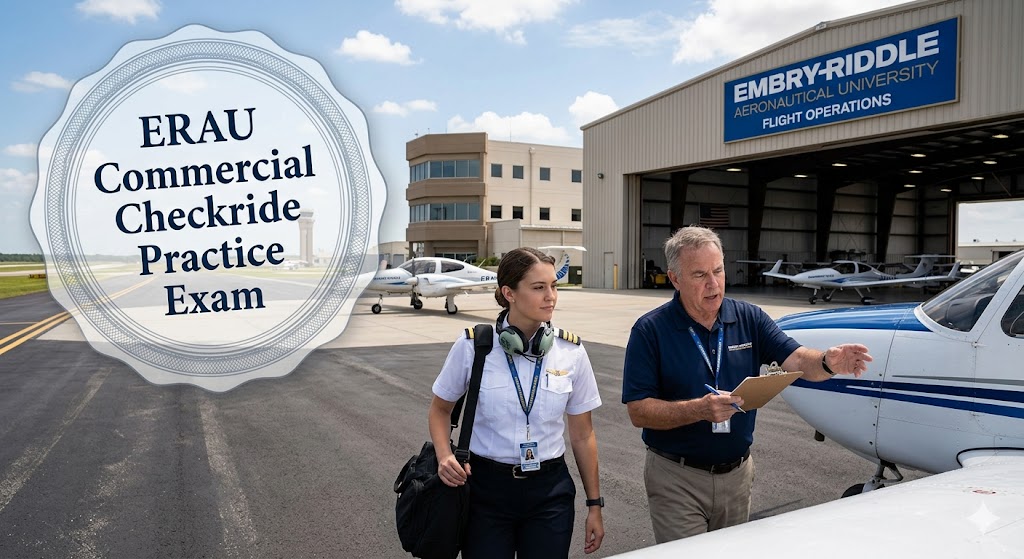
Additional Information
What the Course Entails and Exam Details
This examination is the culmination of the ERAU Commercial Pilot flight course and covers all topics and skills outlined in the FAA Commercial Pilot – Airplane Airman Certification Standards (ACS), along with university-specific standards. Students must demonstrate mastery of both ground knowledge and flight proficiency to commercial standards, which require tighter tolerances than private pilot requirements.
The core areas evaluated during the ERAU practice checkride include:
Ground Knowledge and Oral Exam Topics
Pilot Qualifications: Comprehensive understanding of commercial pilot privileges, limitations, and recent flight experience requirements.
Airworthiness: In-depth knowledge of aircraft documents, inspections, and equipment required for flight.
Weather Information: Analysis and interpretation of advanced aviation weather products and decision-making based on that data.
Performance and Limitations: Calculating aircraft performance and ensuring operation within weight and balance limits.
Operation of Systems: Detailed technical knowledge of all primary and secondary aircraft systems, including complex systems like retractable landing gear and constant-speed propellers.
Commercial Operations: Understanding of Federal Aviation Regulations (FARs) pertaining to commercial operators, including private vs. common carriage.
Flight Maneuvers and Areas of Operation
Takeoffs, Landings, and Go-Arounds: Precision maneuvers, including short-field and soft-field operations.
Performance Maneuvers: Mastery of Chandelles, Lazy Eights, and Steep Spirals.
Ground Reference Maneuvers: Execution of Eights on Pylons with precision.
Navigation: Advanced use of navigation systems, diversion procedures, and pilotage.
Emergency Operations: Demonstrating emergency descents, simulated engine failures, and the complex Power-Off 180° accurate landing.
High-Altitude Operations: Knowledge of physiology and systems related to flight at high altitudes.
What to Expect in the Final Exam
The ERAU Commercial Checkride Practice Exam is a multi-stage process that closely mirrors the official FAA checkride. Students should prepare for a long and demanding day, or potentially multiple days, that consists of a thorough oral exam followed by one or more flight evaluations.
First, you will sit for an extensive oral examination with an ERAU check airman. This section is dynamic and scenario-based, testing your ability to apply theoretical knowledge to real-world commercial flying situations. The check airman will probe your understanding of everything from airspace complexity to system malfunctions.
Following successful completion of the oral portion, you will proceed to the flight portion. If you are in the single-engine course, this will involve flying aircraft like the Cessna 172 NAV III and a PA-28R-201 Arrow to demonstrate competence in both simple and complex aircraft operations. If in the multi-engine course, the evaluation will be in a multi-engine aircraft, such as the Diamond DA42.
You will be expected to perform all maneuvers required by the Commercial ACS and ERAU course standards to Commercial tolerances. For example, on landings, you may be required to make your point within 100 feet, a significant reduction from the 200 feet allowed at the Private Pilot level.
There is no numerical passing score; your performance is evaluated as either 'Satisfactory' or 'Unsatisfactory'. To pass, you must demonstrate mastery of the aircraft, sound judgement, and consistent adherence to safety and airmanship standards.
How to Study and Exam Centers
Preparation for the ERAU practice checkride is an iterative process of study, practice, and feedback.
Effective Study Strategies
Deep Dive into the ACS: The FAA Commercial Pilot – Airplane Airman Certification Standards (ACS) is your primary guide. You should know every task, knowledge area, and risk management element listed.
ERAU Course Materials: Rigorously review all university-provided manuals, checklists, and Lesson Guides. These contain the specific methods and procedures required by your instructors.
Mock Oral Exams: Actively seek out mock oral sessions with other students, your primary flight instructor, or advanced students. Verbalizing answers to complex scenario questions is the best way to prepare for the oral exam.
Chair Flying: Mentally rehearse every maneuver, procedure, and checklist. Visualizing the perfect execution of a Chandelle or a high-altitude emergency descent can build muscle memory and confidence.
Review Previous Evaluations: Study feedback from all your stage checks throughout the course to identify and correct recurring weak areas.
Taking the Exam
This is an internal, in-house evaluation conducted exclusively at Embry-Riddle Aeronautical University.
You will not find this test on online portals or at commercial testing centers like Pearson VUE. The exam is scheduled and administered through ERAU's Flight Operations department at your specific campus (e.g., Daytona Beach, FL, or Prescott, AZ). It is conducted by ERAU Check Airmen, who are senior instructors authorized by the university to conduct course-completion evaluations. You will take the test in university aircraft from your assigned flight line.
Job Opportunities from the Course
Successful completion of this ERAU Commercial Pilot course, marked by passing this practice checkride and the subsequent official FAA exam, unlocks numerous lucrative and exciting career paths in the aviation industry.
Certified Flight Instructor (CFI): This is a common and vital first step for building flight experience while training new pilots.
First Officer, Regional Airline: Begin your airline career flying for a regional carrier.
Corporate Pilot: Fly private jets or turboprops for companies and high-net-worth individuals.
Charter Pilot: Operate on-demand passenger or cargo flights (Part 135 operations).
Cargo/Freight Pilot: Fly essential goods and packages for cargo carriers.
Aerial Photographer: Conduct specialized photographic missions.
Tour Pilot: Provide sightseeing flights in popular destinations.
Agriculture Pilot: Apply fertilizers and pesticides (crop dusting).
Air Ambulance/Medevac Pilot: Transport critical patients and medical teams.
Pipeline/Powerline Patrol Pilot: Perform vital utility infrastructure inspections.
Frequently Asked Questions
Reviews
5.0
Based on 0 reviews
Leave a Review
No reviews yet. Be the first to review!